

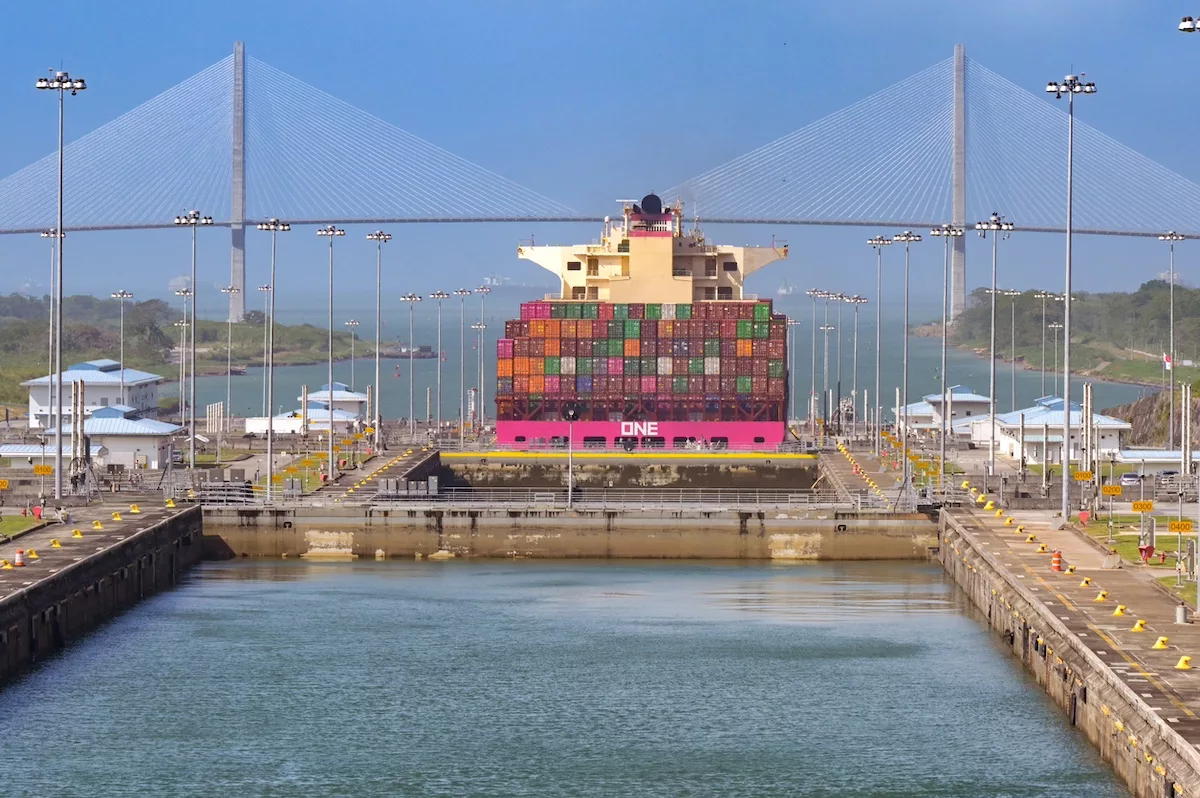
China is reported to be pressing for state-owned ocean carrier Cosco to take a controlling stake in a proposed $22.8 billion sale encompassing two controversial ports at the Panama Canal. Following pressure from President Donald Trump on Hong Kong-based operator CK Hutchison to transfer ownership of shipping centers, U.S. investment firm BlackRock and Swiss container shipping operator MSC initially reached a deal in March to acquire the two ports flanking the Panama Canal's entrances. According to The Wall Street Journal, China is threatening to block the deal unless Cosco is granted a controlling stake—escalating from its previous demand for an equal share. From a supply chain perspective, the Panama Canal carries 5% of global trade and 40% of container traffic to and from the U.S.—serving as the vital shortcut between the Atlantic and Pacific.
In early 2025, Trump reiterated threats that the U.S. would reclaim control of the Panama Canal—claiming that China's influence over the CK Hutchison-owned ports poses a national security risk. Months of negotiations between the Trump administration and canal authorities culminated in the announcement of the ports' sale to a BlackRock-led group, though CK Hutchison stated in August that it is unlikely the deal will close before 2026. From a supply chain perspective, CK Hutchison Holdings is part of the CK Hutchison Group controlled by Li Ka-shing—operating with 295 teams across 53 ports globally. Hutchison Ports is among the leading players in the global container port market. Balboa (on the Pacific side) and Cristobal (on the Atlantic side) are the two Panama ports subject to the sale.
From a supply chain perspective, Cosco Shipping (China Ocean Shipping Company) was formed through the 2016 merger of Cosco and China Shipping—based in Shanghai, it is the world's fourth-largest container carrier. OOCL (Orient Overseas Container Line) is a company that Cosco acquired from Hong Kong in 2018. BlackRock, led by Larry Fink, is the world's largest asset manager—based in New York and managing assets under management of $11 trillion. BlackRock Global Infrastructure Partners (GIP, acquired in 2024) specializes in infrastructure investments. MSC (Mediterranean Shipping Company), controlled by the Aponte family and based in Geneva, Switzerland, is the leader in the global container market. Terminal Investment Limited (TIL) serves as MSC's terminal arm, operating at 70+ terminals globally. The BlackRock-MSC-TIL consortium covers Hutchison's 43 ports, which is a far broader package than Panama alone.
From a supply chain perspective, the Panama Canal opened in 1914 and was transferred from the U.S. to Panama in 1999 under the Torrijos-Carter Treaties. The Panama Canal Authority (ACP) operates the canal. The Neopanamax expansion, completed in 2016, allows larger vessels to transit—container ships carrying up to 14,000 TEU can now pass through the canal. The Suez Canal, Strait of Malacca, Strait of Hormuz, Bosphorus, Bab-el-Mandeb, Strait of Gibraltar, Cape of Good Hope, and the Northern Sea Route are other critical chokepoints in global maritime trade. The State Administration for Market Regulation (SAMR), China's antitrust regulator, has the authority to block the closing of the BlackRock-MSC deal due to Hutchison's Hong Kong connections—similar to CFIUS (Committee on Foreign Investment in the U.S.) national security reviews, which may be applied bidirectionally on the U.S. side. Ultimately, China's demand for Cosco to hold a controlling stake demonstrates clearly how U.S.-China geopolitical tensions are playing out over global port infrastructure.
Key Points:
1. China is demanding that Cosco receive a controlling stake.
2. The BlackRock-MSC March consortium is valued at $22.8 billion.
3. Trump is pressuring CK Hutchison on national security grounds.
4. CK Hutchison says the deal is unlikely to close before 2026.
5. The previous equal stake demand has been escalated to a controlling interest.

