

MB Energy, Daimler Truck and Kawasaki Sign JDA for Hamburg Liquefied Hydrogen Supply Chain to Europe (Early 2030s COD)
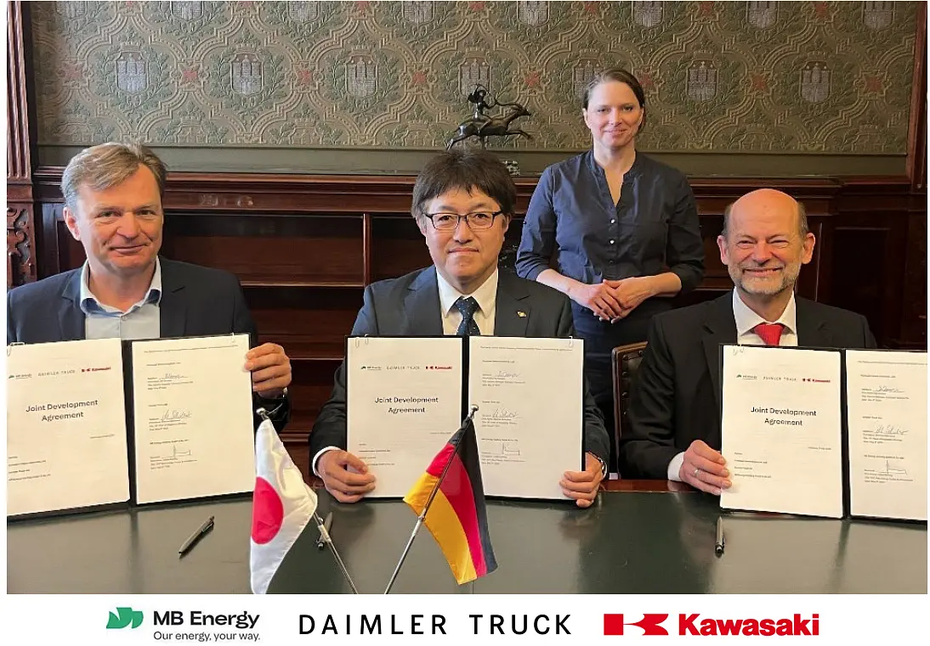
MB Energy, Daimler Truck AG and Kawasaki Heavy Industries, Ltd. have signed a Joint Development Agreement (JDA) to establish a liquefied hydrogen (LH2) supply chain centered on the Port of Hamburg. The agreement was signed at one of the world's largest port festivals, the Hamburg Port Anniversary, symbolically underscoring Hamburg's candidacy as a critical energy hub for Europe. The three companies will combine their respective areas of expertise to carry out concrete work to bring an economically viable LH2 supply chain to the Port of Hamburg; the target is to achieve Commercial Operation Date (COD) for LH2 and hydrogen supply in the early 2030s. The agreement builds on the previously established Japan–Germany hydrogen supply chain MoU and aims to scale hydrogen trade internationally.
The division of roles among the three companies structures the project end-to-end. On the MB Energy side, decades of experience in fuel sourcing, trading and logistics are complemented by an existing supply chain and service station network; the conversion of sites at long-haul logistics nodes for LH2 compatibility is also part of the plan. MB Energy's enport division has been active in tank storage logistics since 1972, operating 13 terminals with a total of 2.6 million m³ storage capacity in Germany, Denmark and Hungary. SVP New Energy, Storage & Infrastructure Volker Ebeling said, "Hydrogen can be one of the key enablers of Europe's energy transformation; Hamburg is ideally placed to become Germany's main gateway. We are combining MB Energy's infrastructure, service station network and trading expertise with Daimler Truck's next-generation hydrogen truck developments and Kawasaki's hydrogen storage and transportation technologies." Under Daimler Truck's dual-track decarbonization strategy (battery-electric + hydrogen), the Mercedes-Benz GenH2 Truck prototype demonstrated liquid hydrogen's long-haul road transport potential in 2023 by covering 1,047 km on a single tank in Germany; in customer trials, 5 GenH2 trucks together covered more than 225,000 km. The company will produce 100 Mercedes-Benz NextGenH2 Truck semi-trailer tractors at its Woerth plant from end-2026 and place them into customer operation, with serial production and industrial scaling targeting the European market in the early 2030s. Head of Regulatory Strategy Manfred Schuckert said, "The scaling of hydrogen trucks in Europe over the next decade will be possible only if reliable and competitive LH2 supply is available." On the Kawasaki Heavy Industries side, the company supplies hydrogen liquefiers, LH2 storage tanks and the design/manufacturing of LH2 carrier ships; it has started construction of a 40,000 m³-class LH2 carrier and is building a terminal in Kawasaki City with a 50,000 m³ LH2 storage tank, one of the largest in the world. Hydrogen Strategy GM Kei Nomura said, "This Hamburg-based initiative is a critical step in building a hydrogen supply chain for Japan and Germany."
From a supply chain perspective, this JDA is critical along four axes. First, the first end-to-end commercial architecture of a global LH2 supply corridor is taking shape: producing country → liquefier → 40,000 m³ LH2 carrier → Hamburg LH2 terminal → enport tank storage network (2.6 million m³) → service stations + truck stops → Daimler Truck fleet. This functions as a cryogenic analogue of the existing LNG chain — operators share a learning curve in low-temperature transportation, boil-off management and IGF Code compliance. Second, the early-2030s COD target is synchronized with EU Fit for 55 and ETS2 (road fuel) 2027 timelines; it will enter service exactly when carbon pricing pressure on the heavy-duty sector translates directly into LH2 demand. Third, the choice of the Port of Hamburg consolidates its position as Northern Europe's energy gateway; with HHLA (Hamburger Hafen und Logistik AG) terminals and competing with Rotterdam, Hamburg can emerge as a LH2 hub. Fourth, the Japan–Germany bilateral hydrogen axis — combined with Kawasaki's Australia coal-gasification and Saudi Arabia green-hydrogen projects — produces the first clear template for a multi-continental LH2 import portfolio for Europe. Once this chain is complete, an opportunity will emerge to integrate with Türkiye's Mediterranean LH2 transit potential (renewables-based green hydrogen production + EastMed link).
Key Takeaways:
1. MB Energy + Daimler Truck + Kawasaki Heavy Industries signed a Joint Development Agreement for a liquefied hydrogen (LH2) supply chain to Europe via the Port of Hamburg.
2. The agreement was signed at the Hamburg Port Anniversary; it targets international scaling on the basis of the existing Japan–Germany hydrogen MoU.
3. The Commercial Operation Date (COD) target is early 2030s.
4. The Daimler Truck Mercedes-Benz GenH2 Truck prototype covered 1,047 km on a single tank in 2023; from end-2026, 100 NextGenH2 trucks will be produced at Woerth and placed into customer operation.
5. Kawasaki Heavy Industries has started construction of a 40,000 m³-class LH2 carrier; it is building a 50,000 m³ LH2 storage tank in Kawasaki City (one of the largest in the world).
6. MB Energy's enport division plans to make its 13 terminals and 2.6 million m³ tank storage capacity in Germany/Denmark/Hungary hydrogen-ready.
7. Supply chain: cryogenic LH2 corridor (LNG analogue) + early-2030s COD synchronized with EU Fit for 55 and ETS2 + Hamburg as European LH2 hub candidate + Japan–Germany bilateral axis → multi-continental LH2 import portfolio; integration opportunity for Türkiye's Mediterranean LH2 transit.

