

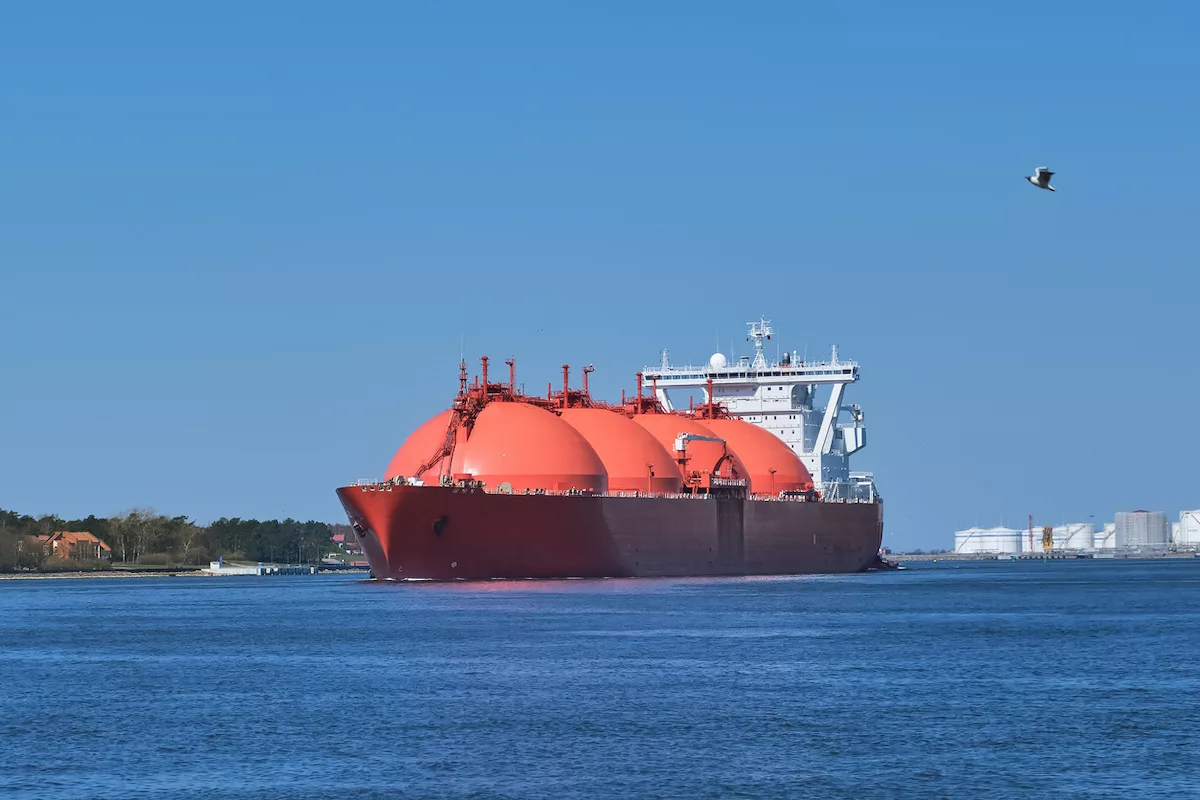
The container shipping industry is rapidly shifting toward cleaner fuels — more than half of all new ships on order are being prepared to run on alternatives to conventional heavy fuel oil. As of the end of August 2025, shipowners have on order 534 container ships capable of using alternative fuels — according to data released on September 18 by the maritime organization BIMCO. These vessels account for 53% of all container ships currently on order and 77% of the total cargo capacity on order — measured in twenty-foot equivalent units (TEU). BIMCO projects that more than a quarter of the global container fleet will operate on alternative fuels by 2030. BIMCO notes that larger vessels are leading the transition — vessels with alternative fuels account for 81% of all orders for ships with 8,000 TEU or greater capacity. Conversely, other major maritime sectors are following more slowly — alternative fuel vessels account for only 8%, 9%, and 17% of bulkers, product tankers, and crude oil tankers on order, respectively. BIMCO suggests this may reflect structural differences — the container sector is dominated by a few major companies, while the bulker and tanker markets are more fragmented and comprised of smaller operators. From a supply chain perspective, BIMCO (Baltic and International Maritime Council), headquartered in Bagsværd, Denmark, was founded in 1905 and is the world's largest international maritime organization — representing more than 60% of global commercial ton supply. David Loosley is BIMCO Secretary General & CEO. Niels Rasmussen is BIMCO's chief maritime analyst.
From a supply chain perspective, LNG (Liquefied Natural Gas) is currently the most popular alternative fuel — preferred to power approximately two-thirds of all alternative-fuel vessels on order — with methanol fuels accounting for 31%. Methanol emerged in 2023 — but LNG has since surpassed it — likely due to greater global availability and established infrastructure for fuel supply. HFO (Heavy Fuel Oil), VLSFO (Very Low Sulphur Fuel Oil), MGO (Marine Gas Oil), and MDO (Marine Diesel Oil) are the main conventional marine fuels — with VLSFO becoming dominant following the IMO 2020 sulfur cap. LNG, methanol, ammonia, hydrogen, biofuel, e-fuel (e-methanol, e-ammonia, e-LNG), and nuclear (SMR, Small Modular Reactor) are the main alternative marine fuels. Dual-fuel engine technologies include WinGD X-DF, MAN Energy Solutions ME-GA, ME-LGIM (methanol), and ME-LGIA (ammonia). WinGD (Winterthur Gas & Diesel, owned by CSSC), MAN Energy Solutions (Volkswagen Group), Wärtsilä, Mitsubishi Heavy Industries, Hyundai Heavy Industries, and Doosan Engine are the major ship engine manufacturers.
From a supply chain perspective, global container shipping is led by MSC (Mediterranean Shipping Company, the world's largest with 6+ million TEU capacity), Maersk (A.P. Moller-Maersk, second largest), CMA CGM (third, including APL, ANL, Mercosul Line, Containerships, Sofrana ANL, CEVA Logistics, and Bolloré Logistics), COSCO Shipping Lines (including OOCL), Hapag-Lloyd (merging with UASC and CSAV), ONE (Ocean Network Express, a merger of NYK, MOL, and K Line), Evergreen Marine, HMM (formerly Hyundai Merchant Marine), Yang Ming, ZIM, Wan Hai Lines, PIL (Pacific International Lines), SITC International, Zhonggu Logistics, X-Press Feeders, Sinokor, and KMTC Line. The major global carrier alliances include 2M Alliance (MSC + Maersk, ending in 2025), Gemini Cooperation (Maersk + Hapag-Lloyd, February 2025), Premier Alliance (HMM + ONE + Yang Ming), and Ocean Alliance (CMA CGM + COSCO + Evergreen + OOCL).
From a supply chain perspective, the IMO (International Maritime Organization) sets the global maritime decarbonization roadmap. The IMO 2023 GHG Strategy sets a net-zero GHG target by 2050 — including interim targets of 20-30% reduction by 2030 and 70-80% reduction by 2040. EEXI (Energy Efficiency Existing Ship Index), CII (Carbon Intensity Indicator), SEEMP (Ship Energy Efficiency Management Plan), and EEDI (Energy Efficiency Design Index) are the main IMO efficiency requirements. FuelEU Maritime (effective January 2025), EU ETS (Emissions Trading System, covering shipping from 2024), and EUA (EU Allowances) are the main European maritime climate regulations. The IMO Net-Zero Framework is expected to be approved at MEPC 83 in October 2025 — including a global fuel standard (GFI, Global Fuel Standard) and a carbon pricing mechanism (net-zero contribution, NZC). Maersk took delivery of its first large methanol-fueled container ship, Laura Maersk, in 2024. HMM, CMA CGM, Hapag-Lloyd, MSC, Evergreen, and OOCL are the major container carriers ordering methanol/LNG dual-fuel vessels. In conclusion, BIMCO's 2025 data represents a measurable and concrete indicator of container shipping's leadership in maritime decarbonization.
Key Points:
1. 534 container ships on order are equipped with alternative fuel capacity.
2. 53% of total orders (vessels) and 77% (TEU) are alternative-fuel powered.
3. 81% of large vessels of 8,000+ TEU are alternative-fuel powered.
4. LNG accounts for 2/3 of alternative orders; methanol for 31%.
5. By 2030, a quarter of the global container fleet is projected to operate on alternative fuel.

