

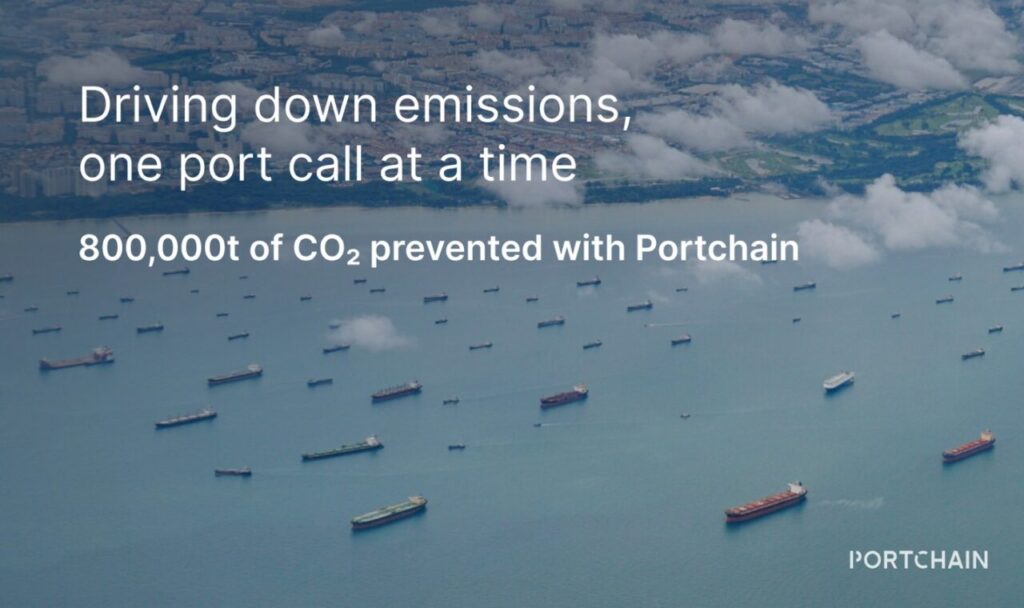
Portchain announced a significant sustainability milestone in the global container shipping industry. Portchain Network, the platform developed by the company, has contributed to preventing 800,000 metric tonnes of CO₂ emissions since its launch in 2022.
This savings is equivalent to 654,922 petrol vehicles used for one year, 239 wind turbines' annual production, or 13 million trees growing over 10 years in terms of environmental impact.
Portchain Network: Digital collaboration ecosystem
Portchain Network is a global digital platform that provides standardized data sharing among mainline carriers, feeder operators, and port terminals.
The Portchain Connect system, which forms the core of the platform:
Shares real-time vessel schedules,
Provides berth alignment in port planning,
Enables vessels to arrive at ports at the right time through Just-In-Time (JIT) port calls
driving operational efficiency.
As challenges like global congestion, climate-related disruptions, and port congestion grow in maritime shipping, Portchain's digitalization model simplifies this complex planning process.
Fuel savings and emission reduction
According to Portchain data, thanks to JIT port calls:
5.9% reduction in fuel and CO₂ emissions when planning between vessel and port is done 24 hours before arrival,
Up to 14% reduction when planning is done before departure from the previous port.
Carriers and terminals in the network have achieved 2–4% average fuel savings, while some cases have attained efficiency gains of up to 9%. These results demonstrate the concrete environmental benefits of digital coordination in the maritime sector.
Portchain CEO: "We aim to reduce 0.5% of global emissions"
Portchain CEO and Co-founder Niels Kristiansen summarized the company's long-term goals as follows:
"Our goal is to reduce 0.5% of global emissions. This path goes through the widespread adoption of Just-In-Time calls across the entire maritime industry. This goal requires scale, collaboration, and digitalization."
Kristiansen emphasized that Portchain Network still has significant growth potential, noting that as more carriers and terminals join the network, efficiency and sustainability will increase exponentially.
The JIT approach: A new standard in maritime shipping
The JIT model enables vessels to arrive at ports precisely on time by optimizing voyage speeds. This way, vessels avoid unnecessary acceleration or waiting, reducing fuel consumption and carbon emissions. Additionally, berth utilization efficiency at ports increases and coordination times shorten.
Through digitalization and secure data sharing, real-time information flow is enabled between vessels and port authorities. This situation reduces port congestion, lowers delays, and improves energy efficiency.
Sectoral impact
The maritime industry is undergoing significant transformation in the 2020s due to fuel costs, carbon regulations (IMO 2023), and supply chain disruptions. Portchain Network is at the center of this transformation, making "digital port integration" a standard concept.
According to experts, as digital networks become more widespread, carbon reduction targets in maritime shipping will become far more achievable.
Kristiansen characterizes this achievement as a "beginning":
"This is only the first step. True transformation will happen when efficiency, financial sustainability, and environmental impact complement each other."
Key Takeaways:
Portchain Network has delivered 800,000 tonnes of CO₂ savings since 2022.
The network connects mainline carriers, feeder lines, and terminals through digital data sharing.
Through Just-In-Time (JIT) calls, fuel and emissions are reduced by 5.9–14%.
Average fuel savings 2–4%, reaching up to 9% in some cases.
CEO Niels Kristiansen: "We aim to reduce 0.5% of global emissions."
The system increases port efficiency through digitalization and collaboration, reducing waiting times.
800,000 tonnes of CO₂ savings is equivalent to the impact of 650,000 vehicles, 239 turbines, or 13 million trees.
Author: SedatOnat.com
We would be happy to receive your feedback.
Wishing you happy reading.

