

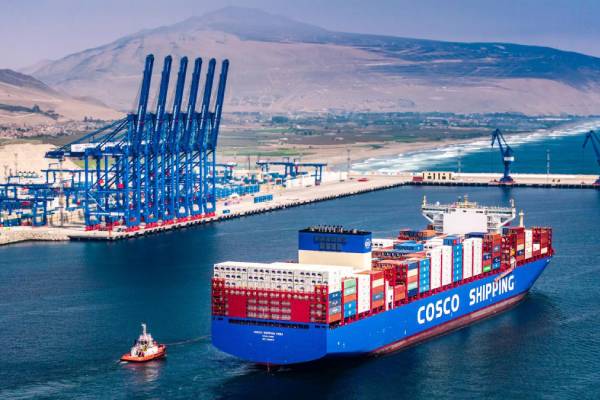
On November 14, Chinese President Xi Jinping inaugurated Chancay Port in Peru. This landmark project strengthens China's presence in Latin America as part of its Belt and Road Initiative (BRI). The 3.6 billion-dollar deepwater port is primarily financed by China and operated by China Ocean Shipping Company (COSCO). COSCO holds a 60 percent stake in the project. Chancay Port aims to transform trade between South America and Asia while completely bypassing North America.
\nLocated 78 kilometers north of Lima, Chancay Port plans to reduce shipping times between Latin America and Asia by 10 days and cut logistics costs by more than 20 percent. The development is expected to generate 4.5 billion dollars annually for Peru, equivalent to 1.8 percent of the country's GDP. The port's advanced infrastructure comprises four berths capable of accommodating ultra-large container vessels with capacities up to 18,000 TEU. These features position Chancay Port as a critical logistics hub for export goods including copper, blueberries, soybeans, and lithium.
\nThe port is expected to play a significant role in supporting the lithium triangle countries—Bolivia, Chile, and Argentina—which are critical to the electric vehicle industry. Peru's President Dina Bolaurte characterized the project as transformative, stating, "With this megaproject, we are initiating a transformation that will position our country as a world-class logistics, technology, and industrial center." The port will provide direct connectivity between Peru and China with a 23-day sea voyage, further deepening commercial ties.
\nHowever, the project has raised concerns in U.S. policy circles. Critics worry about China's expanding geopolitical and economic influence in the region. Army General Laura Richardson told the Wall Street Journal, "This will make it even easier for the Chinese to extract all these resources from the region." While U.S. officials are calling for increased American investment in South America, Peru's Foreign Minister Javier González-Olaechea urged the U.S. to expand its presence in the region, describing the country as "a very important friend who gives us very little time."
\nChancay Port operations are planned to commence in early 2025. In the long term, the port's capacity is expected to expand to 15 berths and an annual throughput of 1.5 million TEU. This development will reshape trade routes between Latin America and Asia while supporting China's global trade ambitions. The completion of the project will contribute to Peru's positioning as a worldwide center for logistics, technology, and industry.
\nKey Points:
\n- \n
Chancay Port is a 3.6 billion-dollar project implemented as part of China's Belt and Road Initiative (BRI).
\n The port is operated by COSCO, which holds a 60 percent stake in the project.
\n It aims to reduce shipping times between Latin America and Asia by 10 days and cut logistics costs by more than 20 percent.
\n It will generate 4.5 billion dollars annually, equivalent to 1.8 percent of Peru's GDP.
\n The port comprises four berths capable of accommodating ultra-large container vessels with capacities of 18,000 TEU.
\n It will support the lithium triangle countries, which are critical to the electric vehicle industry.
\n The U.S. is concerned about China's increasing influence in the region and is calling for greater American investment.
\n In the long term, Chancay Port's capacity will be expanded to 15 berths and an annual throughput of 1.5 million TEU.
\n
---
\n-------------------
\n\nWe would be delighted to receive your feedback.
\nWishing you happy reading.

