

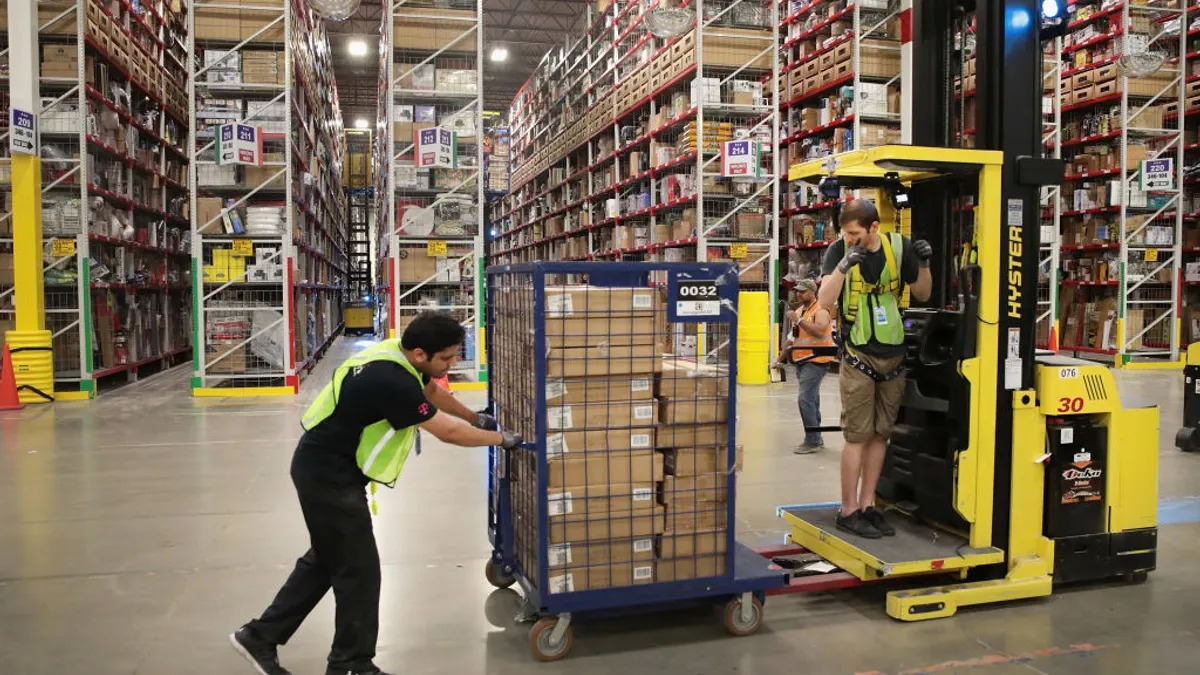
Amazon is accelerating its technology investments to reduce its carbon footprint while expanding grocery operations. The company announced that through a pilot program conducted with Trane Technologies, it has reduced energy consumption by approximately 15% across three grocery fulfillment centers in North America. The results were disclosed in a company announcement dated December 1st.
In the pilot application, Trane Technologies' BrainBox AI platform was deployed in integration with Amazon Web Services (AWS) infrastructure. The system autonomously manages HVAC (heating, ventilation and air conditioning) components within the building, optimizing temperature, ventilation, and energy consumption in real time. BrainBox AI treats the building not as a static structure but as a learning and adaptive system.
Amazon stated that pilot results exceeded expectations and announced that the technology would be rolled out across more than 30 grocery fulfillment and distribution sites throughout the United States. The company also plans to deploy this system in in-store operations beginning in 2026.
Why Grocery Fulfillment Centers?
Amazon's grocery business unit:
refrigerated spaces,
perishable products requiring precise temperature control,
high-energy-intensive operations
account for a significant share of the company's total Scope 1 and Scope 2 emissions. For this reason, grocery fulfillment centers are positioned as high-impact areas for carbon reduction projects.
The BrainBox AI system simultaneously analyzes external weather conditions, building occupancy rates, historical consumption data, and operational requirements to reduce energy waste. Unlike conventional time-based HVAC control, this approach is based on predictive optimization logic.
Alignment with Amazon's Sustainability Goals
Amazon targets achieving carbon neutrality across all operations by 2040. However, according to the company's latest Sustainability Report, total carbon emissions in 2024 increased by 6% on an annual basis. This increase represents a step backward following a 3% reduction recorded in 2023. Management attributes this fluctuation to the rapidly expanding logistics network and growing delivery volumes.
Christina Minardi, Vice President of Amazon Worldwide Grocery Stores Real Estate and Store Development, evaluated the pilot project with the following words:
"We're continually looking for data-driven, scalable solutions to reduce our carbon footprint while maintaining operational excellence."
According to Minardi, BrainBox AI enables Amazon to simultaneously meet its sustainability goals and operational performance requirements.
Technology and Logistics Integration Deepening
This initiative also demonstrates that Amazon is more tightly integrating grocery logistics with its core e-commerce and distribution network. The company:
continues pilot programs for in-store micro-fulfillment centers at Whole Foods Market locations,
has expanded same-day delivery networks for perishables to more than 1,000 cities and towns,
is integrating grocery orders more extensively into last-mile optimization processes.
Energy efficiency investments have become critical for maintaining the cost and carbon balance of this intensive logistics infrastructure. Particularly in cold-chain operations, energy optimization directly impacts operating margin and sustainability KPIs.
Strategic Assessment
Amazon's BrainBox AI initiative matters on three fronts:
Scalability: The pilot is planned to be rapidly scaled across the national network.
Data-driven building management: Logistics centers are transitioning from static infrastructure to digital assets.
Carbon-cost balance: Emission reductions directly lower energy costs as well.
According to experts, Amazon's approach could establish a new standard in the AI-driven building management field for large-scale retail and logistics operators. At energy-intensive facilities such as grocery fulfillment centers, savings in the 10–15% range create meaningful impact at the sector level.
Key Takeaways:
Amazon reduced energy consumption by 15% across three grocery fulfillment centers.
Technology: Trane Technologies – BrainBox AI + AWS integration.
The system autonomously optimizes HVAC and ventilation.
The deployment will expand to 30+ U.S. facilities; it will enter stores in 2026.
Amazon's target: 2040 carbon neutrality; emissions rose 6% in 2024.
Grocery logistics plays a critical role in Amazon's carbon footprint.
Author: SedatOnat.com
We would be pleased to receive your feedback.
Wishing you good reading in advance.

