

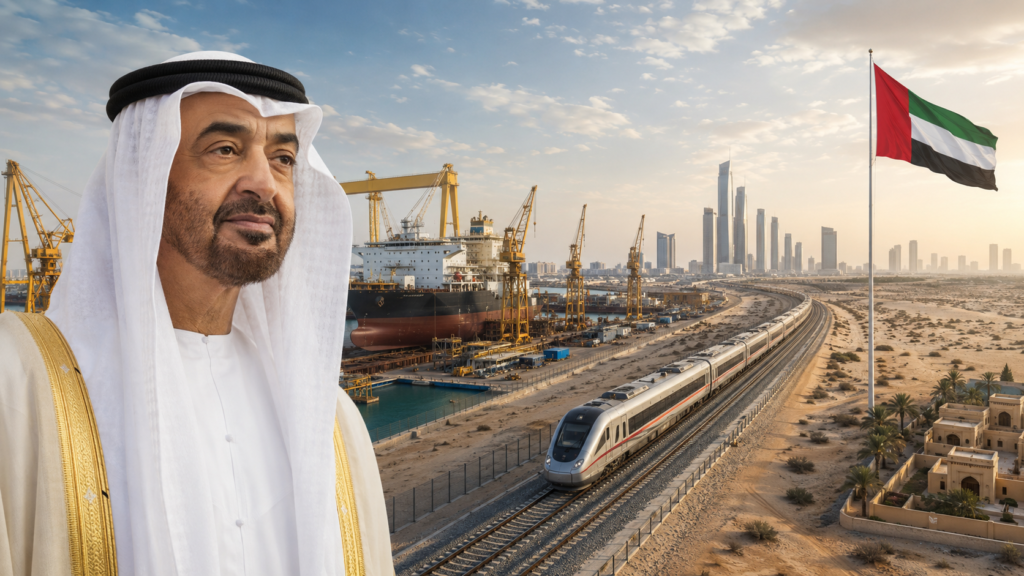
The United Arab Emirates (UAE) is rapidly diversifying and hardening its maritime infrastructure in response to geopolitical risks over the Strait of Hormuz and the Red Sea. Two announcements by AD Ports Group and DP World mark a strategic inflection in the UAE's long-term maritime strategy. Read separately, each is a logistics milestone; read together, they represent a directional shift in regional trade architecture.
AD Ports Group handled over 54,000 TEUs at Fujairah Terminals and Khor Fakkan Port (both on the Gulf of Oman coast, outside Hormuz) in April 2026, redeploying its logistics network across land, rail, sea, and air routes in response to traffic conditions through the Strait of Hormuz. The group scaled up its dedicated vessel fleet to 24 ships operating eight feeder services, providing alternative gateways and maintaining supply chain integrity. During the same period, a memorandum of understanding (MoU) was signed with CMA CGM to expand inland logistics connectivity at Khalifa Port; the agreement aims to connect cargo flows directly to industrial zones and regional trade corridors using a rail-linked intermodal network. Khalifa Port plans to reach 15 million TEU annual handling capacity by 2030 and recently announced its intention to add drydock services. Container volumes across the AD Ports network rose 23% year-on-year to 7.7 million TEUs in 2025.
DP World announced a $2.5 billion investment plan in major logistics and port infrastructure projects across India, Africa, South America, and Europe in May 2025. The company operates 78 marine and inland terminals in 40 countries, expanding its global supply chain capabilities. Jebel Ali Port has an annual capacity of approximately 19.3 million TEUs and reached record breakbulk volumes (5.36 million tonnes) in late 2025, driven by infrastructure projects across the Gulf. Simultaneously, DP World expanded its electric internal terminal vehicle fleet at Jebel Ali from 14 units to 146 in one year—one of the largest increases in the Middle East—cutting greenhouse gas emissions by over 10%.
Regional tensions and uncertainty in Strait of Hormuz transit flows have elevated the importance of Gulf of Oman-coast ports such as Fujairah and Khor Fakkan, which provide alternative gateways outside Hormuz. Additionally, Dubai-based architecture firm Znera presented a canal concept called Union Strait in April 2026 to bypass the Strait of Hormuz. The project envisions building smart cities, logistics hubs, and free trade zones along the UAE's east-west axis and is described as a "national backbone." Though not yet an active construction project, the canal idea reflects the UAE's ambition to be not just an oil exporter but an owner of alternative logistics corridors in the coming decades.
The UAE is also modernizing its maritime security capacity: the UAE Navy is equipped with Baynunah-class corvettes, the UMIS unmanned mine-countermeasure suite from France, and expanded surveillance capabilities, operating off Yemen and the Horn of Africa. In Abu Dhabi, the Integrated Transport Centre launched field trials of AI-powered autonomous maritime patrol vessels. These developments demonstrate the UAE's determination to harden its maritime architecture not only commercially but also strategically and militarily. Note: This summary draws on Container News's publicly visible headline + subhead + opening paragraph and on sector background on UAE maritime strategy.
Key Takeaways:
1. AD Ports Group handled 54,000+ TEUs via Hormuz-external routes (Fujairah, Khor Fakkan) in April 2026; operated 24-vessel fleet across 8 feeder services.
2. MoU signed with CMA CGM for intermodal logistics network at Khalifa Port; Khalifa targets 15M TEU/year capacity by 2030.
3. DP World announced $2.5bn investment plan across 4 continents in May 2025; scaled Jebel Ali electric vehicle fleet from 14 to 146 units.
4. Znera firm presented Hormuz bypass canal concept (Union Strait); envisions smart cities + logistics hubs along UAE's east–west axis.
5. UAE Navy operates with Baynunah-class corvettes and UMIS mine-countermeasure systems off Yemen/Horn of Africa; Abu Dhabi launched autonomous patrol vessel trials.

