

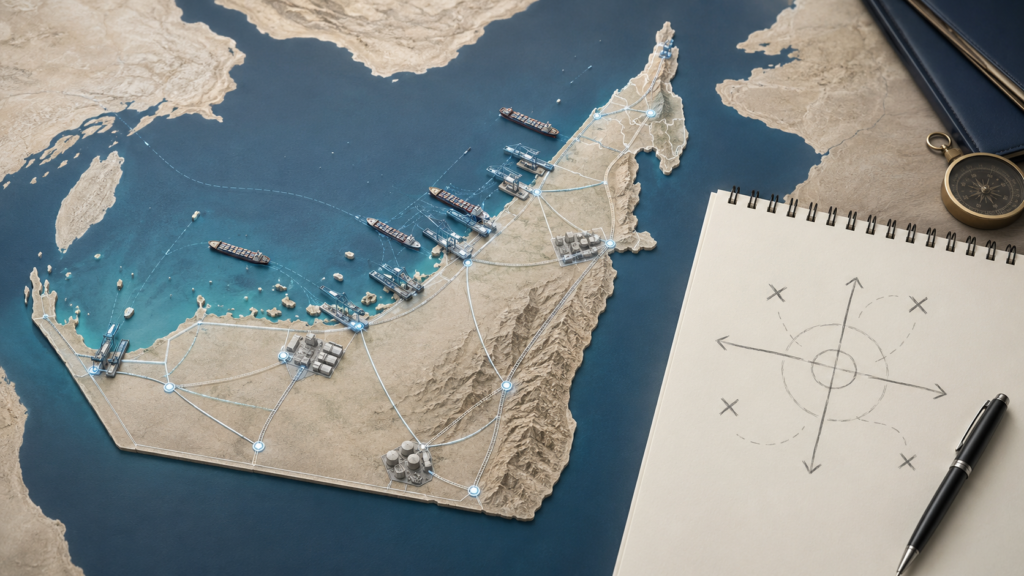
The United Arab Emirates (UAE) is being forced to reconsider its decades-long commercial neutrality model due to the Strait of Hormuz crisis. Despite the UAE stating it was not Iran's enemy, after the start of US-Israeli operations on February 28, 2026, it became the Gulf state most heavily targeted by Iranian missile and drone attacks, suffering almost as many strikes as Israel in the first twenty-four hours of the war. The Islamic Revolutionary Guard Corps (IRGC) declared that the UAE's critical port of Fujairah sits on an area of the Strait of Hormuz over which Iran exerts maritime control, subjecting any ship traveling to or from the port to Iranian jurisdiction.
Oil exports from Fujairah rose following the closure of the Strait of Hormuz in March, averaging 1.62 million barrels per day (bpd) in March compared with 1.17 million bpd in February according to a Kpler analyst, as the UAE diverted oil via the Abu Dhabi Crude Oil Pipeline to the port of Fujairah on the Arabian Sea. AD Ports Group took urgent measures to ensure continuity of regional supply chains. The group handled more than 70,000 standard containers through Fujairah ports and rerouted regional shipping services operated by Seven Feeders and Global Feeder Shipping through Fujairah and Khorfakkan ports on the Gulf of Oman, providing an efficient logistical alternative for the UAE and Gulf Cooperation Council (GCC) countries and ensuring continuity of regular shipping services along three main trade corridors.
Experts emphasize that the UAE faces tension between security and economic priorities. The UAE noted that Israel and the United States stood by it during the Iran war, marking increased distance from traditional Gulf policy, and security cooperation between the two countries reached unprecedented levels. However, Abu Dhabi's reaction to Pakistan's mediation efforts between Iran and the US shows that mediation is regarded as a form of unacceptable neutrality at a time when Iran has directly targeted Gulf territory. While most official Gulf statements channel anger toward Iran, there is clearly frustration with the United States (and more so Israel) for launching the war without informing the GCC or accounting for its security, and differing answers on where to direct this frustration are generating friction among Gulf states.
The CEO of DHL Global Forwarding's Middle East and Africa unit told customers that shipping through the Strait of Hormuz will take at least four to six months to normalize, advising them to plan for disruption, chaos, delays, and extra costs to persist for a sustained period. The International Maritime Organization (IMO) noted that around 20,000 seafarers, as well as port workers, are impacted in the region, stating that while disruption to global trade is significant, IMO's primary concern remains the humanitarian and safety implications for seafarers operating in the area.
Note: This summary draws on Container News's publicly visible headline + subhead + opening paragraph and on sector background on the Hormuz crisis and operational management of Gulf ports.
Key Takeaways:
1. UAE became the most heavily targeted by Iranian missile strikes despite its commercial neutrality policy
2. IRGC declared Fujairah Port within Iranian maritime control zone, subjecting all ships to its jurisdiction
3. AD Ports Group created alternative trade corridor by redirecting 70,000+ containers through Fujairah
4. DHL warned Hormuz normalization will take 4-6 months, advising planning for sustained disruption
5. IMO noted 20,000 seafarers affected in region, highlighting humanitarian dimension

