

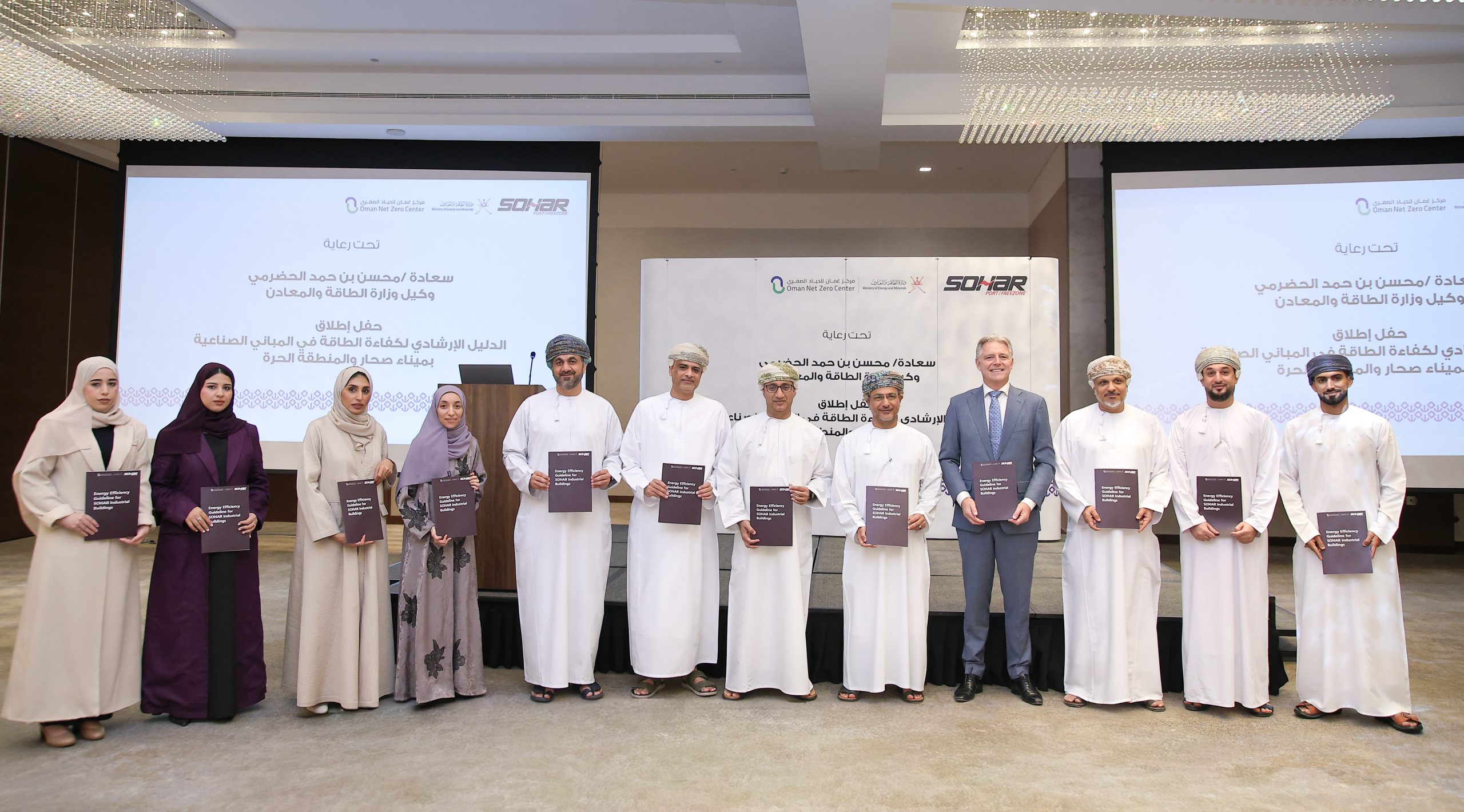
SOHAR Port and Freezone, in collaboration with the Ministry of Energy and Minerals through the Oman Net Zero Centre, has launched the Energy Efficiency Guideline for SOHAR Industrial Buildings. The framework provides a structured methodology to help industrial tenants improve energy performance, reduce operating costs and strengthen operational resilience across the port and freezone ecosystem.
The guideline offers a methodology for assessing building energy performance, identifying inefficiencies and implementing targeted improvement measures at the facility level. It incorporates key performance indicators covering cooling setpoints, energy use intensity, water heating energy intensity and the performance of lighting, air conditioning and mechanical ventilation systems, supporting more informed operational and investment decisions.
The framework draws on ASHRAE 90.1, ASHRAE 105, IPMVP and ISO 6946, while aligning with Oman's Building Code and occupational health and safety regulations under Ministerial Decree 286/2008. The initiative supports Oman Vision 2040 priorities — industrial productivity, economic diversification and resilient infrastructure — and contributes to Oman's broader decarbonisation agenda.
Eng. Mohsen Al Jabri, Director General of the Oman Net Zero Centre, said the guideline enables energy savings of 15 to 20% with relatively short payback periods, characterising it as a practical and scalable model for industrial facilities. Dr Abdullah Al Abri, Vice President of Sustainability and Acting HSSE Director at SOHAR Port and Freezone, highlighted that buildings — including offices, warehouses and workshops — represent a significant and often overlooked source of energy consumption within industrial ecosystems. The launch was held under the patronage of H.E. Mohsen bin Hamad Al Hadhrami, Undersecretary of Energy and Minerals.
From a supply chain perspective, three dimensions stand out. First, SOHAR Port's strategic role on the Gulf of Oman route — positioned as an alternative to the Strait of Hormuz — means tenant-level energy efficiency standards translate directly into operating-cost competitiveness for industrial investors in the region. Second, with FuelEU, EU CBAM and SEC climate disclosure regimes tightening Scope 1-2-3 emissions reporting, verifiable energy data at the facility level strengthens tenants' ability to absorb carbon pass-through pricing in their export chains. Third, embedding ASHRAE 90.1 and IPMVP baselines in the port ecosystem moves Oman up the standards-compliance ladder in regional industrial competition with Saudi Arabia, the UAE and Qatar.
Key Takeaways:
1. SOHAR Port and Freezone, with the Oman Net Zero Centre, has launched an energy efficiency guideline for industrial buildings.
2. The guideline defines KPIs covering cooling setpoints, energy use intensity, lighting, air conditioning and mechanical ventilation.
3. It draws on ASHRAE 90.1, ASHRAE 105, IPMVP and ISO 6946, aligned with Oman's Building Code.
4. Officials say the framework enables 15–20% energy savings with relatively short payback periods.
5. The launch supports Oman Vision 2040 goals on industrial productivity, economic diversification and decarbonisation.

