

Spirit Airlines Suspends Operations: Bankruptcy as Jet Fuel Hits $4.51/Gallon, 4,000+ Flights Cancelled
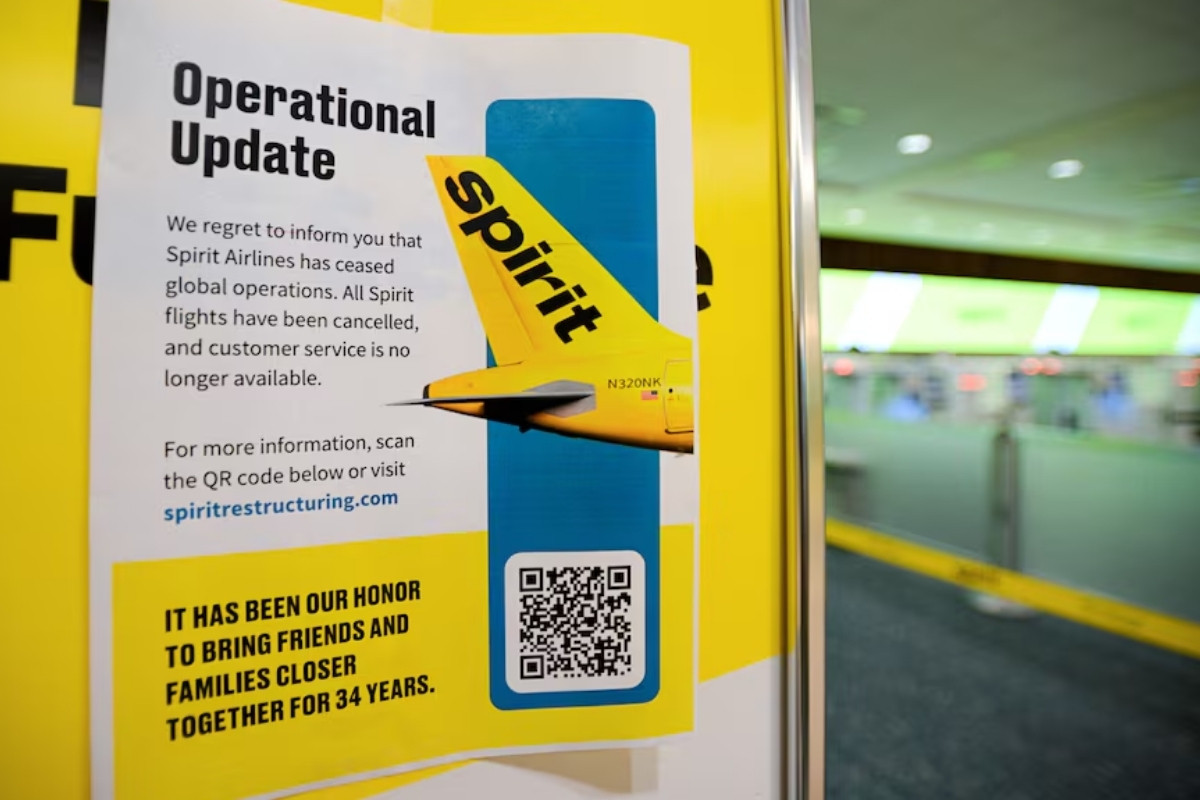
US low-cost carrier Spirit Airlines has suspended operations after surging jet fuel prices and an inability to secure financing forced it into bankruptcy. The airline failed to win creditor support for a $500 million rescue package proposed by the Trump administration — a setback for the very plan the White House had brought forward. At its peak Spirit operated roughly 5% of US domestic flights, making it the first US airline of this size to fail in two decades.
Spirit said operations would be wound down in an orderly manner; all flights have been cancelled and passengers were urged not to travel to airports. According to aviation analytics firm Cirium, the carrier had more than 4,000 flights scheduled between 1 and 15 May — every one of them now zero. Following the US-Israeli strikes on Iran and disruption around the Strait of Hormuz, jet fuel prices nearly doubled in two months. Spirit's restructuring plan had assumed $2.24/gallon for 2026; the price rose to $4.51/gallon, breaking the airline's balance sheet.
Spirit's exit has opened space for rivals. JetBlue Airways and Frontier Airlines have launched discount campaigns for displaced passengers, and majors including United Airlines and American Airlines have signalled capacity additions and price caps. US Transport Secretary Sean Duffy said efforts had been made to find a buyer, but no acquirer emerged. Cirium data shows Spirit carried about 1.7 million passengers in February, with market share sliding from 5.1% to 3.9% — a fall that further weakened an already fragile balance sheet.
From a supply chain and aviation-economics standpoint Spirit's collapse signals at three levels. First, this is the first major US casualty of the Iran-war-driven jet fuel crisis; because the low-cost model is far more fuel-cost-sensitive than premium peers, the failure is a warning shot for financially weakened comparable carriers (especially European operators already issuing fuel-shortage warnings). Second, the rejection of a $500 million rescue package by creditors signals reduced lender confidence in restructuring outcomes — and constrains how far the Trump administration can intervene in the sector. Third, the layoffs of thousands of staff are the concrete consequence of how global energy prices ripple through the aviation-personnel-baggage-maintenance supply chain; the capacity absorption now under way at JetBlue, Frontier, United and American will redistribute market share in the short term.
Key Takeaways:
1. Spirit Airlines suspended operations and entered bankruptcy after the jet fuel crisis and creditor rejection of a $500 million rescue package.
2. Following the Iran war and Strait of Hormuz disruption, jet fuel jumped from $2.24/gallon (the restructuring assumption) to $4.51/gallon in two months.
3. Cirium data shows more than 4,000 flights scheduled 1–15 May were cancelled; market share fell from 5.1% to 3.9%.
4. JetBlue and Frontier launched discount campaigns; United and American flagged capacity additions and price caps.
5. First major US airline bankruptcy in two decades — a warning shot for fuel-cost-sensitive low-cost carriers, particularly in Europe.

