

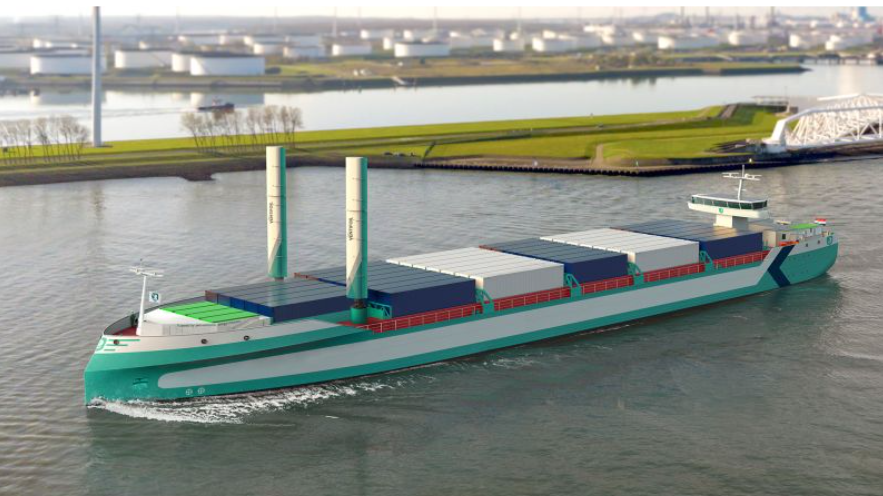
Tharsis Ship Management has secured funding for its eSeaRiverBarge project under the EU Innovation Fund 2024 call for net-zero technologies. The award backs the development and deployment of two zero-emission sea-river container vessels designed to operate both at sea and deep inland along the Rhine, including during low-water periods.
Each vessel will offer capacity of up to 378 TEU and feature an open-top hold optimised for 30- and 45-foot containers, enabling direct transport between European seaports and inland terminals without transshipment. The concept is built around a swappable energy architecture, with 16 onboard positions for ISO energy containers capable of carrying batteries, hydrogen or ammonia. The vessels will use ZESpacks supplied by Zero Emission Services under an Energy- and Charging-as-a-Service model, shifting energy supply from fixed bunkering to modular exchange.
Wind-assisted propulsion, hull air lubrication and a triple electric propulsion system are integrated to reduce greenhouse gas emissions, positioning the design for full commercial operation. The vessels will be constructed entirely within the European Union. Construction is scheduled to start in early 2027, with entry into service targeted for 2029.
CINEA (the European Climate, Infrastructure and Environment Executive Agency) manages the Innovation Fund and other EU programmes supporting climate, transport and infrastructure initiatives. The project illustrates a tangible move from fixed bunkering to modular energy-container exchange and could reshape decarbonisation approaches across European shortsea and inland waterway transport.
Key Takeaways:
1. Tharsis Ship Management secured EU Innovation Fund 2024 financing for its eSeaRiverBarge project.
2. The two-vessel programme will deliver 378 TEU container ships able to sail at sea and on the low-water Rhine.
3. The design carries 16 ISO energy containers for batteries, hydrogen or ammonia; Zero Emission Services will supply ZESpacks.
4. Wind-assisted propulsion, hull air lubrication and triple electric propulsion are integrated to cut emissions.
5. Construction starts in 2027, with entry into service in 2029; both vessels will be built entirely within the EU.

