

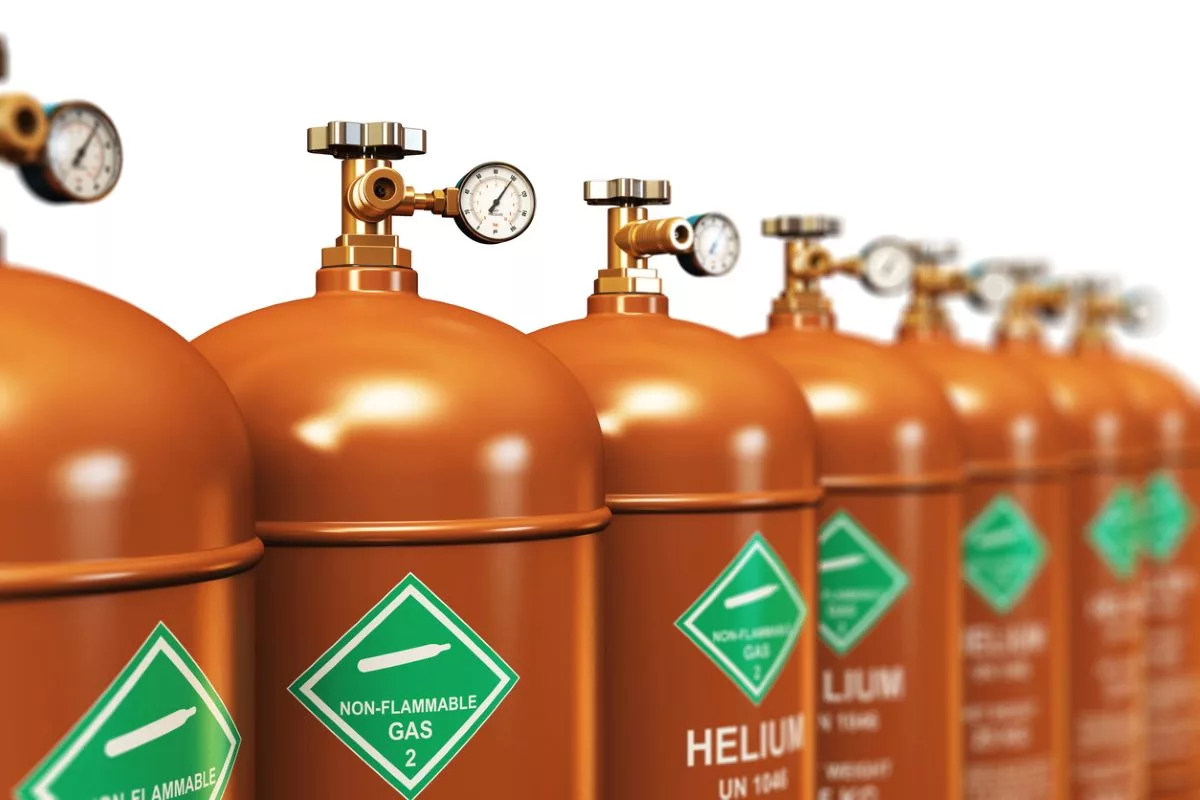
Moody's Ratings released a report on April 20 reiterating warnings from March, cautioning that lost helium production could potentially disrupt artificial intelligence, data center supply chains, and much more. The credit rating agency's report states: "Helium supply disruptions resulting from the conflict in the Middle East shine a spotlight on the exposure of downstream industries like semiconductors". David Pan, director of Moody's separate unit providing financial software and economic research and AI sector applications leader, said: "Helium doesn't get much attention in the AI supply chain, but it should". From a supply chain perspective, the industrial gas supply chain's long-distance transportation via cryogenic ISO container and tube trailer requires EX-T1 class international hazardous materials standards, and specialized fleet capacity is extremely limited.
Reuters reported on March 26 that industry executives are working to source alternative supplies of the gas; however, the Moody's Ratings report delves deeper into the potential consequences of a shortage. In his April 21 statement, Pan said: "It's essential for cooling wafers during chip etching, and there is no viable substitute at scale". Pan added: "Hyperscalers are committing roughly $650 billion to U.S. AI infrastructure this year alone. And, that investment assumes the supply chain holding it together remains intact". Pan further stated: "The AI economy runs on tokens, tokens run on GPUs, and GPUs depend on Qatari helium, Israeli bromine, and LNG tankers with a single, 21-mile-wide exit from the Persian Gulf. This is the risk of a critical, irreplaceable input in the AI supply chain colliding with surging reliance on AI compute". From a supply chain perspective, helium dependence in EUV (Extreme Ultraviolet Lithography) and plasma etching processes represents one of the most vulnerable points in fab-based manufacturing workflows against geopolitical fragility.
Helium is not manufactured; it accumulates over millions of years through radioactive decay and is captured only as a byproduct of natural gas processing. According to Oxygen Service Company (OSC), there are only 14 helium refineries worldwide, and the helium supply was already contracting rapidly before current disruptions, given that sources in Qatar—which supplies approximately 30% of the world's high-purity helium—are facing current cutoffs. Meanwhile, global industry dependence on helium is only increasing. However, before the current conflict, demand was expected to grow more slowly than new supply over several years, leaving the helium market in surplus. In 2025, global helium supply exceeds demand. World demand is projected at approximately 170 million cubic meters in 2025, while supply reaches approximately 184 million cubic meters. This surplus supply pushes prices downward and incentivizes producers to store the excess. From a supply chain perspective, Linde plc, Air Liquide, Air Products, and Iwatani are the main players in global helium distribution, and long-term take-or-pay contracts provide partial buffers against supply shocks.
The Middle East conflict disrupts this balance by affecting Qatari production and exports, creating renewed tightness particularly for high-purity helium used in electronics. Spot prices have risen sharply; however, the vast majority of helium continues to be sold under long-term contracts. Helium is critical in several stages of semiconductor production, including as a coolant and in leak detection, and has no effective substitute. The U.S. is the largest helium producer, followed by Qatar, Algeria, Russia, and Australia. Moody's Ratings notes that indicators show major Asian semiconductor producers started the year with only several months of helium inventory. South Korean chipmakers, including Samsung Electronics Co. (Aa2 stable) and SK hynix Inc. (Baa1 stable), have stocks sufficient to last at least through June according to Reuters; however, companies are paying premiums to secure inventory. Liquid helium in containers can be held for only 45 days before it begins to deteriorate. OSC notes that helium has a role in the creation of "nearly every electronic device you own". U.S. Congress enacted the Helium Act of 1925, which targets helium reserves. As a result, the helium shortage stands out as one of the most concrete impacts of the Iran conflict on AI infrastructure and semiconductor supply chains.
Key Points:
1. Moody's Ratings warns that helium shortages threaten AI and data center supply chains.
2. Qatar supplies approximately 30% of global high-purity helium.
3. There are only 14 helium refineries worldwide.
4. Samsung and SK hynix have stocks sufficient to last at least through June.
5. Pan emphasizes that GPUs depend on Qatari helium, Israeli bromine, and LNG tankers.

