

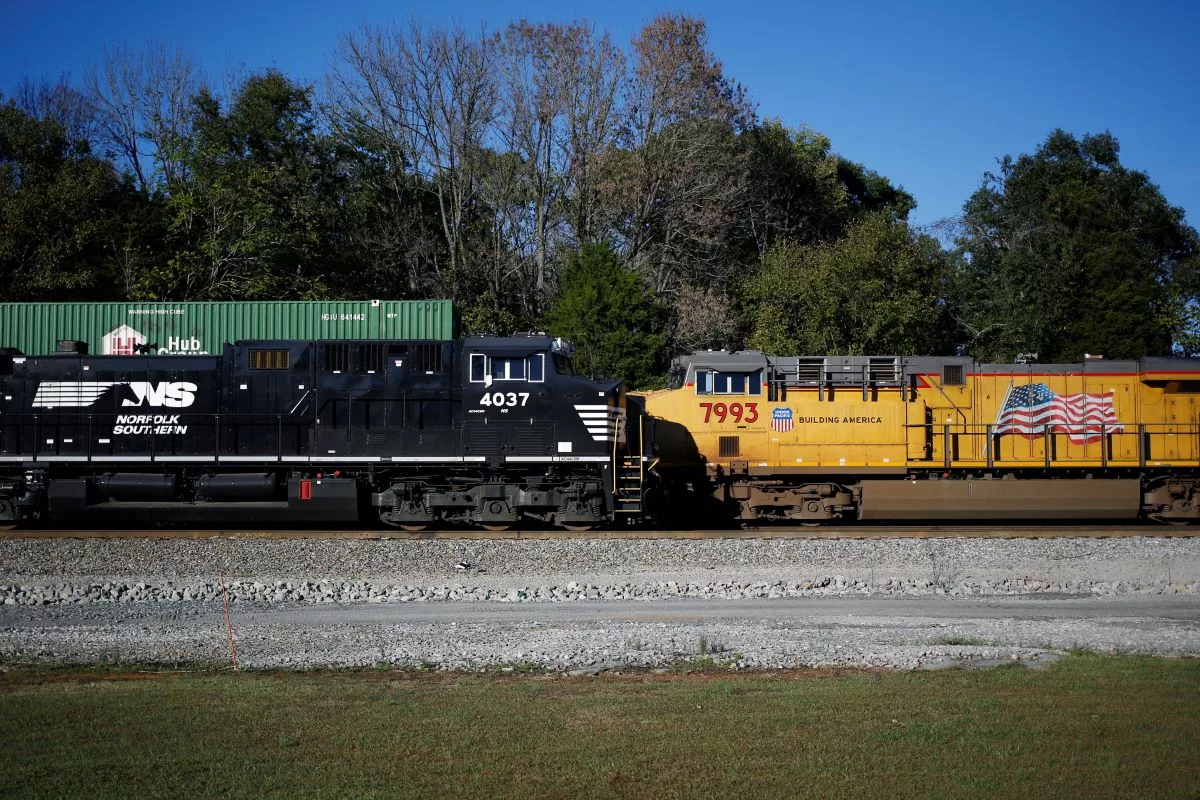
Commerce Secretary Howard Lutnick said he will support consolidation as a tool to make the U.S. freight rail industry more efficient—a potential endorsement of Union Pacific’s proposed 72 billion dollar acquisition of Norfolk Southern. The railroad industry’s current interchange system at the nation’s midpoint is creating bottlenecks that need to be relieved, Lutnick said in a CNBC interview on August 19. "Whether that needs to happen through a merger or in some other way, I leave to the regulators and the supervisors," Lutnick said. "But the concept of more efficient throughput across the country is clearly something we applaud." Union Pacific announced in July a deal to acquire Norfolk Southern for approximately 72 billion dollars in cash and stock. The combination would merge Union Pacific’s network across Western states with Norfolk Southern’s East Coast tracks—creating the U.S.’s first truly transcontinental single-operator Class I railroad.
From a supply chain perspective, Union Pacific Corporation (UP; UNP)—based in Omaha, Nebraska—is the largest Class I railroad in the U.S., operating a 32,000-mile network across 23 western states, with Jim Vena as President & CEO. Norfolk Southern Corporation (NSC; NSC)—based in Atlanta, Georgia—operates a 19,500-mile network in the eastern U.S. across 22 eastern states, with Mark George as President & CEO. Howard Lutnick is the U.S. Secretary of Commerce, assuming office during the Trump 2.0 administration and former CEO of Cantor Fitzgerald. The U.S. has seven Class I railroads: Union Pacific, BNSF Railway (owned by Berkshire Hathaway), CSX Corporation, Norfolk Southern, Canadian National Railway (CN), Canadian Pacific Kansas City (CPKC), and Kansas City Southern (now part of CPKC). The Surface Transportation Board (STB) is the U.S. federal agency that regulates railroad mergers, with Robert Primus as STB Chairman.
From a supply chain perspective, the U.S. railroad industry moves more than 2 billion tons of freight annually, representing 28 percent of U.S. freight tonnage and 40 percent in ton-miles. Intermodal (containers, trailer-on-flatcar) and carload (coal, grain, automobiles, chemicals, metals, forest products, aggregates) are the primary commodity categories. The UP and NS merger would bypass bottlenecks at major interchange points in Chicago, Memphis, St. Louis, New Orleans, and Kansas City—enabling direct transcontinental service under a single operator from U.S. Pacific ports (Los Angeles, Long Beach, Oakland, Seattle, Tacoma) to Atlantic ports (New York-New Jersey, Norfolk, Charleston, Savannah, Jacksonville, Baltimore). The Association of American Railroads (AAR)—based in Washington, DC—is the U.S. railroad industry representative organization, with Ian Jefferies as President & CEO. The Federal Railroad Administration (FRA) is the federal regulator within the Department of Transportation. Precision Scheduled Railroading (PSR) is an operational model developed by E. Hunter Harrison and adopted by CSX, UP, NS, CN, and CPKC.
From a supply chain perspective, the UP-NS merger must pass all public interest tests in the STB approval process—with evaluations of competitive impact, rate issues, service impact, employee impact, and environmental impact. No Class I merger has been approved by the STB since the UP-Southern Pacific merger in 1996, except for Canadian Pacific-Kansas City Southern (CPKC), which was completed in 2023. The 2001 Major Rail Consolidation Procedures established stricter STB standards—requiring the merger proponent to demonstrate public benefit. BNSF and CSX are potential counter-merger candidates. U.S. shippers, represented by the National Industrial Transportation League (NITL), American Chemistry Council, National Grain and Feed Association, National Mining Association, and American Forest & Paper Association, are primary carrier-sector organizations likely to oppose railroad consolidation over single-operator pricing power concerns. Consequently, Lutnick's support signal within the Trump 2.0 administration creates significant political momentum for STB approval of the UP-NS merger—though final approval depends on the regulatory review process, which historically takes years.
Key Takeaways:
1. Howard Lutnick signals support for the UP-NS merger on CNBC.
2. Union Pacific acquires Norfolk Southern for 72 billion dollars in cash and stock.
3. The merger creates the U.S.'s first transcontinental single-operator Class I railroad.
4. The Surface Transportation Board (STB) must approve the merger.
5. Chicago, Memphis, and St. Louis are major interchange bottleneck points.

