

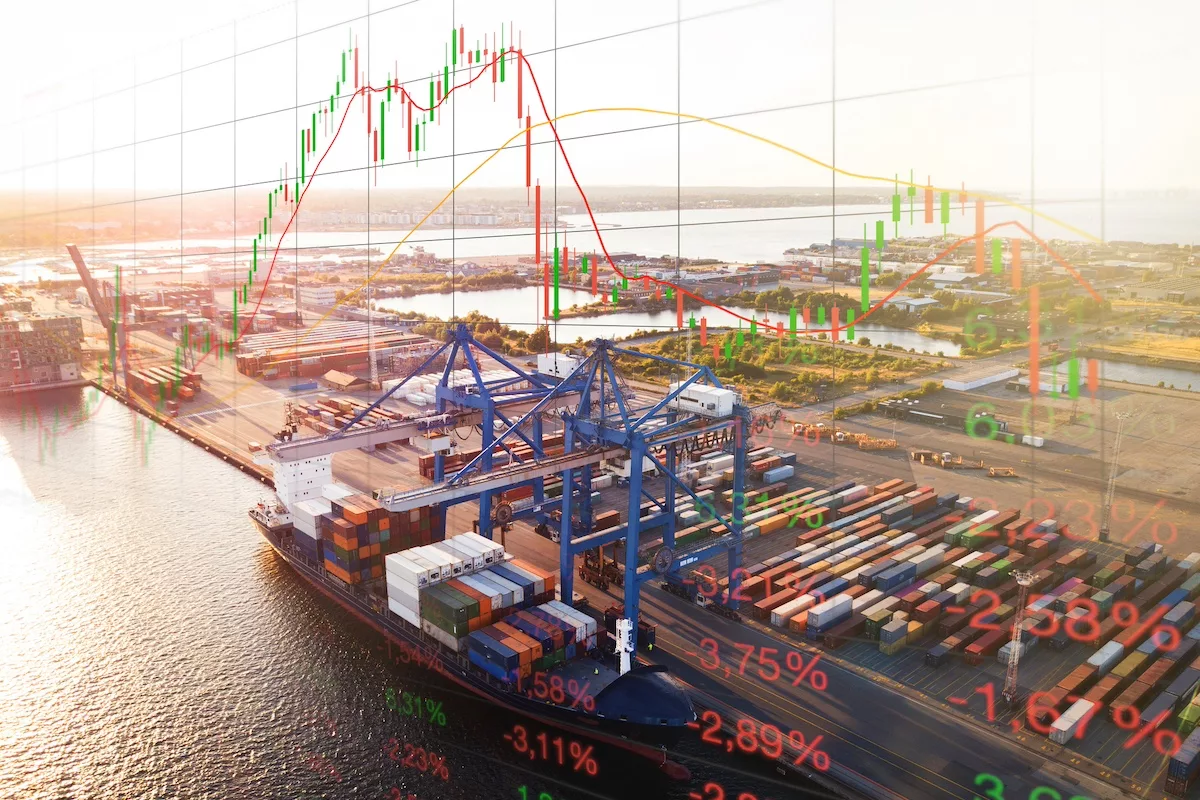
SupplyChainBrain reports that Nick Bowman, Senior Editor at SupplyChainBrain, offers analyst insight that the Trump administration's sweeping tariffs are driving slowdowns across some of the U.S.'s most critical shipping hubs—driven by a rapidly rising number of blank sailings, plummeting imports, and growing fears of a potential recession. According to a press release from freight forwarder Flexport dated April 21, ocean carriers are withdrawing capacity from transpacific eastbound trade at rates faster than during the pandemic—with eight carriers completely suspending seven weekly service loops. "Additionally, multiple services are being blanked across alliances and carriers for several weeks, with more blank sailing announcements expected," Flexport states, noting that blank sailings nearly doubled between the weeks of April 13 and 20—and that more than 25 percent of weekly service loops have already been canceled for late April and early May. According to shipping data provider Port Optimizer, scheduled vessels at the Port of Los Angeles for the week of April 27 are down more than 27 percent compared to the previous week—and also down 9 percent year-over-year compared to the same period last year. The Wall Street Journal also reports that the port expects import volumes to decline by 35 percent over the coming two weeks.
From a supply chain perspective, Flexport, founded in 2013 and based in San Francisco, California, U.S., is led by founder and CEO Ryan Petersen and provides global digital freight forwarding and ocean and air freight brokerage services. Other major digital freight forwarding competitors include Forto (based in Berlin, CEO Michael Wax), Zencargo, FreightHub, Twill (owned by Maersk), iContainers, Freightos (CEO Zvi Schreiber, based in Israel, a leading freight marketplace), Project44 (CEO Jett McCandless, based in Chicago, a leading visibility platform), FourKites, e2open, and Descartes Systems Group, which serve as major ecosystem players. Port Optimizer is a port forecasting platform provided by Wabtec (CEO Rafael Santana, based in Pittsburgh)—covering the Port of Los Angeles and Port of Long Beach. The largest container ports in the U.S. include: (1) Port of Los Angeles (Gene Seroka, Executive Director); (2) Port of Long Beach (CEO Mario Cordero); (3) Port of New York and New Jersey (Bethann Rooney, Director of Port Department); (4) Port of Savannah (Griff Lynch, Executive Director, Georgia Ports Authority); (5) Port of Houston; (6) Port of Virginia; (7) Port of Charleston; (8) Northwest Seaport Alliance (Tacoma/Seattle); (9) Port of Oakland; and (10) PortMiami.
From a supply chain perspective, the major ocean carrier alliances include: (1) 2M Alliance (Maersk and MSC—dissolving in 2025); (2) Gemini Cooperation (Maersk and Hapag-Lloyd; taking effect in February 2025); (3) Premier Alliance (ONE, HMM, Yang Ming); and (4) Ocean Alliance (CMA CGM, COSCO, OOCL, Evergreen), which represent the major 2025 alliance structures. The major ocean container carriers include MSC Mediterranean Shipping Company (CEO Soren Toft, based in Geneva, #1 global capacity), Maersk (CEO Vincent Clerc, based in Copenhagen), CMA CGM (CEO Rodolphe Saadé, based in Marseille), COSCO Shipping (based in Beijing), Hapag-Lloyd (CEO Rolf Habben Jansen, based in Hamburg), ONE Ocean Network Express (CEO Jeremy Nixon, based in Singapore), Evergreen Marine (based in Taiwan), Yang Ming, HMM, and ZIM (CEO Eli Glickman, based in Israel), which represent the top 10 carriers.
From a supply chain perspective, the Trump administration's tariff regime includes: (1) tariffs on China ranging from 145 percent to 245 percent (following April 2 "Liberation Day"); (2) a baseline tariff of 10 percent on all countries (April 2025); (3) a 25 percent tariff on steel and aluminum; (4) a 25 percent tariff on automobiles and parts; and (5) a 25 percent tariff on Canada and Mexico (for non-USMCA goods), which represent the primary tariff measures. The affected sectors include: (1) retail imports—Walmart, Target, Home Depot, Lowe's, Costco; (2) e-commerce—Amazon, Shopify, Wayfair; (3) footwear and apparel—Nike, Adidas, Lululemon; (4) consumer electronics—Best Buy, Apple; and (5) automotive—Ford, GM, Stellantis, Toyota, which represent the most significantly affected sectors. The major U.S. port regulatory authorities include the Federal Maritime Commission (FMC, Chairman Daniel Maffei), the U.S. Department of Transportation (Secretary Sean Duffy), Maritime Administration (MARAD), and U.S. Customs and Border Protection (CBP), which serve as the principal federal agencies. In conclusion, Bowman's report on the port crisis suggests that global U.S. ocean container import flows are being fundamentally restructured—and that tariff cost modeling and alternative sourcing strategies (including nearshoring) appear to be emerging as primary strategic priorities for supply chain managers.
Key Takeaways:
1. Nick Bowman of SupplyChainBrain reports tariff-driven slowdowns emerging at U.S. ports.
2. Flexport notes transpacific capacity withdrawal is faster than during the pandemic.
3. Port of Los Angeles vessel counts for the week of April 27 are down 27 percent.
4. Wall Street Journal forecasts a 35 percent drop in import volume over two weeks.
5. Trump's tariffs on China of 145 percent and higher are a major pressure driver.

