

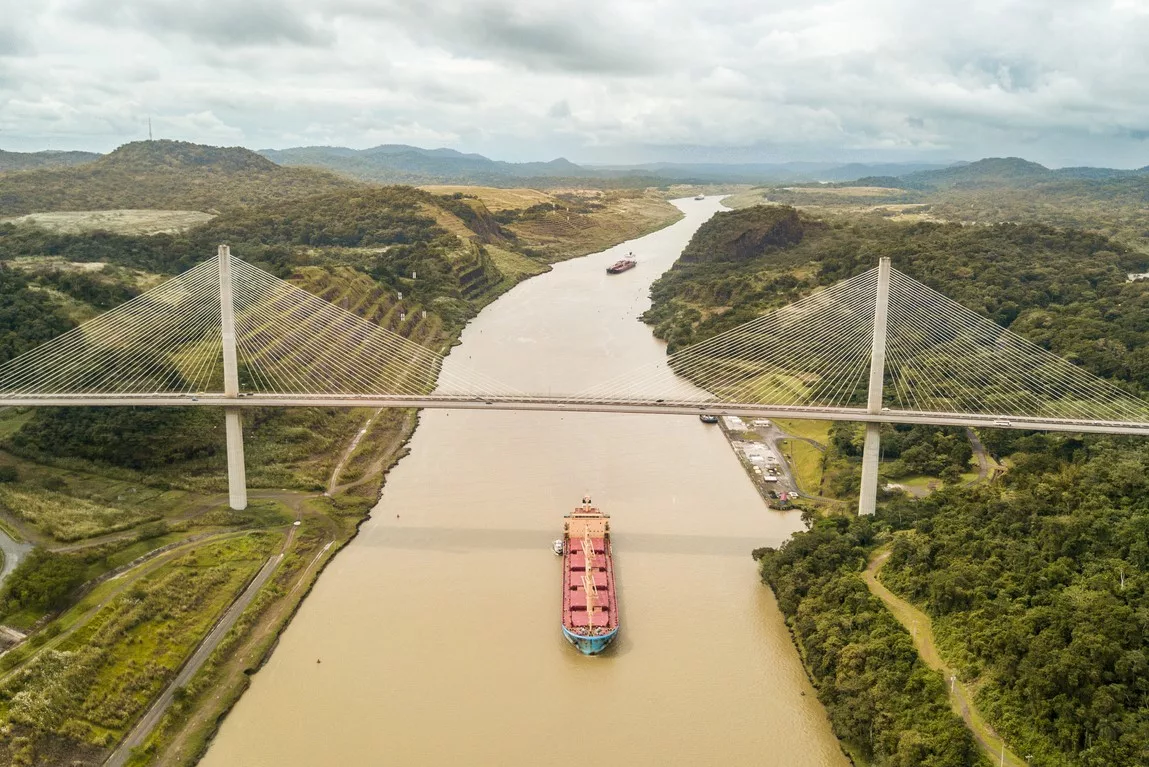
Panama's government has issued a decree ordering the Panama Maritime Authority to assume control of two ports located at the entrances of the Panama Canal, facilities that have long occupied a contentious status. The order responds to a Supreme Court decision that declared the operating concession held by Hong Kong-based CK Hutchison unconstitutional. From a supply-chain perspective, this move redraws the corridor risk profile for transpacific and transatlantic services between the U.S. East Coast and Asian main routes overnight. Major liner operators including Maersk, MSC, Hapag-Lloyd, and CMA CGM are expected to reassess their call planning for Balboa and Cristobal in the near term.
\nAccording to the Associated Press, a decree issued on February 23 orders the Panama Maritime Authority to assume control of the ports citing "reasons of urgent social interest," and the order encompasses all cranes, equipment, computer systems, and software at the hubs. The measure effectively places Balboa and Cristobal terminals under temporary state control, escalating tensions with CK Hutchison and reopening the question of who will ultimately operate the ports going forward. From a supply-chain perspective, preserving liner schedule continuity means that container call sequencing stability, turn time performance, and contractual service contract terms may require additional flexibility during annual renewal periods.
\nPanama initially announced plans to have AP Moller-Maersk's APM Terminals unit temporarily assume administrative control of the terminals pending a new concession tender. Subsequently, CK Hutchison has made threats of legal action against the Danish liner operator and claimed that a forced takeover could potentially disrupt regional commerce. The Panaman government, however, has emphasized that terminal operations will not be disrupted while the dispute is being resolved. From a supply-chain perspective, Maersk's interim operator position is a headline being closely monitored with competitive sensitivity in the post-2M era. The FMC and other regulatory bodies may assess down the road whether this arrangement is intended to be permanent.
\nPanama's Supreme Court invalidated CK Hutchison's concession contract in a July 2025 ruling, stating that the original agreement failed to meet constitutional requirements regarding transparency and competitive bidding frameworks. The court decision effectively stripped the Hong Kong-based operator of its legal standing at the ports and now, after months of political maneuvering, has resulted in direct government intervention. From a supply-chain perspective, the global parallel to this case suggests that port portfolios owned by Hong Kong and Chinese entities may be undergoing restructuring under geopolitical pressure. CK Hutchison's global terminal portfolio encompasses numerous strategic ports including Felixstowe, Rotterdam, and Antwerp, and the direct or indirect reverberations of the Panama situation may influence long-term investment planning across this network. Ultimately, the Panama Canal port dispute is emerging as a critical inflection point where the balance between sovereignty and commercial continuity is being redefined in global port operations.
\nKey Points:
\n1. Panama is placing Balboa and Cristobal ports under temporary government control by decree.
\n2. The decree encompasses cranes, equipment, computer systems, and software.
\n3. APM Terminals' interim administrative operator role remains on the agenda.
\n4. The Supreme Court found the concession contract unconstitutional in July 2025.
\n5. CK Hutchison is signaling potential legal action against the takeover.
We would be pleased to receive your feedback.
\n[43519]

