

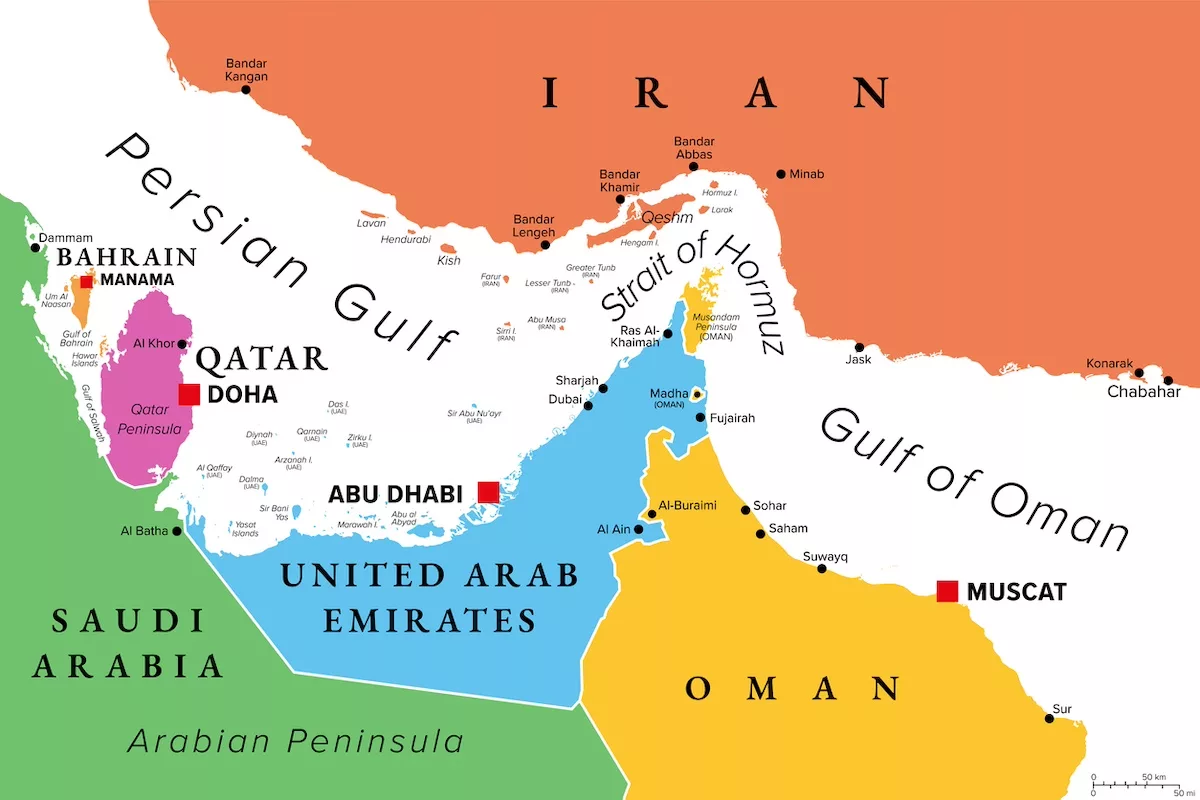
Iran has announced a partial closure of the Strait of Hormuz, citing what the country's leadership characterizes as security precautions during a period when the Revolutionary Guard is conducting military exercises in the region. The move creates notable disruptions to shipping flows and insurance premiums at a critical maritime chokepoint through which a significant portion of global crude oil passes, even if only in the short term. From a supply chain perspective, transit windows for VLCC, Suezmax, and LR2 tankers are being recalculated during the military exercise period, and crude supply flow schedules for Asian refineries face minor adjustments. The situation underscores the geopolitical vulnerability of crude oil supplies originating from the Middle East and affects insurance war risk premiums.
According to CNBC reports, the temporary closure beginning February 17 is aimed at ensuring maritime security during the Revolutionary Guard's "Smart Control of the Strait of Hormuz" exercise, which is expected to include live missile tests. The closure coincides with a period when the U.S. and Iran are conducting second-round negotiations in Geneva, Switzerland to discuss Iran's nuclear program. It also marks the first time the strait has been closed since the Trump administration began threatening military action in the region in January. According to CNN reports, the U.S. military is continuing a buildup that precedes the negotiations and constitutes a significant concentration of air and naval assets in the Middle East. This concentration adds an additional pressure layer to the regional maritime security equation.
In 2025, approximately 13 million barrels of crude oil pass through the Strait of Hormuz daily, representing roughly 31% of global seaborne crude oil flows. Jacob Larsen, head of security and safety at the Baltic and International Maritime Council (BIMCO), stated in comments to CNBC that the partial closure will likely cause minor delays but will not result in a major disruption. From a supply chain perspective, this assessment indicates that Asian refinery crude supplies are expected to remain relatively resilient provided the exercise remains limited in scale and duration. Flows of crude oil from Saudi Arabia, the UAE, Kuwait, and Iraq to China, India, South Korea, and Japan are expected to return to normal rhythms outside the exercise window.
During this process, negotiations between the U.S. and Iran are focused solely on Iran's nuclear program, with crackdowns on protesters—which Donald Trump initially cited as justification for military action—not on the agenda. Iran's Foreign Minister Abbas Araghchi stated in remarks to reporters that the two sides have reached agreement on the "guiding principles" of the negotiations, but more work remains to be done. From a supply chain perspective, the preservation of negotiation grounds suggests that war risk premium increases in freight markets could gradually ease. In conclusion, the brief closure of the Strait of Hormuz stands out as an important case study in which the geopolitical contact points of the global crude oil supply chain are being tested.
Key Points:
1. Iran partially closes the Strait of Hormuz as of February 17.
2. The closure is in effect during the Revolutionary Guard's "Smart Control" exercise.
3. In 2025, 13 million barrels of crude pass through the strait daily, representing 31% of global seaborne flows.
4. BIMCO expects disruptions to remain minor in scale.
5. U.S.-Iran negotiations continue in Geneva focused on the nuclear program.
Your feedback would make us happy.

