

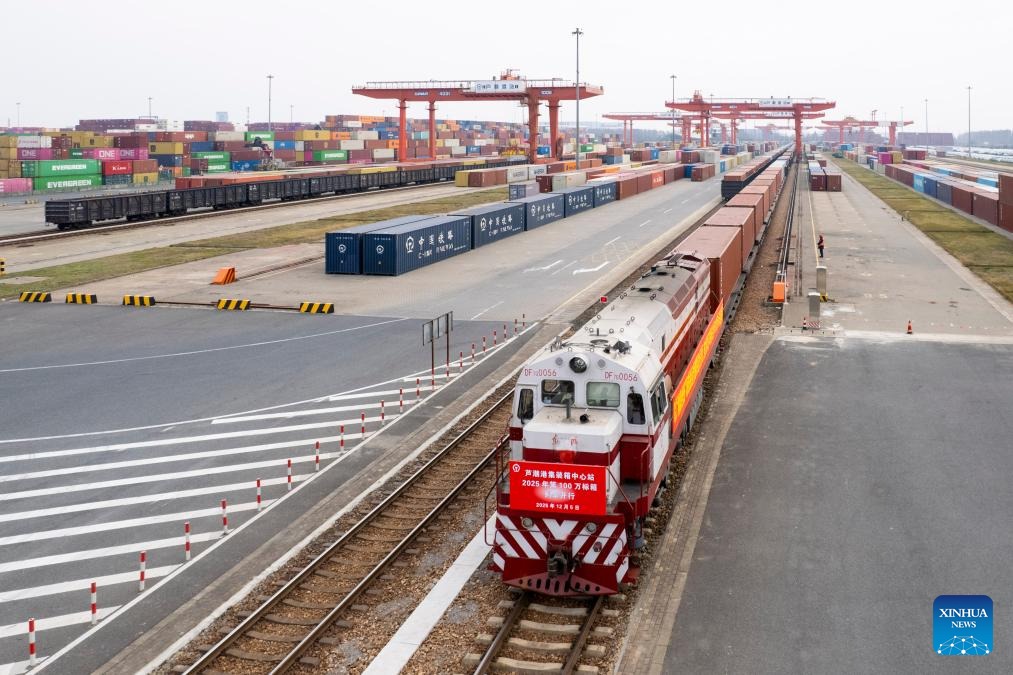
Shanghai sea-rail intermodal network reached a new milestone in 2025. According to China News, following the departure of a train carrying solar panel modules and automotive components from Shanghai Luchaogang Container Center Station on the morning of December 5, the year's cumulative sea-rail volume formally surpassed the 1 million TEU threshold. This figure represents the highest level on record, with year-on-year growth of approximately 20 percent according to official data.
At the heart of this growth lie intensive operational improvements executed by China Railway Shanghai Group Co., Ltd. throughout 2025. The company:
optimized locomotive crew scheduling processes,
reduced train idle time at stations,
increased the frequency of fully loaded by axle services,
achieved a daily capacity of 20 train pairs on the Nanxiang–Luchaogang line,
indicated that a potential of 22 train pairs is feasible when service scheduling is further refined.
Beyond these optimizations, the company's hybrid "block trains + single wagons" model generates approximately 90,000 TEU in additional handling capacity annually. This model strengthens terminal–hinterland connectivity by providing single-wagon flexibility without compromising the efficiency of block trains.
Luchaogang's Critical Role and Infrastructure Expansions
Luchaogang Container Center Station, constructed as the primary railway hub for Yangshan Deep-water Port, commenced operations on December 4, 2005. In recent years, the station has undergone a multi-phase capacity expansion program to alleviate the "last-mile" bottleneck:
loading and unloading lines were extended,
new and modernized gantry crane models were commissioned,
dedicated container yards were expanded,
an integrated dispatch center was established to consolidate railway–port–cargo operations under one roof.
Today the station operates across a total of 32 full-length tracks arranged as 4 groups × 8 lines. The average handling time for a container at the station is approximately 3 minutes. With a design capacity of 1.2 million TEU/year, the station is approaching its capacity limits given the current growth trajectory; however, operational improvements are making the system increasingly efficient.
Regional and National Connectivity
Shanghai's sea-rail network today provides connectivity with more than 40 cities across 10 or more provinces and municipalities:
Major industrial zones such as Shanghai, Jiangsu, Zhejiang, Anhui, Sichuan occupy central positions in this network. Authorities characterize this traffic flow as "stable," indicating the strengthening of China's domestic logistics integration.
2024–2025 Performance Comparison
In 2024, Shanghai's sea-rail volume exceeded 900,000 TEU and demonstrated growth exceeding 30 percent on an annual basis. The surpassing of 1 million TEU in 2025 on this foundation confirms the sustainable growth of the intermodal model.
Chen Songdi, Director of Multimodal Transportation at China Railway Shanghai Group, notes that total inbound–outbound volume could reach 1.09 million TEU by year-end 2025, representing approximately 15 percent growth compared to 2024.
Strategic Assessment
This performance reflects three key trends:
Intermodal capacity is enhancing China's port competitiveness.
Bottlenecks in hinterland access for mega-ports such as Yangshan are being alleviated.Rail transport is reducing the carbon intensity of short-to-medium-distance road freight.
The sea-rail model is gaining priority in line with China's environmental targets.Equipment and process modernization are reducing the risk of terminal congestion.
In conclusion, Shanghai's sea-rail intermodal network not only set a volume record in 2025; it has simultaneously reinforced China's integrated logistics infrastructure's global competitive strength.
Key Takeaways:
2025 sea-rail volume surpassed 1 million TEU threshold (20 percent growth).
Luchaogang Station's annual capacity stands at 1.2 million TEU.
The Nanxiang–Luchaogang line achieved daily capacity of 20–22 train pairs.
Hybrid block train + single wagon model generates +90,000 TEU additional capacity annually.
The network provides connectivity with 40+ cities across 10 or more regions.
2025 total is expected to exceed 1.09 million TEU.
Related Article:
Author: SedatOnat.com
We would be delighted to receive your feedback.
Wishing you happy reading.

