

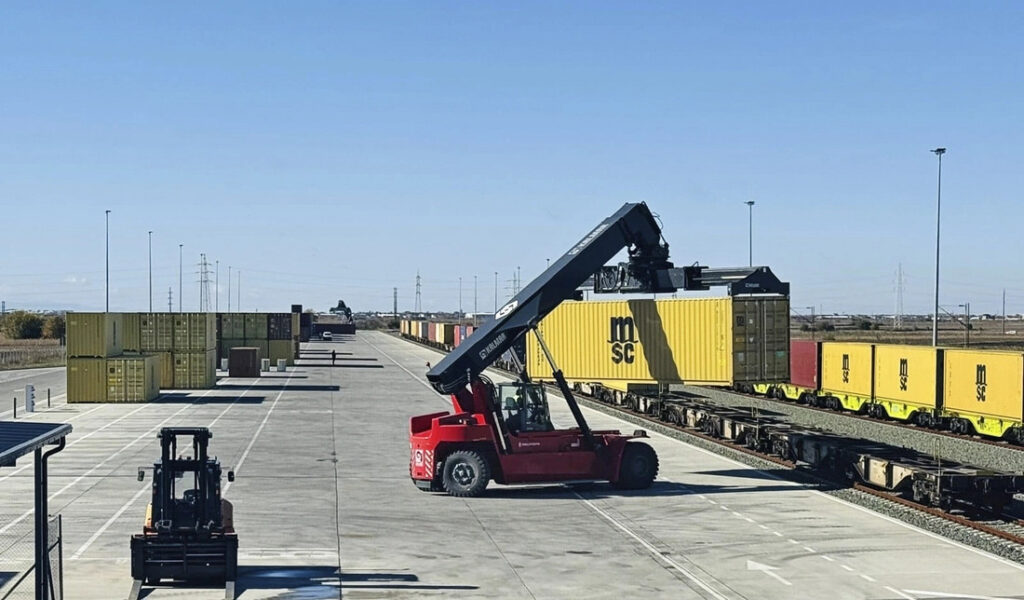
Mediterranean Shipping Company (MSC) has launched a new intermodal rail link that will connect Serbia directly to global trade networks. Starting in October 2025, the line operates between the Batajnica terminal near Belgrade and the Port of Trieste on Italy's Adriatic coast.
\nThe new line stands out as a critical connection that integrates landlocked countries such as Serbia, North Macedonia, and Montenegro into MSC's global maritime and logistics networks.
\nFaster access to global markets
\nThe new intermodal service delivers shorter transit times and more predictable supply chains for customers shipping automotive parts, ore, machinery, packaging materials, and consumer goods.
\nOperating with regular weekly departures, the line can carry more than 70 TEU container capacity. Through this connection, customers gain access to a solution that is more sustainable and cost-effective than road transportation.
\nStevica Carapic, MSC's Regional Director for Serbia, North Macedonia, and Montenegro, underscored the service's strategic importance for regional logistics integration, stating:
\n"This new rail line represents a step that strengthens Serbia and the Balkans' position within MSC's global logistics network.\n
\nBy combining rail and maritime transportation, we can offer our customers more reliable and sustainable supply chain solutions."
\n
Trieste: The Adriatic's gateway to global logistics
\nThe new connection centers on Trieste, one of Europe's most strategic ports. As an Adriatic gateway where MSC operates its own terminal, Trieste represents a vital hub in its maritime network reaching Asia, Africa, and the Americas.
\nThrough this connection, exporters in Serbia gain direct access to MSC's global intermodal network. Via Trieste, faster and eco-friendly transport is provided to the Mediterranean, Far East, Northern Europe, and North American markets.
\nSustainability and efficiency benefits
\nAccording to MSC, the new rail line will:
\n- \n
Provide a more efficient solution as an alternative to road transportation,
\n Deliver eco-friendly logistics by reducing CO₂ emissions,
\n Enhance operational flexibility by shortening transit times.
\n
This line strengthens MSC's intermodal infrastructure across Europe while representing a step aligned with the European Green Deal objectives.
\nMSC stated in its announcement, "This connection will not only accelerate shipping but will also help our customers reduce their carbon footprint."
\nSerbia's regional logistics role strengthens
\nIn recent years, Serbia has made significant investments toward becoming a regional logistics hub in the Balkans. The country is positioned as a strategic transit point for reaching Central European, Mediterranean, and Black Sea markets thanks to its location on Pan-European Transport Corridor X.
\nMSC's new line, integrated with dry port infrastructure in the Balkans, makes the door-to-port model more accessible for landlocked countries.
\nA new link in the intermodal network
\nThe new line is part of MSC's intermodal expansion strategy across Europe. The company has launched new rail connections between Hungary, Poland, Slovakia, and the Czech Republic over the past two years.
\nThrough these efforts, MSC shifts high-volume cargo from roads to rail, supporting both sustainable transportation objectives and reducing logistics costs.
\nCarapic summed up the significance of the new line:
\n"This connection represents a transformative step not only for MSC but also for Serbia's regional trade potential.\n
\nThrough the Trieste link, customers can now reach global markets directly and securely through a single gateway."
\n
Key Takeaways:
\n- \n
MSC has launched a new intermodal rail line from the Batajnica terminal near Belgrade to the Port of Trieste.
\n The line carries automotive, machinery, ore, and consumer goods.
\n Weekly departures with 70+ TEU capacity provide shorter transit times and lower emissions.
\n Trieste is MSC's primary sea gateway in the Adriatic and exit point to global markets.
\n The line promotes eco-friendly and sustainable transportation as an alternative to roads.
\n MSC's European intermodal network continues to expand from the Balkans to Central Europe.
\n This initiative supports Serbia's strategy to become a logistics hub and strengthens regional trade integration.
\n
----------
\n\n--------------------
\nAuthor: SedatOnat.com
\n--------------------
\n\nWe would be happy to receive your feedback.
\nWe wish you happy reading in advance.
\n
