

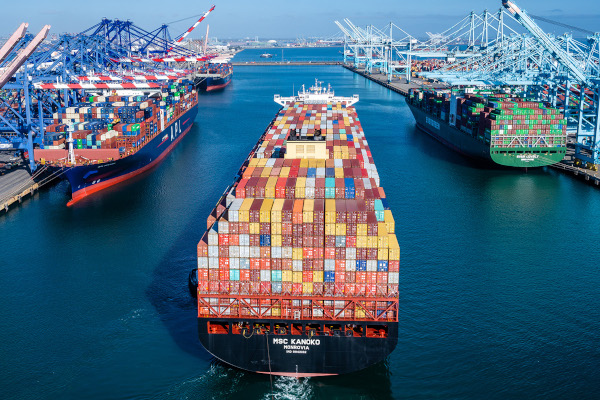
Modern container ships are massive logistics platforms that form the backbone of global trade and can simultaneously transport thousands of containers. These vessels play a critical role in moving electronics, textiles, food, machinery, chemicals, and a diverse range of industrial products to world markets. Yet how such vast quantities of cargo are organized, secured, and balanced on the ship is a subject of considerable curiosity for many.
A video shared by Ali Al Samahi on X demonstrates just how complex and scientifically grounded cargo organization on container ships truly is. The footage clearly shows how containers are positioned on the ship's deck and in the lower hold sections, how each slot is planned, and how cargo balance is maintained.
Weight Distribution: The Foundation of Ship Balance
The most critical phase of the container loading system is the proper distribution of weight throughout the vessel.
The heaviest containers are placed in the lower sections of the ship (particularly in the double bottom and lower holds).
Medium-weight cargo is positioned in the mid-deck areas;
The lightest containers are generally stowed on deck.
This arrangement is essential to prevent the ship from listing, maintain trim balance, and enable stable movement through waves.
Planning by Destination: Essential for Quick Unloading
On container ships, each box is stowed in a specific sequence according to its destination port.
This ensures:
Containers to be unloaded earlier are placed on top,
Those unloaded later are placed below.
This method accelerates port operations and optimizes the crane handling process.
Size and Type Management
Containers come in different sizes such as 20 ft and 40 ft. Additionally, there are specialized types such as:
Reefer (refrigerated),
Open-top,
Dangerous goods
containers.
Each of these container types has specific positioning requirements established according to international regulations:
Reefer containers are placed in areas close to power supply lines.
Hazardous cargo is maintained at specified distances from certain containers or ship equipment.
Open-top containers are generally carried on deck.
Ship Software Systems: "Stowage Planning"
Although this highly complex loading plan is supervised by humans, it is largely prepared using automated stowage planning software. The system:
Calculates the center of gravity,
Stability curves,
IMO safety regulations,
Unloading sequences between ports
to create an optimized loading plan through simultaneous analysis.
What Does the Video Show?
The video presents both the internal structure of the container ship and the deck stowing arrangement in 3D modeling. This visualization:
Shows each container's position number,
Hold compartment divisions,
The twist-lock system,
The cage and bay-row-tier arrangement
in detailed fashion.
The footage demonstrates that the loading process resembles solving a "giant puzzle": even a small error can jeopardize ship stability.
Key Points:
Containers are planned according to weight, size, and destination port.
For ship stability, heavy cargo is placed in lower holds and light cargo on the upper deck.
Special containers such as reefer and hazardous cargo are stowed within specific regulatory frameworks.
Stowage planning software automatically performs balance and safety calculations.
The video clearly demonstrates how technical and critical container arrangement is.
Author: SedatOnat.com

