

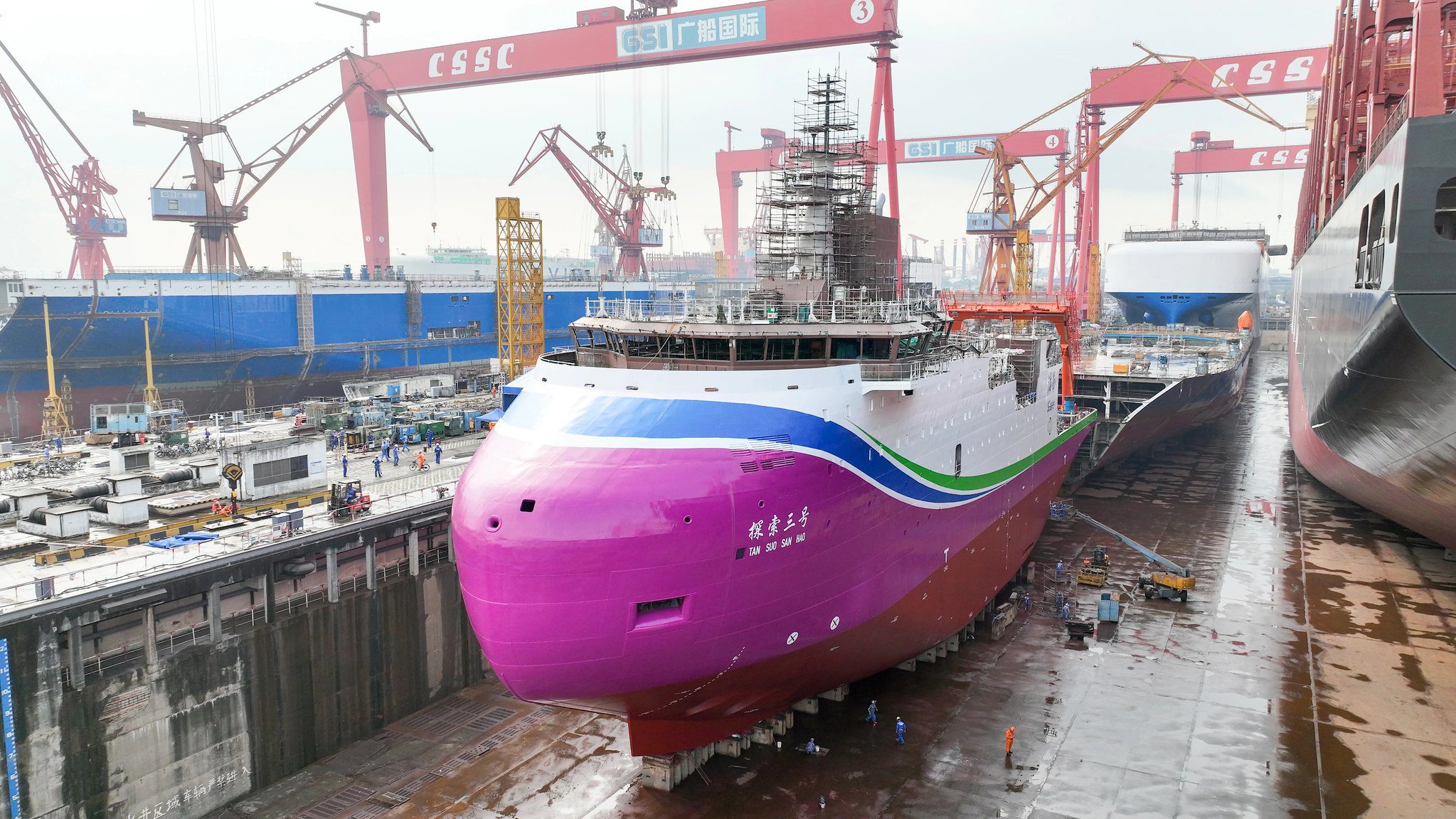
China has delivered Tan Suo San Hao (Exploration No. 3), its first scientific research vessel designed for global deep-sea exploration. Built by Guangzhou Shipyard International Co., Ltd., the 104-meter vessel boasts impressive capabilities including 10,000 tons of displacement, a range of 15,000 nautical miles, and dual-direction ice-breaking capabilities.
The Tan Suo San Hao project, jointly financed by the Hainan provincial government and scientific institutions, demonstrates China's technological prowess in maritime exploration. This development coincides with China's plans for a crewed Arctic Ocean floor expedition, an achievement that would make it only the second nation after Russia to accomplish this feat.
The vessel was completed in less than 10 months from steel cutting to launch, showcasing China's accelerating shipbuilding capabilities. The delivery of Tan Suo San Hao comes following an intensive year of Arctic operations marked by China sending three ice-breakers to the region and conducting its first joint Arctic patrol with Russia.
Despite its geographical distance from the Arctic region, China has expanded its presence by positioning itself as a "near-Arctic state," a claim that Western Arctic nations find controversial. The country's commercial interests in the region are also expanding, with record-breaking crude oil deliveries and container shipping achieved this year.
China's Arctic policy focuses on resource exploration and the development of new sea routes. In particular, development of the Northeast Passage, referred to as the "Polar Silk Road," is being planned in cooperation with Russia. This route aims to accelerate commerce by shortening sea voyages from China to Europe.
Additionally, China's scientific research activities in the Arctic region are accelerating. Ice-breaking research vessels such as Xue Long 2 are being deployed for geological and biological research in the region. These vessels play a critical role in strengthening China's scientific presence in the Arctic.
China's growing presence in the Arctic region could affect global maritime and geopolitical balances. The exploration of natural resources and the opening of new sea routes in the region appear aligned with China's economic and strategic objectives. However, this situation is being closely monitored by other Arctic nations and the international community.
Key Points:
Tan Suo San Hao is China's first scientific research vessel designed for global deep-sea exploration.
The vessel has displacement of 10,000 tons and a range capacity of 15,000 nautical miles.
China is targeting to become the second nation after Russia to conduct a crewed expedition to the Arctic Ocean floor.
The construction of Tan Suo San Hao was completed in less than 10 months from steel cutting to launch.
China is expanding its presence in the region by positioning itself as a "near-Arctic state."
Development of the Northeast Passage, referred to as the "Polar Silk Road," is being planned in cooperation with Russia.
Ice-breaking research vessels such as Xue Long 2 play an important role in China's Arctic scientific research activities.
China's growing presence in the Arctic region could affect global maritime and geopolitical balances.
We would be delighted to receive your feedback.
Wishing you happy reading.

