

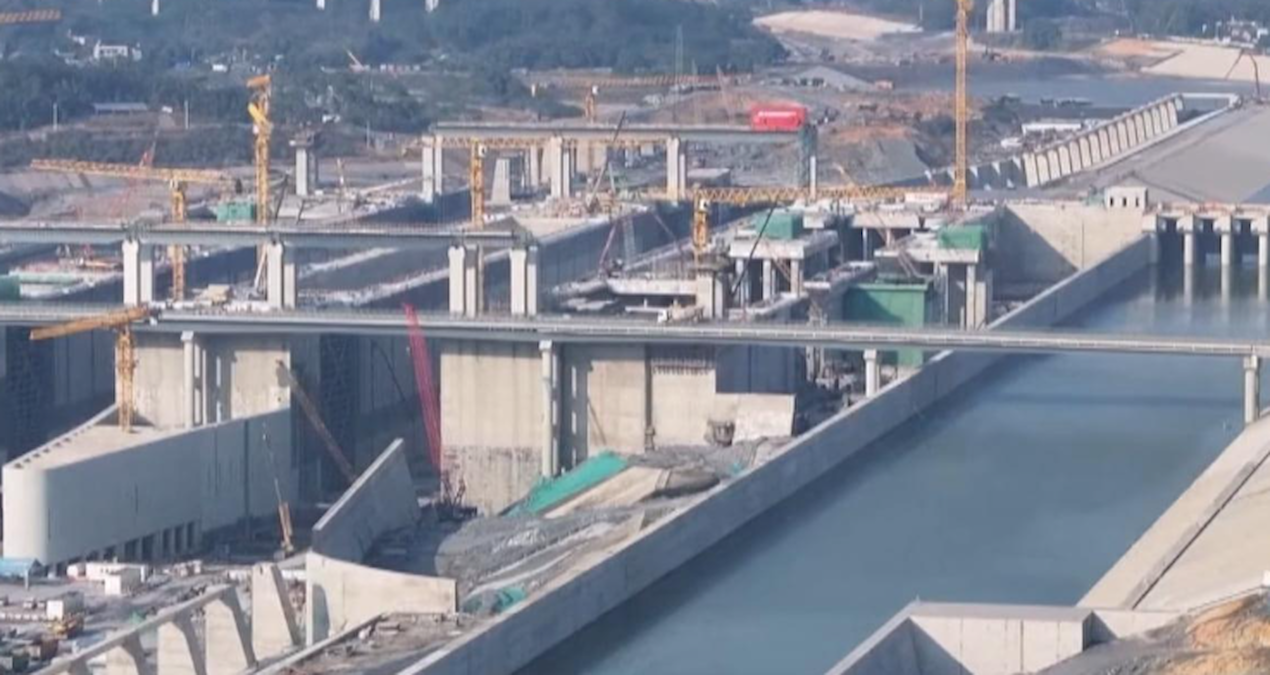
China has cleared a critical milestone on the 134-kilometer Pinglu Canal, a project Beijing frames as a turning point in its inland-to-sea logistics strategy. Built in the Guangxi Zhuang Autonomous Region to give ocean vessels direct access to interior provinces, the canal aims to convert river corridors into an international maritime route. Authorities say 90 percent of project financing is in place, with the canal scheduled to enter operation by end-2026.
One of the 27 crossings planned along the alignment, the Jikai Bridge, opened to traffic this week. Officials called the opening a tangible indicator that surrounding infrastructure is approaching cargo-readiness. The bridge is positioned as one of several land-water interchange points feeding the integrated logistics network being assembled along the canal corridor.
The most distinctive engineering feature is the water-lift lock system designed to overcome a 65-meter elevation difference along the route. Vessels are placed in sealed chambers in which water levels are raised or lowered to transfer ships between sections of the canal at different heights. The complex multi-stage locks are central to year-round, uninterrupted operation. Information published by State Council-affiliated bodies positions the system as one of the most ambitious civil engineering schemes ever undertaken in China's canal program.
From a supply-chain standpoint, Pinglu is expected to shorten existing maritime routes by roughly 560 kilometers, with savings on distance and fuel projected to exceed $750 million per year. By linking China's interior to Southeast Asian markets through the Beibu Gulf, the corridor is set to provide an alternative shipping channel for container and dry-bulk flows across RCEP economies. Project sponsors point to 36 conservation zones and dedicated fish passages built to protect biodiversity, although scientific journals continue to flag concerns about cumulative ecological impacts.
Key Takeaways:
1. The 134-km Pinglu Canal is on track for end-2026 operation with 90 percent of project financing secured.
2. The Jikai Bridge, one of 27 crossings planned along the alignment, opened to traffic this week.
3. A water-lift lock system will overcome a 65-meter elevation difference between canal sections.
4. Existing maritime routes are projected to be shortened by about 560 km, generating over $750 million in annual savings.
5. The canal is positioned as an alternative logistics corridor linking inland China to Southeast Asia via the Beibu Gulf.

