

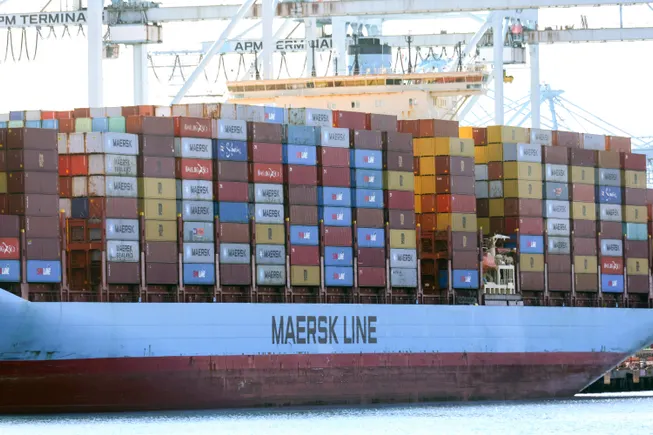
Major logistics companies including FedEx, Maersk and GXO Logistics have downplayed Amazon Supply Chain Services as a competitive threat. Amazon's recently announced offering provides freight transportation, parcel shipping, air freight, global logistics, distribution and fulfillment services to any company, not just those selling on its marketplace.
FedEx CEO Raj Subramaniam told CNBC that Amazon Supply Chain Services and FedEx are operating "two different businesses entirely." Subramaniam emphasized FedEx's end-to-end global network: "The true network is something you can pick up in any one part of the world and get it to any other part of the world in a couple of days, and for that, you need a system like what we have." Maersk CEO Vincent Clerc also highlighted his company's international logistics capabilities in an earnings call. Clerc noted that Amazon and Maersk frequently do business together and called ASCS "a logical continuation of efforts," but emphasized differences: "We are active much more on the international scene where they are active much more on the U.S. domestic scene. We are not so active in the express and last-mile delivery compared to what they are."
Amazon Supply Chain Services does have some international transportation capabilities at launch. It offers inbound shipping from China to several countries via Amazon Global Logistics and charter services through Amazon Air Cargo. Other services like Amazon Freight and Amazon Shipping focus on transporting goods within the U.S. GXO Logistics CEO Patrick Kelleher described ASCS as offering a "standardized solution" that sells access to existing network capacity, while GXO builds standalone, customized logistics solutions. GXO competes with Amazon via its GXO Direct product, which provides shared-use e-commerce fulfillment and represents just under 6% of GXO's business.
Both Kelleher and Clerc flagged data security as a customer concern regarding ASCS's launch. Amazon's private label business competes with a wide range of brands and has faced regulatory scrutiny. Kelleher said, "For enterprise customers, protecting their data is a top priority. Many companies are going to be reluctant to give a competitor deeper visibility into their inventory, demand patterns, sales channels, financials." An Amazon spokesperson stated that the company prohibits using sales data from ASCS customers to make sourcing, inventory or pricing decisions for products in its own store.
Large companies like Procter & Gamble, 3M and American Eagle Outfitters are already ASCS customers. Amazon CEO Andy Jassy told CNBC that small- and medium-sized firms may benefit most from ASCS: "Today, to try and compile a supply chain for any size business, but particularly a small business that doesn't want to have to build out all those capabilities themselves, it's time-consuming and expensive."
Key Takeaways:
1. FedEx, Maersk and GXO Logistics downplay Amazon Supply Chain Services as a major competitive threat.
2. FedEx CEO Raj Subramaniam said the companies operate different businesses, emphasizing FedEx's end-to-end global network.
3. Maersk CEO Vincent Clerc noted his company is more active internationally while Amazon focuses on the U.S. domestic market.
4. GXO Logistics CEO Patrick Kelleher flagged data security as a significant concern for enterprise customers.
5. Large companies like Procter & Gamble, 3M and American Eagle Outfitters are already Amazon Supply Chain Services customers.
[820087]

