

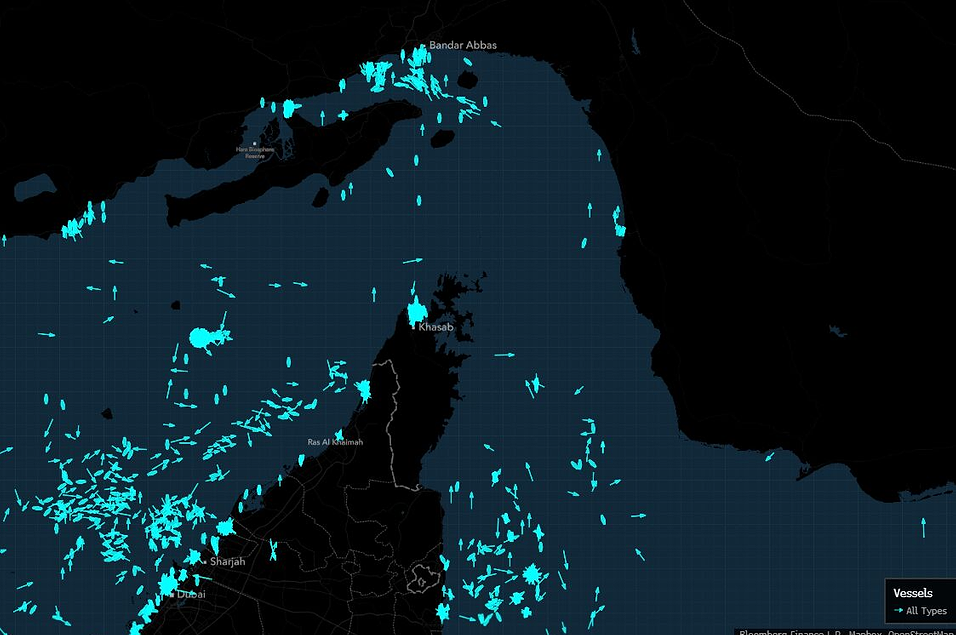
As of May 5, 2026, hundreds of vessels were seen clustering near Dubai while the Strait of Hormuz remained nearly empty, as ships moved away in response to Iran's efforts to widen its area of control. A weeks-long ceasefire between the U.S. and Iran has begun to look increasingly fragile: the two sides exchanged fire as Washington said it had opened a passage through the waterway, and CBS reported that two American destroyers had crossed into the Persian Gulf. Since May 4, nearly 60 vessels across different types have sailed into an area off Dubai monitored by Bloomberg News — an unusually large number even for waters that have seen carriers clustering since the start of the war.
According to vessel signals, at least 363 ships are currently in the area, compared with an average of 294 in the prior seven days. Dubai falls just outside the new Hormuz control area defined by Tehran, which extends south from the strait to Umm al-Quwain, along the United Arab Emirates coast and into the gulf. Monitoring vessels in the Persian Gulf has been complicated since the start of the war by ships going 'dark' (switching off transponders) and increased electronic interference; the exact shape of the Dubai cluster may not capture reality on the water perfectly, but it shows the trend in maritime movement.
Crew members report radio broadcasts warning vessels of new boundaries defended by the Islamic Revolutionary Guard Corps Navy. Attacks on the United Arab Emirates port of Fujairah in the Gulf of Oman, meanwhile, have underscored the expanded Iranian command zone — and kept the strait largely devoid of traffic through the morning of May 5. Anoop Singh, global head of shipping research at Oil Brokerage Ltd, summed up the situation: 'The U.S. is attempting to level the power balance in the strait and that's been reciprocated against by Iran. It's escalation. I'm not expecting a quick reopening of bi-directional flows through the strait.'
The supply-chain implications are severe. Hormuz has become a flashpoint in the nine-week war; traffic has dwindled since U.S. and Israeli strikes on Iran, oscillating each time one side adjusts levels of control. Daily Hormuz passages — around 135 each day before the war — are currently at near zero. The extended lockdown has upended global freight markets, with decades-old benchmarks turning irrelevant overnight. If the U.S. succeeds in guiding more ships out of the strait, the prospect of an exit could alleviate pressure for the hundreds of oil and chemical carriers trapped in the gulf — but the drone strike on ADNOC's supertanker Barakah on May 4 and South Korea reporting its first targeted ship of the war reinforce industry caution.
Key Takeaways:
1. Bloomberg satellite tracking shows 363 ships clustering off Dubai on May 5, 2026 (vs a seven-day average of 294); the Strait of Hormuz is nearly empty.
2. Tehran's new Hormuz control area extends south along the UAE coast to Umm al-Quwain; Dubai sits just outside that boundary.
3. Daily Hormuz passages have collapsed from a pre-war ~135 to near zero; two U.S. destroyers crossed into the Persian Gulf.
4. ADNOC's supertanker Barakah was hit by drones in Hormuz; South Korea reported its first targeted vessel of the war.
5. Oil Brokerage Ltd's Anoop Singh: 'This is escalation. I'm not expecting a quick reopening of bi-directional flows through the strait.'
[44031]

