

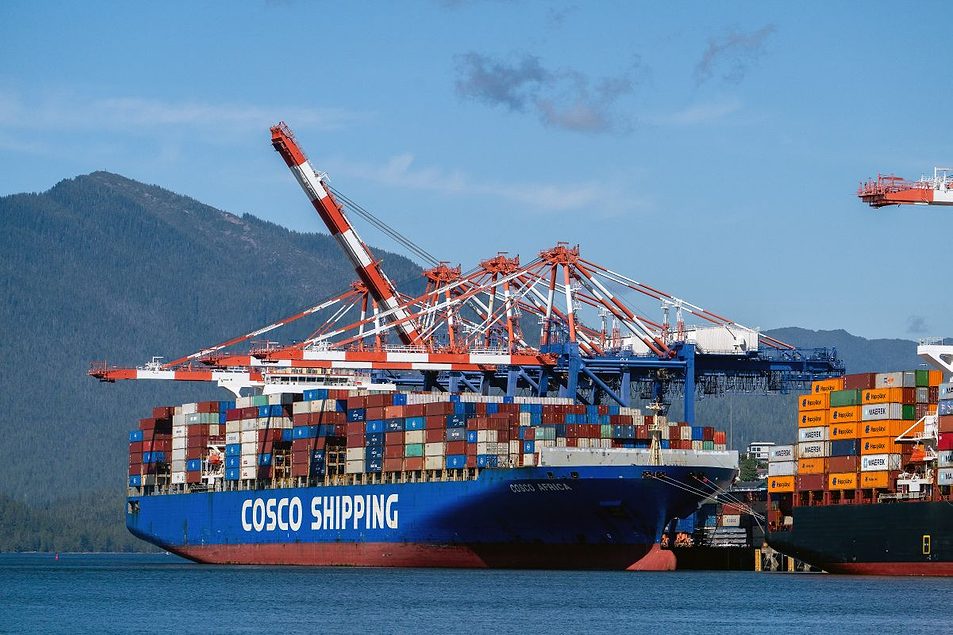
COSCO Shipping Holdings reported a 50% drop in first-quarter profit, citing weaker freight rates and warning that the Middle East war has posed "significant challenges" for the industry. China's largest container liner pointed to growing pressure on the safety and stability of global shipping.
According to the April 29 filing, net income fell to 5.9 billion yuan (about $863 million) from 11.7 billion yuan a year earlier. Revenue dipped 11% to 51.8 billion yuan, with the transpacific route registering the steepest decline.
In its statement, the carrier said, "The conflict in the Middle East has posed significant challenges to the safety and stability of global shipping." Analysts at Bloomberg Intelligence, led by Kenneth Loh, had estimated that container freight rates averaged 14% lower year-on-year during the quarter.
Earlier in April, COSCO told investors that it remained relatively insulated from the Middle East conflict, since capacity on routes calling at the region accounts for a "relatively small proportion" of global total capacity, signaling that direct impact would stay limited.
The Q1 numbers nevertheless show how uncertainty around the Red Sea and the Strait of Hormuz is reaching container pricing through global capacity, insurance and customer-confidence channels even when carriers do not call at the region. Analysts suggest that, unless the conflict eases and indirect pressure on the Suez Canal abates, any rate recovery in the second half could be limited.
Key Takeaways:
1. COSCO Shipping Holdings posted a Q1 2026 net income of 5.9 billion yuan (about $863 million), down 50% year-on-year.
2. Total revenue fell 11% to 51.8 billion yuan, with the steepest decline on the transpacific route.
3. The carrier said the Middle East conflict has posed significant challenges to the safety and stability of global shipping.
4. Bloomberg Intelligence estimated that container freight rates averaged 14% lower year-on-year during the quarter.
5. Although COSCO highlights that Middle East lanes account for a small share of global capacity, Red Sea and Strait of Hormuz uncertainty is still pressuring container pricing globally.
[43979]

