

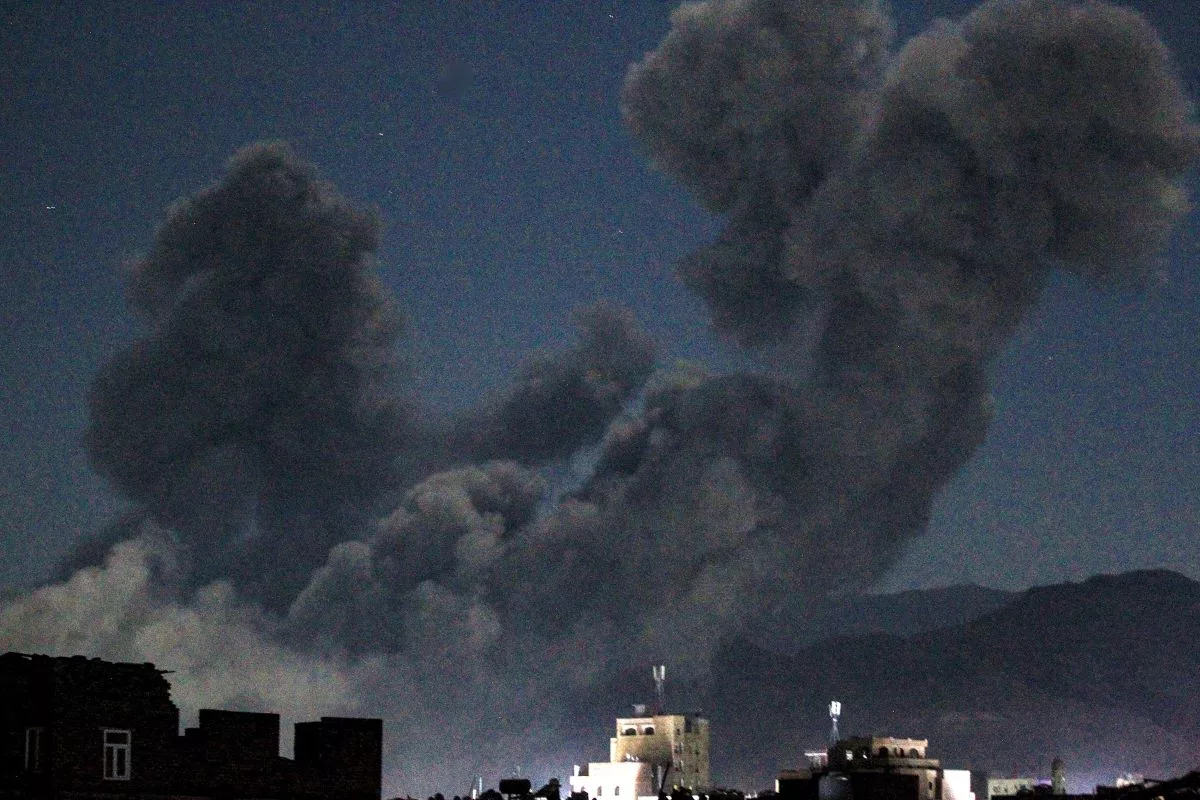
Bloomberg reports that multiple small vessels have attacked a ship near Yemen's Al Hudaydah port in the Red Sea, setting it ablaze and forcing the crew to abandon the vessel—ahead of Israel's military conducting airstrikes on Houthi-controlled ports in Yemen. The vessels fired on the ship and launched self-propelled grenades, according to a company security officer cited as a source, who did not identify the vessel. UK Maritime Trade Operations (UKMTO) said in a series of social media posts on 6 July that a commercial vessel passed by and rescued all crew members, with the ship left abandoned. UKMTO previously stated that an armed security team returned fire during the attack, approximately 51 nautical miles southwest of Al Hudaydah—a stronghold of the Iran-backed Houthi militia, which has been targeting ships in the strategic waterway for more than a year. No group claimed responsibility for the attack. In the later hours of 6 July, the Israel Defense Forces (IDF) conducted airstrikes on Al Hudaydah, Ras Issa, and Al-Salif ports, as well as a power plant in Al Hudaydah, over the Red Sea.
From a supply chain perspective, the Red Sea and Suez Canal represent one of the world's most critical maritime chokepoints—12-15 percent of global container trade, 10 percent of global oil trade, and 8 percent of global LNG trade pass through this route. The Bab-el-Mandeb strait is a 30 km narrow passage between Yemen and Djibouti/Eritrea—the Suez Canal is operated by Egypt—with Suez Canal Authority (SCA) headed by Osama Rabie. The Houthis (Ansar Allah), originating from Sanaa, Yemen, with Mahdi al-Mashat as Supreme Political Council leader, are an Iran-backed Shiite militant group that has attacked Israel-linked vessels in the Red Sea in solidarity with Palestine following Hamas's October 2023 attack. U.K. Maritime Trade Operations (UKMTO) is a subsidiary of the U.K. Royal Navy based in Dubai that issues risk warnings for commercial shipping. Operation Prosperity Guardian, led by the U.S., involving the U.S. CENTCOM, U.K. Royal Navy, French Navy, and the EU's Operation Aspides, serve as the principal protection operations. Combined Maritime Forces (CMF, based in Bahrain) and Combined Task Force 153 (CTF-153) are the main coalition structures.
From a supply chain perspective, changes in global trade routing following the Red Sea crisis include: (1) the Asia-Europe route via the Cape of Good Hope (South Africa) creating an additional 8,000-9,000 nautical miles and 10-14 days of transit time; (2) a 50 percent-plus decline in Suez Canal traffic; (3) losses exceeding 8 billion dollars in Suez Canal revenues for Egypt; (4) increases of 200-300 percent in Asia-Europe freight rates; (5) surges in the SCFI, Drewry WCI, and Xeneta XSI indices; (6) a rise in marine insurance war risk premiums (P&I) to 0.7 percent from the previous 0.05 percent; (7) an additional 14-21 days of lead time in supply chains to Europe. MSC, Maersk, CMA CGM, Hapag-Lloyd, and ZIM Integrated Shipping are the major carriers favoring the Cape route. COSCO and OOCL, along with some Chinese carriers, face fewer disruptions and enjoy a neutrality advantage. Houthi attacks employ: (1) ballistic missiles; (2) cruise missiles; (3) one-way attack drones; (4) attack boats; (5) unmanned underwater vehicles (UUV); (6) naval mines. Notable vessels impacted include Galaxy Leader (November 2023), True Confidence (March 2024), Tutor (June 2024), MV Sounion (August 2024), Magic Seas (July 2025), and Eternity C (July 2025).
From a supply chain perspective, the maritime security impacts of the conflict in Yemen are testing the structural resilience of the global supply chain. The Israel-Hamas war, which began in October 2023, has escalated into a broader regional conflict involving Hezbollah, Houthis, Iran, Syria, and Iraq. The U.S. Trump 2.0 administration has adopted a hardened approach toward the Houthis, launching an intensive air campaign from March 2025 onward. A Trump-Houthi ceasefire (May 2025) proved short-lived, with attacks continuing. Lloyd's of London and the Lloyd's Joint War Committee (JWC) are the primary war risk insurers. Organizations such as BIMCO (Baltic and International Maritime Council), ICS (International Chamber of Shipping), INTERTANKO, and INTERCARGO represent the main maritime industry bodies, calling for diplomatic solutions to ensure crew safety and freedom of navigation. In conclusion, the attacks on Magic Seas and Eternity C stand as concrete evidence that the Red Sea crisis is creating long-term structural changes in global supply chains.
Key Points:
1. UKMTO reports an attack on a vessel near Al Hudaydah, Yemen, on 6 July.
2. All crew members are rescued by a passing commercial vessel—the ship is abandoned.
3. The IDF conducts strikes on Al Hudaydah, Ras Issa, Al-Salif ports, and a power plant the same day.
4. The Houthi militia has been attacking vessels in the Red Sea since October 2023.
5. Operation Prosperity Guardian and EU Aspides are the principal protection operations.

