

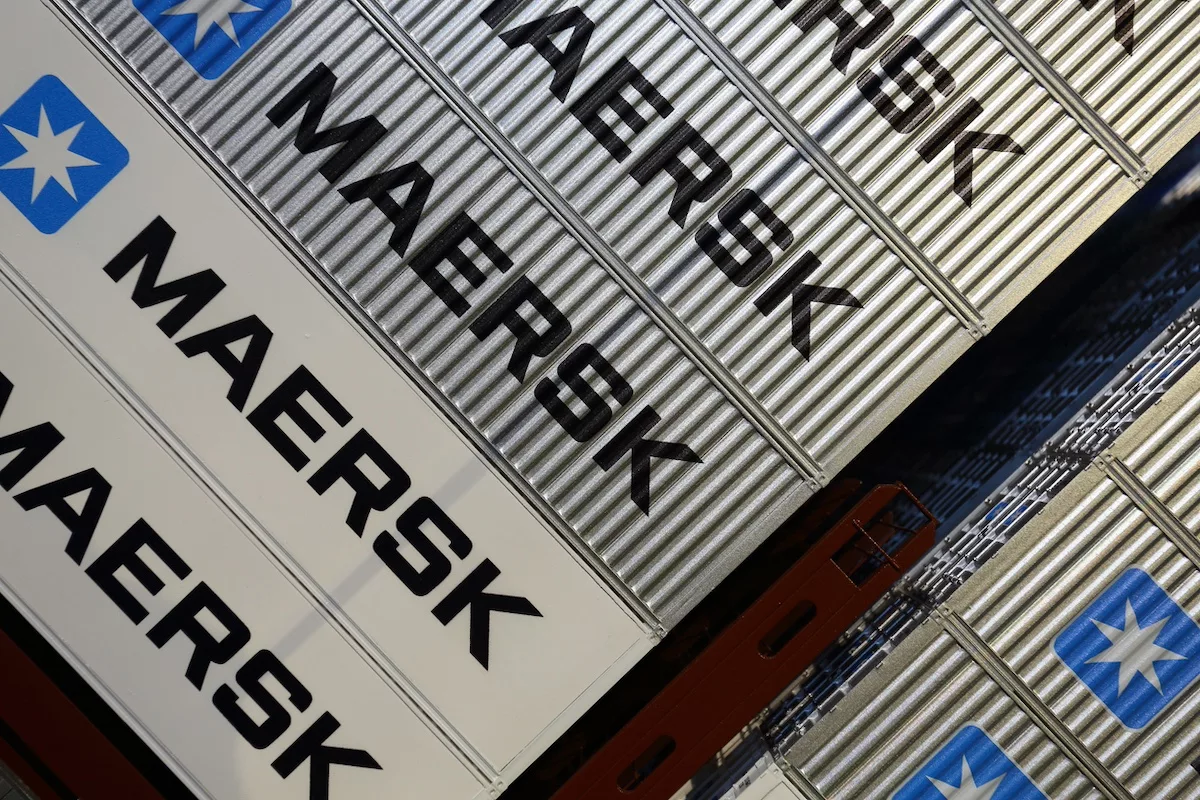
A.P. Moller-Maersk A/S shares are declining as investors digest a more modest-than-expected improvement in the container shipping giant's full-year profit guidance. Maersk's earnings before interest, taxes, depreciation and amortization (EBITDA) are expected to fall in the range of $9 billion to $9.5 billion for 2025—compared with the prior guidance putting the low end at $8 billion—according to the Copenhagen-based company's announcement on November 5. Analysts surveyed had forecast an average of $9.11 billion. Maersk also raised its guidance for the global container market, now expecting roughly 4% growth this year versus its prior forecast of 2%–4%. Third-quarter earnings surpassed expectations. Still, the stock fell as much as 7.5% in Copenhagen—its largest decline since April. From a supply chain perspective, A.P. Moller-Maersk A/S, based in Copenhagen, Denmark and founded in 1904 by Arnold Peter Møller, is the world's second-largest container shipping company.
"The third quarter is somewhat of a bubble. Yes, it's a good report, but everything points to very tough earnings conditions ahead," Mikkel Emil Jensen, senior analyst at Sydbank A/S, said by phone. "Investors aren't really finding any solace in that." From a supply chain perspective, Maersk CEO Vincent Clerc has led the group since 2023. Maersk Ocean, Maersk Logistics & Services, APM Terminals, and Maersk Towage & Maritime Services form the main business segments. Maersk operates a fleet of approximately 700+ container vessels with capacity of 4.5+ million TEU (Twenty-foot Equivalent Unit) globally. MSC Mediterranean Shipping Company remains the global leader with 6+ million TEU. CMA CGM (France), COSCO Shipping Lines (China), Hapag-Lloyd (Germany), ONE (Ocean Network Express; Japan; NYK+MOL+K-Line merger), Evergreen Marine (Taiwan), HMM (South Korea), Yang Ming (Taiwan), ZIM Integrated Shipping Services (Israel), and Wan Hai Lines (Taiwan) round out the global Top 10 container carriers.
From a supply chain perspective, global container shipping alliances are being restructured as of February 2025. Gemini Cooperation (Maersk+Hapag-Lloyd), Premier Alliance (HMM+ONE+Yang Ming), Ocean Alliance (CMA CGM+COSCO+Evergreen+OOCL), and MSC (operating independently and through bilateral partnerships) form the primary alliances for 2025 and beyond. The previous 2M Alliance (Maersk+MSC) ended in January 2025. THE Alliance (Hapag+HMM+ONE+Yang Ming) is also being restructured. The Red Sea crisis, triggered by Houthi attacks, reduced Suez Canal traffic by over 60% in 2024—the Cape of Good Hope route adds 10-14 extra days and 30% in fuel costs. Maersk is targeting a full return to the Red Sea by 2026, though early signs are improving. The Panama Canal, constrained by drought in 2024, is expected to normalize in 2025.
From a supply chain perspective, container shipping economics are tracked through key indices including the SCFI (Shanghai Containerized Freight Index), WCI (Drewry World Container Index), FBX (Freightos Baltic Index), HARPEX, and HRCI. Spot rates, contract rates, fuel surcharge (BAF, Bunker Adjustment Factor), congestion surcharges, peak season surcharges, and GRI (General Rate Increase) form the main pricing components. Asia-Europe, Trans-Pacific, Trans-Atlantic, and Intra-Asia are the primary trade routes. Orderbook, delivery schedule, scrapping, and idle fleet are key metrics for ship supply-demand balance. Global container ship orders are reaching historic highs in 2025—deliveries in 2026-2028 risk creating overcapacity. Trump 2.0 tariffs, particularly on U.S.-China volumes, are driving front-loading, nearshoring, and route diversion as main responses. Ultimately, Maersk's slumping stock price despite raised guidance underscores the container industry's structural supply-demand uncertainty.
Key Points:
1. Maersk raised its 2025 EBITDA guidance to 9-9.5B dollars on November 5.
2. Stock fell 7.5%—the steepest daily decline since April.
3. Container market growth forecast revised upward from 2%-4% to 4%.
4. Mikkel Emil Jensen at Sydbank describes the Q3 report as a "bubble quarter."
5. Investors remain concerned about tough earnings conditions ahead.

