

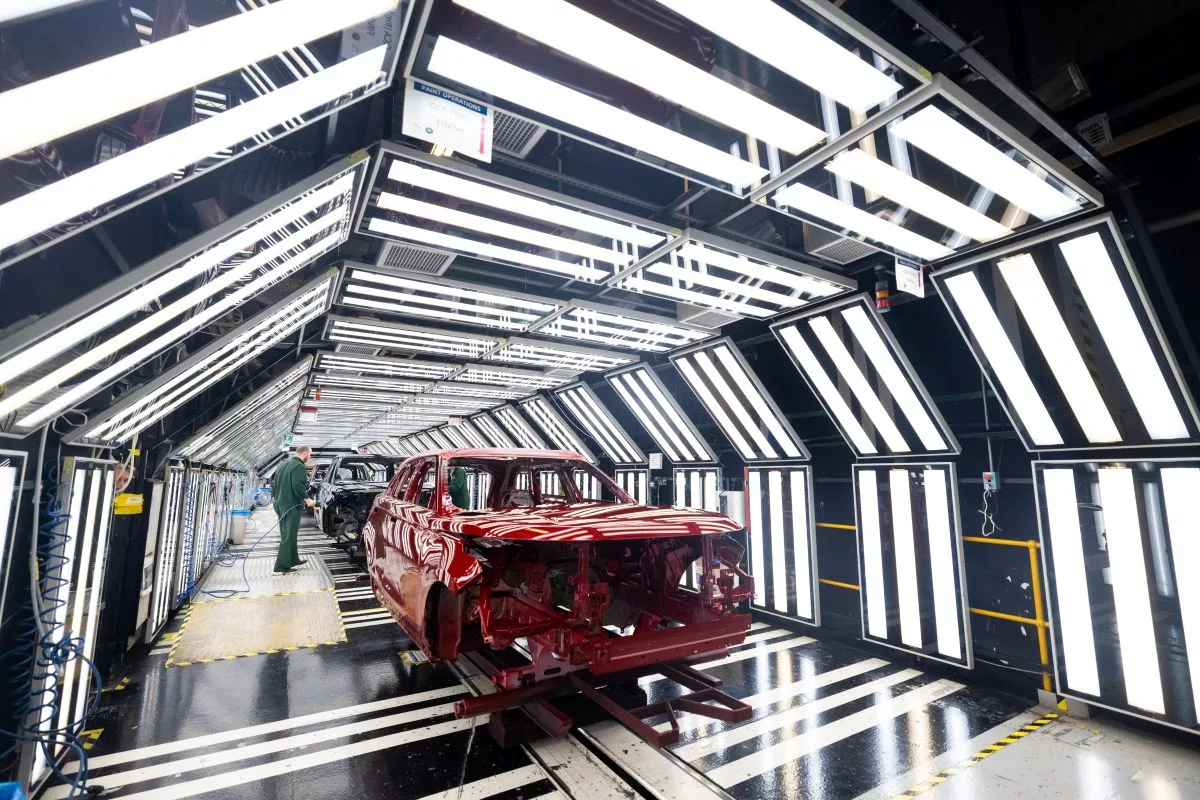
Jaguar Land Rover Automotive Plc has been paralyzed by a cyberattack, causing British automobile production to plummet 27% in September—adding further pressure on the country's troubled automotive sector. According to data released by the Society of Motor Manufacturers & Traders (SMMT) on October 24, automobile production fell to 51,090 units in September. The total decline including commercial vehicles was even more dramatic at 36%—following Stellantis NV's earlier closure of its Vauxhall van plant in Luton this year. From a supply chain perspective, Jaguar Land Rover, headquartered in Coventry, U.K., is owned by Tata Motors (India), which acquired it from Ford Motor Company for $2.3 billion in 2008. Solihull, Halewood, and Castle Bromwich (being closed) are the primary U.K. manufacturing facilities. Range Rover, Range Rover Sport, Range Rover Velar, Range Rover Evoque, Discovery, Discovery Sport, Defender, Jaguar F-Pace, Jaguar XF, and Jaguar I-Pace (EV) comprise the main product line. Adrian Mardell is CEO of JLR. The photograph was taken by Chris Ratcliffe of Bloomberg at the JLR facility in Solihull, U.K.
From a supply chain perspective, the JLR cyberattack began in September 2025—as a result of the attack, JLR's global manufacturing systems (MES, ERP, supplier portals, parts ordering) went offline. Scattered Spider (UNC3944, Octo Tempest), BlackCat/ALPHV, LockBit, Cl0p, and RansomHub are among the leading modern ransomware groups. The group behind the attack on JLR was initially unclear—but investigations point to Scattered Spider. JLR's primary U.K. suppliers, including Evtec Aluminium, UK Speedy Welding, Nifco UK, Stadco, GKN Automotive, Penso, Magnesium Elektron, Bromford Iron & Steel, Sertec, BBS, and Llanwern, have been impacted. The U.K. government has provided JLR with £1.5 billion in credit guarantees to enable suppliers to receive payment. Tata Motors is providing additional financing from Mumbai to inject cash into JLR. JLR production came to a complete halt throughout September-October 2025, with a gradual resumption beginning in November.
From a supply chain perspective, the U.K. automotive sector is in a declining trend with global annual production of 800,000 units—down more than 50% from the 2016 peak of 1.7 million units. Brexit, uncertainty around EV transition investments, and tariff/local content rules are the primary structural challenges. Nissan Sunderland, Toyota Burnaston, BMW Mini Oxford, Ford Bridgend (closing), Honda Swindon (closed 2021), Stellantis Vauxhall Luton (closing 2025), Stellantis Vauxhall Ellesmere Port, Bentley Crewe, Rolls-Royce Goodwood, Aston Martin Gaydon, McLaren Woking, Lotus Hethel (Geely), Morgan Malvern, and Caterham are the major automotive facilities in the U.K. The U.K. ZEV mandate requires 22% of vehicles sold in 2025 to be EV—80% by 2030 and 100% by 2035. Mike Hawes, CEO of SMMT, regularly comments on the weak production figures.
From a supply chain perspective, automotive cyberattack threats are growing structurally. NotPetya 2017 (Maersk, Merck, FedEx; total damage over $10 billion), SolarWinds 2020 (Orion), Colonial Pipeline 2021 (DarkSide), JBS Foods 2021 (REvil), MGM Resorts 2023 (Scattered Spider), Caesars 2023 (Scattered Spider), Change Healthcare 2024 (BlackCat, UnitedHealth), CDK Global 2024 (affecting 15,000+ car dealerships), and JLR 2025 represent some of the largest industrial and supply chain cyberattacks in history. OT (Operational Technology), ICS (Industrial Control System), SCADA, and PLC are core components of manufacturing systems—traditional IT security tools are insufficient. Claroty, Dragos, Nozomi Networks, SCADAfence (Honeywell), and Armis are leading OT/ICS security firms. NIS2 (Network and Information Security Directive 2, EU), CRA (Cyber Resilience Act, EU), UK NCSC (National Cyber Security Centre), NIST CSF (U.S.), ISO 27001, and IEC 62443 are key cybersecurity standards. In conclusion, JLR's 27% production collapse is a clear indicator of the automotive supply chain's structural vulnerability to cyberattacks.
Key Points:
1. JLR cyberattack caused a 27% drop in U.K. September automobile production.
2. Total (including commercial vehicles) declined 36%—compounded by Stellantis Luton closure.
3. SMMT data reported September at 51,090 units.
4. The British automotive sector faces multiple structural pressures.
5. The U.K. government provided JLR suppliers with £1.5 billion in credit guarantees.

