

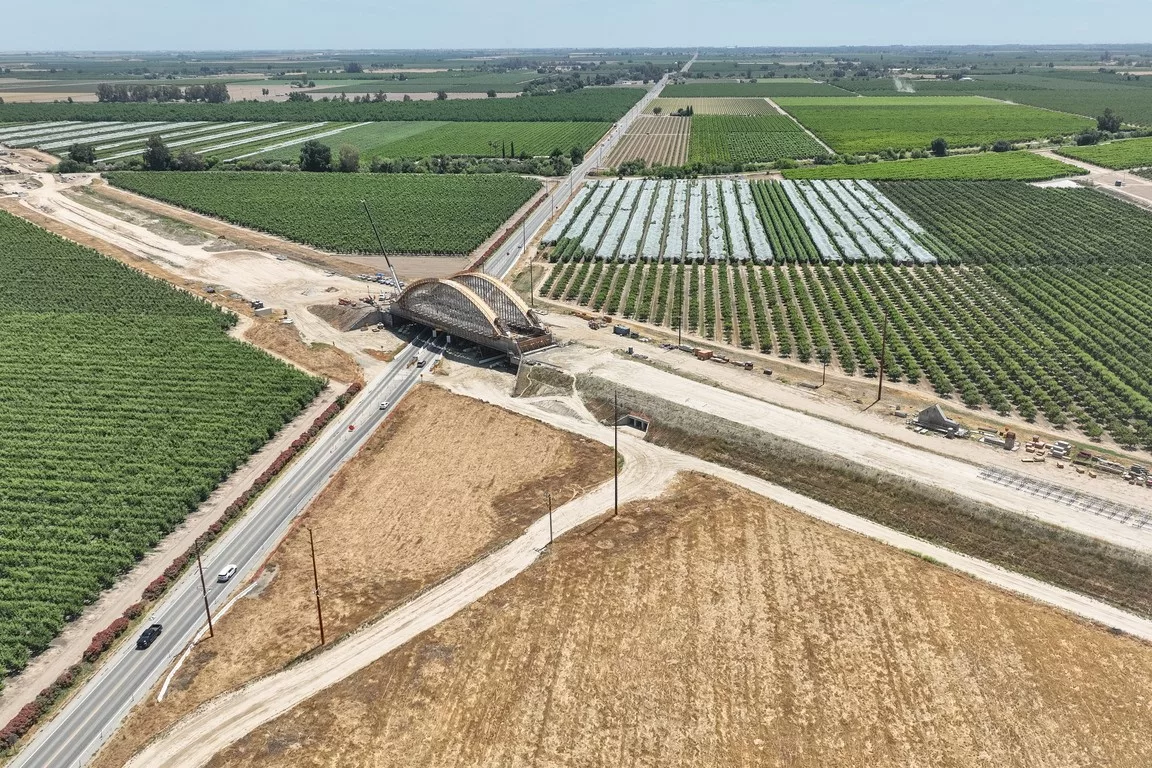
SupplyChainBrain reports that California's troubled high-speed rail project—referred to by critics as a "train to nowhere"—stands to lose $4 billion in unspent federal funding from the Federal Railroad Administration (FRA). Transportation Secretary Sean Duffy announced the decision on July 17. "After 16 years of failure and not a single completed high-speed track, you have no confidence in CHSRA's ability to complete this project," Duffy stated. "This is California's fault. Governor Newsom and his Democratic allies have enabled this waste for years. Federal dollars are not a blank check—they come with a promise to deliver results," Duffy said in a statement. The federal decision is based on the California High-Speed Rail Authority's (CHSRA) failure to address serious project deficiencies. It represents a concrete example of the Trump 2.0 administration's approach to applying stricter performance standards to infrastructure projects.
From a supply chain perspective, the California High-Speed Rail Project ranks among the most ambitious infrastructure initiatives in the U.S.—originally designed to connect San Francisco to Los Angeles, a distance of more than 800 kilometers, in 2 hours and 40 minutes at speeds of 220 mph (350 km/h). Approved by California voters in 2008 through Proposition 1A with an initial bond authorization of $9.95 billion, the initial cost estimate was $33 billion. By 2024, that estimate has ballooned to $128 billion—representing a cost overrun exceeding 300 percent. The Initial Operating Segment (IOS) is a 275-kilometer segment running through the San Joaquin Valley from Merced to Bakersfield, planned to open in the early 2030s. The California High-Speed Rail Authority (CHSRA) is a state agency based in Sacramento, California, with Ian Choudri as CEO and Tom Richards as Board Chair. The Federal Railroad Administration (FRA), a federal agency under the U.S. Department of Transportation (DOT), is led by Drew Feeley as Acting Administrator.
From a supply chain perspective, the global high-speed rail ecosystem includes China (45,000+ kilometers, the world's largest; CRRC Corporation), Japan (Shinkansen; JR East, JR Central, JR West), France (TGV; SNCF; Alstom), Germany (ICE; Deutsche Bahn; Siemens Mobility), Spain (AVE; Renfe; Talgo), Italy (Frecciarossa; Trenitalia), South Korea (KTX; Korail), Taiwan (THSR), Türkiye (YHT; TCDD), and the United Kingdom (HS1; HS2, which faces difficulties) among its major operators. The U.S. lacks true high-speed rail—Acela (Amtrak; Northeast Corridor between Boston and Washington DC) is the fastest train but operates at average speeds around 110 km/h. Brightline (Florida; Miami-Orlando) and Brightline West (Las Vegas-Los Angeles; planned) are private-sector initiatives. Texas Central Railway (Dallas-Houston; using JR Central Shinkansen technology) remains mired in uncertainty. Major global railway manufacturers include Alstom (Saint-Ouen-sur-Seine, France), Siemens Mobility (Berlin, Germany), CRRC Corporation (Beijing, China), Hitachi Rail (Genoa, Italy), Hyundai Rotem (Changwon, Korea), Stadler Rail (Bussnang, Switzerland), Talgo (Madrid, Spain), and Wabtec Corporation (Pittsburgh, PA).
From a supply chain perspective, U.S. rail infrastructure is dominated by Class I carriers including BNSF Railway (owned by Berkshire Hathaway; Fort Worth, Texas), Union Pacific Railroad (Omaha, Nebraska), CSX Transportation (Jacksonville, Florida), Norfolk Southern Railway (Atlanta, Georgia), Canadian National Railway (CN; Montreal, Canada), and Canadian Pacific Kansas City (CPKC; Calgary, Canada)—though most focus primarily on freight. Amtrak (Washington DC; Roger Harris, President) remains the nation's only national passenger rail operator. The cancellation of high-speed rail project funding reflects common challenges facing major infrastructure projects globally: (1) cost overruns, (2) schedule delays, (3) supply chain inadequacies, (4) regulatory complexity, (5) environmental review (NEPA; National Environmental Policy Act), (6) land acquisition (eminent domain), and (7) community opposition. Railroad infrastructure investment in the U.S. received $102 billion from the Bipartisan Infrastructure Law (BIL; IIJA; 2021). The Trump 2.0 administration is reviewing implementation of this funding and taking a stricter approach to underperforming projects. Consequently, the FRA's cancellation of $4 billion in CHSRA financing signals a structural shift in U.S. infrastructure policy—one signaling heightened expectations for performance standards and accountability at the national level.
Key Points:
1. Sean Duffy, Transportation Secretary, cancels $4 billion in federal funding on July 17.
2. The FRA (Federal Railroad Administration) withdraws financing due to CHSRA performance deficiencies.
3. California High-Speed Rail has produced no completed high-speed track in 16 years.
4. Initial cost estimates have risen from $33 billion to $128 billion.
5. Governor Newsom and Democrats are criticized by the Trump administration.

