

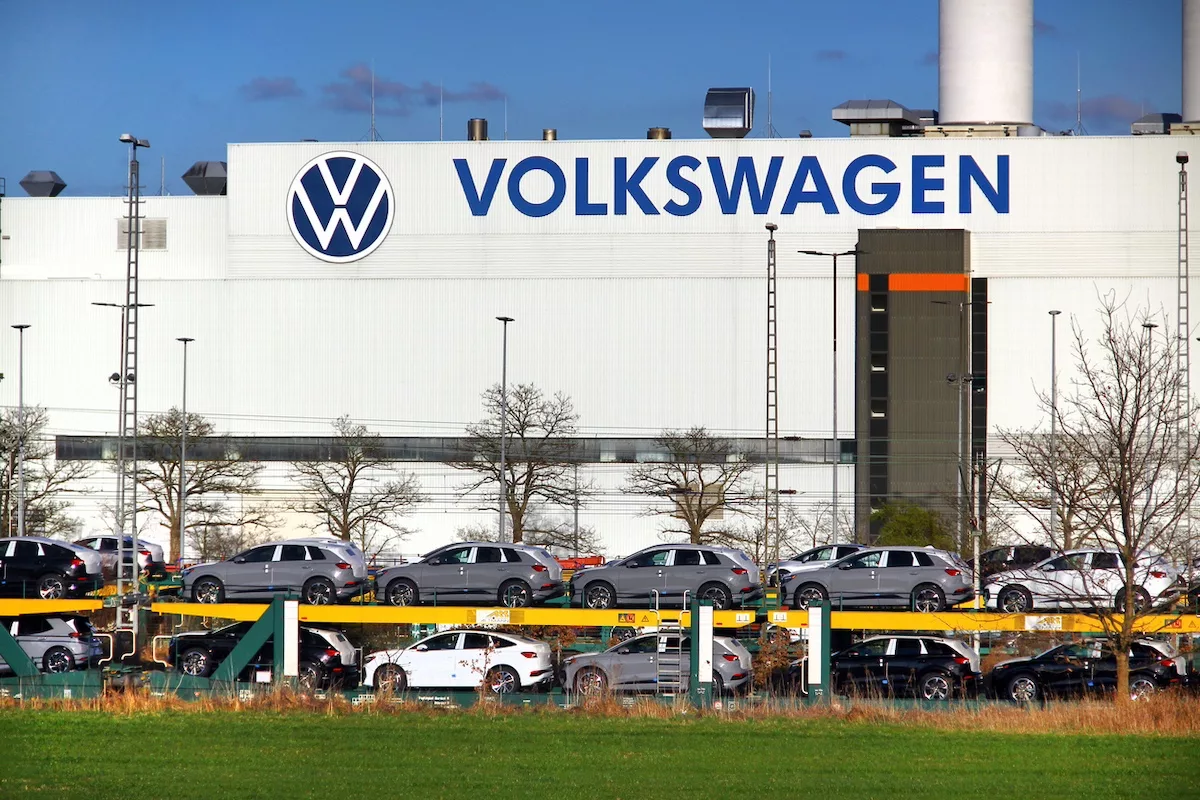
Volkswagen reported a third-quarter operating loss of $1.5 billion — a result driven by ongoing financial pressure from Trump administration tariffs and a costly retreat from electric vehicles at its Porsche brand. Volkswagen expects tariffs to cost the company more than $5.7 billion by year-end and anticipates an additional $5.4 billion hit from its decision to reverse the all-electric strategy at Porsche. In a statement on October 30, Arno Antlitz, chief financial officer of the automotive manufacturer, addressed these results. This marks Volkswagen's first quarterly loss in five years. From a supply chain perspective, Volkswagen Group (Volkswagen AG), headquartered in Wolfsburg, Germany and founded in 1937, is the world's second-largest automotive manufacturer, after Toyota. Core brands include Volkswagen, Audi, Porsche, Lamborghini, Bentley, Bugatti (via Mate Rimac joint venture), SEAT, CUPRA, Škoda, Scania, MAN, and Ducati, along with VW Commercial Vehicles. The photograph, credited to iStock aquatarkus, was taken at the Volkswagen facility in Mosel, Germany. Mosel is located in Saxony near Zwickau, home to VW's electric vehicle production plant for the ID. Series (ID.3, ID.4, ID.5).
From a supply chain perspective, Porsche AG (Porsche Automobil Holding SE as majority shareholder) has major product lines including the Cayenne, Macan, Panamera, Taycan, and Boxster/Cayman alongside its iconic 911. Porsche had aggressively targeted having 80% of new vehicle sales electric by 2030, but is reversing this goal in 2024–2025. The Macan EV reached production in 2024, though a fully electric 911 version is being shelved. Launches of the Cayenne EV and Panamera EV are being delayed as the company continues with internal combustion and hybrid variants. Oliver Blume serves as CEO of both Porsche and the Volkswagen Group. Audi is planning to close its Brussels facility due to the end of production for the e-tron GT and Q8 e-tron. VW plans to wind down ID.3 production early at its Wolfsburg plant. Cariad, a VW Group subsidiary handling software and EV electronic architecture, has experienced delays and leadership changes. A $5.8 billion joint venture with Rivian was established to address VW's software and EE architecture challenges.
From a supply chain perspective, the impact of Trump 2.0 tariffs on global automotive is significant. Section 232 auto tariffs apply a 25% rate to all vehicles imported into the U.S., including parts not in compliance with USMCA. The EU expects to negotiate a 15% reciprocal tariff rate with Trump 2.0, though for autos this represents a net increase. Volkswagen, Audi, Porsche, BMW, and Mercedes-Benz are major exporters to the U.S. market and operate local production facilities (VW Chattanooga, TN; BMW Spartanburg, SC; Mercedes Tuscaloosa, AL). Audi, as the VW Group brand without local U.S. production, faces the greatest tariff impact. Volkswagen is reviving the Scout Motors brand and building a new EV SUV and pickup facility in South Carolina with annual capacity for 200,000 vehicles, backed by a $2 billion investment.
From a supply chain perspective, slowing global EV demand is forcing multiple automakers to revise their strategies. Ford is reducing F-150 Lightning production and discounting the Mustang Mach-E. General Motors (GM) is accelerating its Ultium platform with core EV lines including the Chevrolet Equinox EV, Blazer EV, Cadillac Lyriq, and GMC Hummer EV, though lowering annual production targets. Stellantis is similarly revising its EV strategy following Carlos Tavares's departure as CEO at year-end 2024. Hyundai, Kia, and Genesis are maintaining relatively stronger EV momentum. Toyota is relatively sheltered from EV slowdown thanks to its aggressive hybrid strategy. Chinese EV manufacturers including BYD, SAIC, Geely, Chery, and Great Wall Motors are expanding exports globally, particularly into the European market. EU CBAM and potential tariffs on Chinese EVs aim to protect European manufacturers. Ultimately, Volkswagen's first quarterly loss in five years signals that traditional automakers are undergoing serious structural transformation under the dual pressure of tariffs and the EV transition.
Key Points:
1. Volkswagen reported a Q3 operating loss of $1.5 billion.
2. Estimated tariff costs by year-end exceed $5.7 billion.
3. Porsche's all-electric strategy reversal carries an additional $5.4 billion hit.
4. CFO Arno Antlitz announced the results on October 30.
5. This marks VW's first quarterly loss in five years.

