

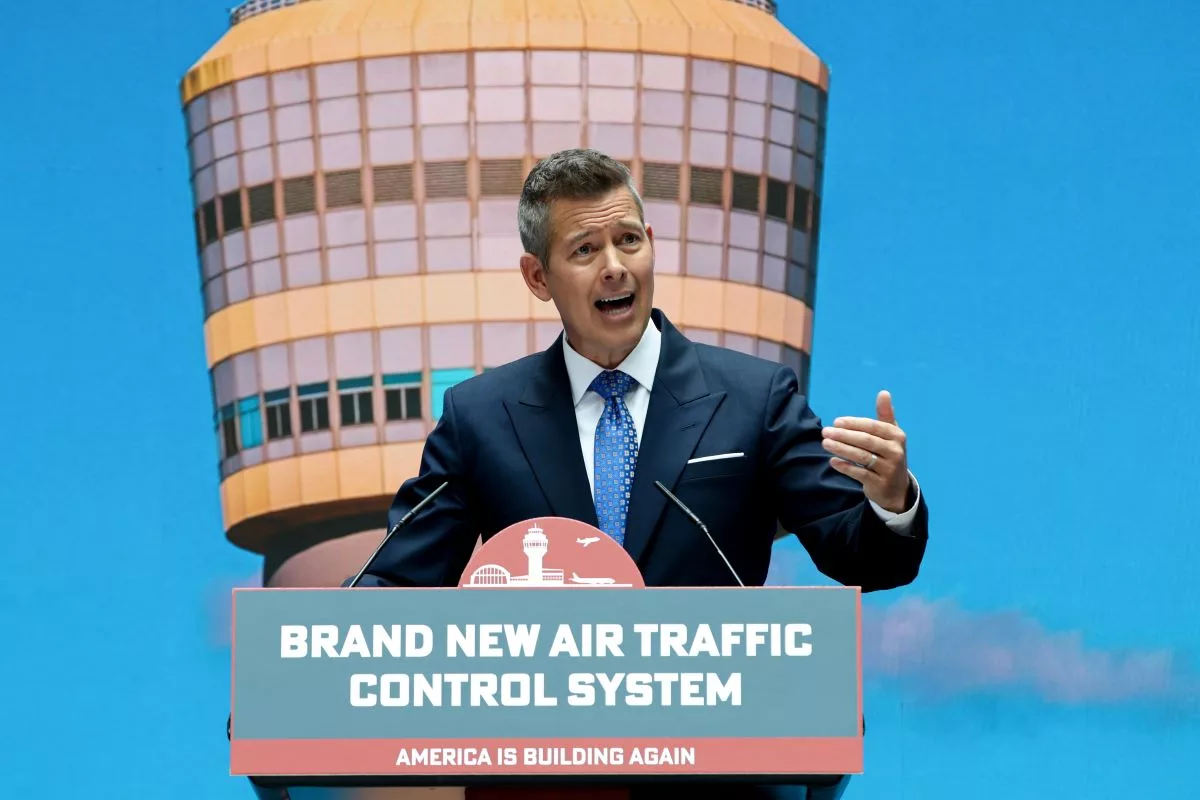
SupplyChainBrain reports that U.S. Transportation Secretary Sean Duffy has unveiled a comprehensive proposal to overhaul the aging system managing the nation's approximately 45,000 daily flights, calling for the construction of six new air traffic control centers and the replacement of more than 600 radars. More than a dozen airport towers will be renovated—the agency's telecommunications network will be upgraded with new fiber, wireless, and satellite connections. The plan was unveiled at a press conference at the Transportation Department headquarters in Washington on May 8. President Donald Trump joined via phone to discuss aspects of the plan—including his desire to have the effort carried out through a single contract. "I want to give one big beautiful contract responsible for everything," Trump said while Duffy held a telephone to the podium microphone. The proposal marks an alarming sign of strain and represents the broadest initiative in years to modernize the nation's air traffic control system. Controllers last week lost radio and radar at a Philadelphia facility directing aircraft to Newark Liberty International Airport in New Jersey. The outage left them unable to see or communicate with aircraft transiting busy airspace for approximately 90 seconds—according to Bloomberg News. Duffy was joined on stage by CEOs of Delta Air Lines Inc., United Airlines, American Airlines, Southwest Airlines, and JetBlue.
From a supply chain perspective, Sean Duffy, U.S. Department of Transportation (USDOT) Secretary, is a former Wisconsin Republican congressman and former Fox News anchor appointed by the Trump administration in January 2025. The Federal Aviation Administration (FAA), a subordinate agency of USDOT, has Bryan Bedford nominated as Administrator (former Republic Airways CEO) with Chris Rocheleau serving as Acting Administrator. The FAA's primary systems include NextGen (Next Generation Air Traffic Control), NOTAM (Notice to Airmen), STARS (Standard Terminal Automation Replacement System), and ERAM (En Route Automation Modernization). Major U.S. carriers include Delta Air Lines (Ed Bastian CEO; Atlanta), United Airlines Holdings (Scott Kirby CEO; Chicago), American Airlines Group (Robert Isom CEO; Fort Worth), Southwest Airlines (Bob Jordan CEO; Dallas), JetBlue Airways (Joanna Geraghty CEO; New York), Alaska Airlines, Spirit Airlines, Frontier Airlines, and Hawaiian Airlines.
From a supply chain perspective, major U.S. cargo carriers include FedEx Express (Memphis), UPS Airlines (Louisville), Atlas Air (owned by Apollo), Amazon Air (Hebron, Kentucky), Kalitta Air, Western Global Airlines, and Ameriflight. Newark Liberty International Airport (EWR) is operated by the Port Authority of New York and New Jersey (PANYNJ; Rick Cotton Executive Director)—a major hub for United Airlines—handling approximately 49 million passengers annually. The Philadelphia TRACON (Terminal Radar Approach Control) is operated by the FAA and serves multiple airports in the New York region, including EWR. Air traffic controller shortages have been a longstanding issue—the FAA operates with approximately 3,000 vacant positions out of a 14,000-person certified controller workforce. The National Air Traffic Controllers Association (NATCA; Nick Daniels President) is the primary union and has called for accelerated training and extended retirement ages.
From a supply chain perspective, major air traffic control modernization technologies include (1) ADS-B (Automatic Dependent Surveillance-Broadcast), (2) Data Comm, (3) SWIM (System Wide Information Management), (4) NAS Voice System, (5) TFM (Traffic Flow Management), (6) PBN (Performance-Based Navigation), (7) Time-Based Flow Management, and (8) satellite-based surveillance. Major air traffic technology providers include Raytheon (owned by RTX), Lockheed Martin, Leidos, Saab Sensis, Indra Sistemas, Thales Group, L3Harris Technologies, Frequentis, Honeywell Aerospace, and Collins Aerospace. Key industry organizations include the Air Line Pilots Association (ALPA; Jason Ambrosi President), Airlines for America (A4A; Nick Calio CEO), and the Aerospace Industries Association (AIA). In essence, Duffy's proposal for six new centers appears to reflect a fundamental reassessment of U.S. air traffic control infrastructure modernization and resilience requirements globally—on-time delivery and flight safety appear to be paramount strategic priorities for airline cargo operations and supply chain managers.
Key Takeaways:
1. Sean Duffy (USDOT) proposes 6 new ATC centers and 600+ radar replacement.
2. Trump wants "one big beautiful contract"—a single-contractor model.
3. Newark/Philadelphia TRACON experienced 90-second radar/radio loss.
4. Delta, United, American, Southwest, and JetBlue CEOs on stage offering support.
5. FAA operating with ~3,000 controller vacancies while managing 45,000 daily flights.

