

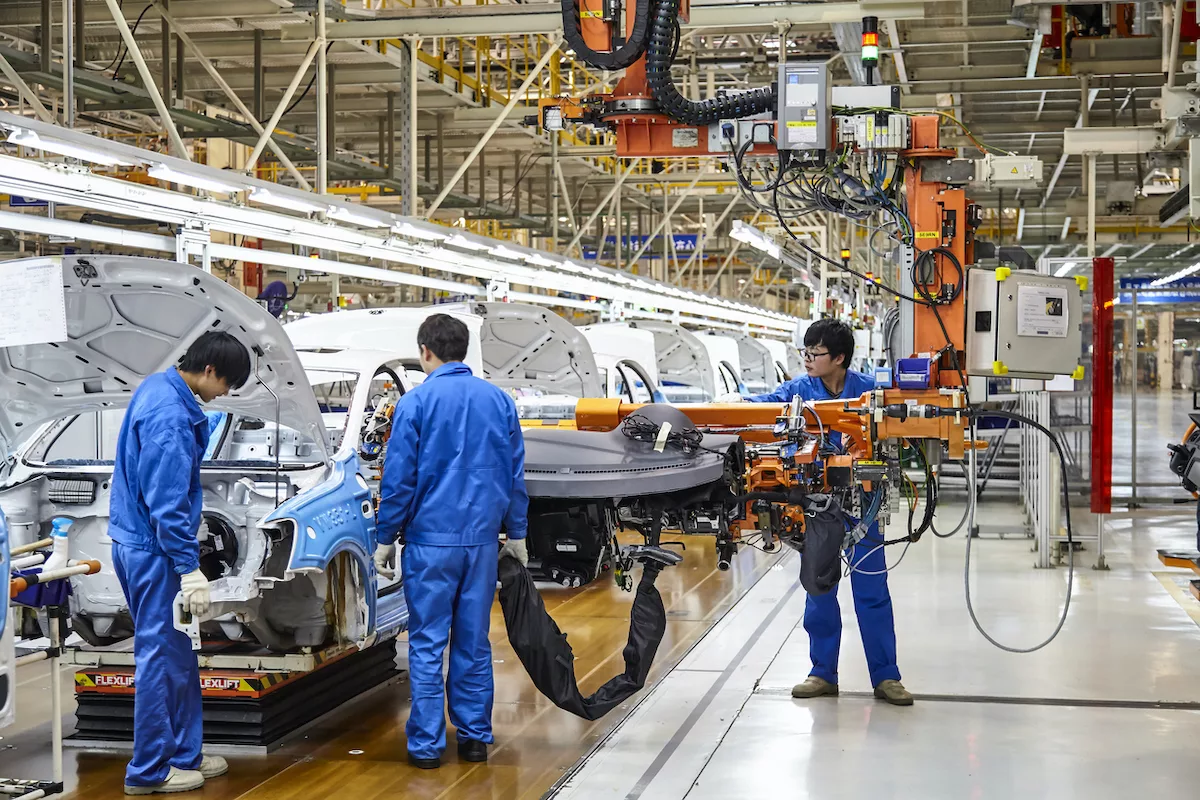
The conventional wisdom of recent years holds that China is losing its dominance as a manufacturing power. Rising wages for Chinese workers, volatile U.S. tariffs, geopolitical tensions, and shipping costs to distant markets are cited as reasons manufacturing is returning to the Western Hemisphere. But what if there is something inherent in the nature of Chinese manufacturing that continues to disadvantage the American model? That's what Allan Evans believes. Evans is CEO of Unusual Machines, a U.S.-based manufacturer producing drone components for military and commercial use. From a supply chain perspective, the UAS (Unmanned Aircraft System) component market comprises categories including flight controller, ESC (Electronic Speed Controller), motor, propeller, battery, camera, and radio link, and DJI's roughly 70% share of the global market remains a strategic concern under Section 1260H and NDAA restrictions.
Evans spent a decade in China launching production lines for virtual reality headsets, manufacturing tens of thousands of units annually. He witnessed firsthand how Chinese factories manage suppliers, components, finished products, and workers in the field. And he says today's reality of that world differs from the perception many Westerners hold. In the early years of China's manufacturing boom, factories were largely staffed by workers migrating thousands of miles from rural communities to major production hubs like Shenzhen. They lived in dormitory-like conditions, returning to their villages and families only during Chinese New Year—what has been described as the world's largest human migration. From a supply chain perspective, the Pearl River Delta, Yangtze River Delta, Bohai Economic Rim, and Chengdu-Chongqing clusters have been the primary geographies of EMS (Electronics Manufacturing Service) and ODM (Original Design Manufacturer) concentration.
Evans says this is no longer the complete picture. China's urban centers now host many factory workers and a growing middle class. A younger demographic benefits from the advantages of the internet economy and digital convenience. Evans uses the phrase, "China, in the last 30 years, has done the greatest job in the history of the world in destroying poverty." Today's Chinese factory worker possesses a work ethic that is not easily replicated in the West. As in much of Asia, there is a strong hierarchical culture and willingness to comply with management directives. Evans states, "China builds systems to scale, not people," and adds, "Manufacturers invest heavily in tooling and process engineering so production continues even in disruptions." From a supply chain perspective, jig and fixture design and SMED (Single Minute Exchange of Die) implementation are evidence that Toyota Production System (TPS) principles are being applied at scale in Chinese factories to reduce changeover time.
By contrast, the American manufacturing environment is "contractual instead of cultural," populated by "rockstar" engineers far less interchangeable than the typical Chinese worker. China also benefits from a certain "density" in supplier relationships, while U.S. counterparts require stronger supplier planning and deeper inventory strategies. Even when a U.S. manufacturer relocates a facility westward, it must continue to depend on distant offshore sub-suppliers for critical raw materials, components, and assemblies. Yet Unusual Machines, with its facility in Orlando, Florida, is able to compete at scale with Chinese manufacturers. Some of this is attributable to nascent reindustrialization efforts like the CHIPS and Science Act passed by the Biden Administration, cutting-edge automation, and the growing impact of artificial intelligence. From a supply chain perspective, reshoring decisions require landed cost calculations that include Section 301 tariffs, ocean freight, USMCA rules of origin compliance, and working capital costs in addition to FOB China pricing. Ultimately, Evans's experience clearly demonstrates that the U.S.-China manufacturing equation encompasses not just tariffs or wages, but also structural cultural differences.
Key Takeaways:
1. Evans notes that China still holds structural advantages.
2. The phrase "China builds systems to scale, not people" stands out.
3. The U.S. operates on a "contractual" workforce model; China operates on a "cultural" one.
4. Supplier density remains one of China's enduring advantages.
5. The CHIPS Act and automation enable the U.S. to compete.

