

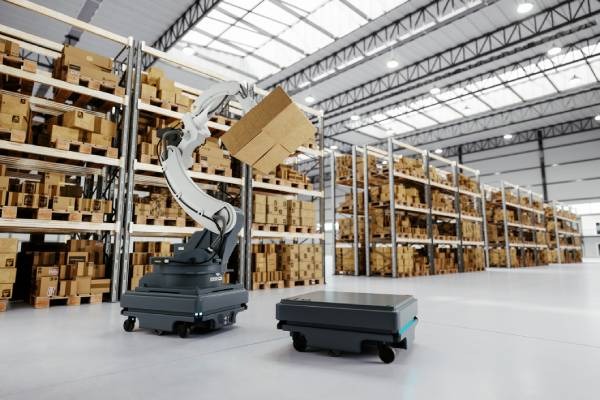
A new study released ahead of Black Friday presents a compelling counter-argument to years of debate surrounding "AI is eliminating jobs." Joint research by Mecalux and the MIT Intelligent Logistics Systems Lab demonstrates that artificial intelligence and automation in warehouses make workers more efficient, faster, and safer rather than replacing them. Moreover, more than half of companies using AI report hiring additional staff.
The study, which included over 2,000 logistics managers from 21 countries, shows that AI-based systems are now actively in use in more than 90% of warehouses. This represents a dramatic shift from just a few years ago when such systems were confined to experimental projects—today, most large-scale companies have transitioned to advanced automation or full automation phases.
Dr. Matthias Winkenbach, director of MIT's laboratory, says AI has become the "core nervous system" of warehouse operations:
"The challenge now isn't technology; it's harmonizing people, data, and processes. The true power of AI emerges in the last mile."
Where is AI being deployed?
Nearly all warehouse operations are now optimized with AI-powered solutions:
Order picking: Route optimization and task assignment
Inventory management: Real-time demand forecasting and shelf-level accuracy
Workforce planning: Shift management, workload distribution
Equipment maintenance: Predictive maintenance applications
Safety: Risky behavior detection and drill simulations
Javier Carrillo, CEO of Mecalux, summarizes the most distinctive advantage of smart warehouses:
"Smart warehouses are not just faster; they're also more adaptable, more resilient, and more predictable."
Return on AI investment accelerates
According to the research, most companies allocate 11–30% of their technology budgets to AI. The average return on investment period is 2–3 years. The key drivers of this acceleration include:
Higher inventory accuracy
Accelerated order throughput
Reduced errors
More efficient workforce utilization
In short, the payback on AI investment is now far more clearly measurable. It has moved beyond pilot projects to become long-term strategy.
AI doesn't reduce headcount—it actually increases it
The study's most striking finding:
More than 50% of companies have increased their workforce following AI adoption.
Moreover, employee satisfaction and productivity have risen significantly. This is because while AI automates heavy, repetitive, and error-prone tasks, it redirects workers to:
data analysis,
equipment management,
optimization,
technical maintenance
and other higher-value roles.
In warehouses today, positions such as AI technicians, data specialists, automation engineers, and robot maintenance teams have become standard.
Next frontier: Generative AI
92% of companies report AI is being deployed in some form in their operations, while 87% plan to increase their AI budgets over the next three years.
The most exciting technology on the horizon is Generative AI.
Dr. Winkenbach explains it this way:
"Classical machine learning predicts problems; generative AI engineers solutions."
This signals a paradigm shift across all processes—from warehouse design to code generation, from documentation to workflow automation.
Conclusion
The study shows that warehouses are becoming smarter, not more robotic. AI doesn't replace people; it makes them more effective, faster, and safer. At the same time, it's transforming the workforce structure by opening new business areas and specialized roles in supply chains.
Key Points
Research: Mecalux + MIT ILS Lab
90% of warehouses use AI
More than half of companies hired additional staff following AI implementation
AI investment ROI period: 2–3 years
Generative AI is viewed as the most valuable technology in logistics
Biggest challenges: integration, data quality, technical expertise
Author: SedatOnat.com
We would be delighted to hear your feedback.
Wishing you happy reading.

