

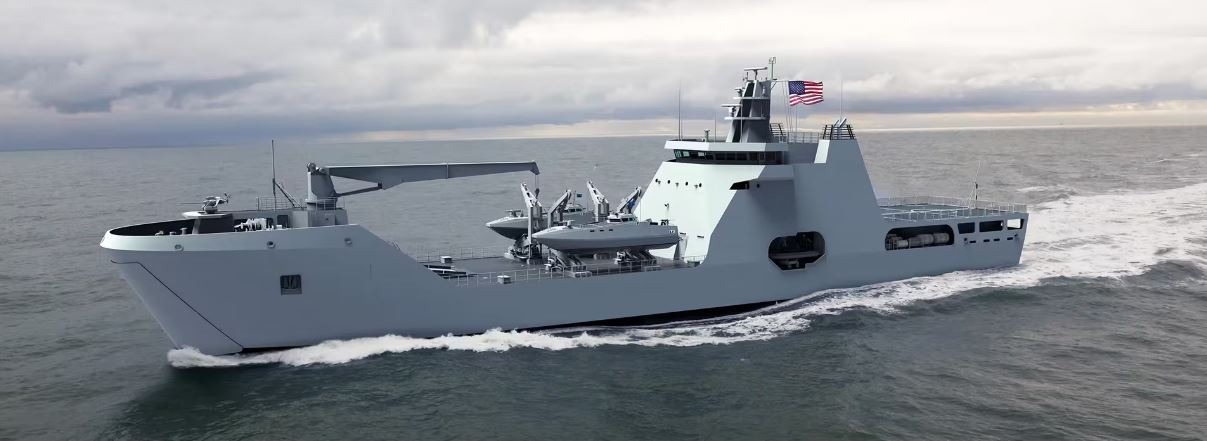
The U.S. Navy has made a critical decision in its Medium Landing Ship (LSM) program, aimed at strengthening amphibious and littoral operations capabilities, by selecting the LST 100 landing ship design developed by Damen Shipyards Group. According to the company's statement, the Navy plans to construct up to 35 vessels based on this design at U.S. shipyards.
The decision was announced to the public on December 5 by Secretary of the Navy John C. Phelan. Phelan described the LST 100 as "a platform that strikes the right balance in terms of capability, cost, and speed," weighing approximately 4,000 tons with a range exceeding 3,400 nautical miles. For the Navy, these vessels provide a solution capable of rapidly responding to current and future operational requirements.
Why an Existing Design?
In a statement following the decision, the Naval Sea Systems Command (NAVSEA) emphasized that the selection resulted from a competitive evaluation process and highlighted the preference for a mature design requiring no further development. According to NAVSEA, this approach:
enables rapid fielding of a critically needed capability,
reduces technical risk,
shortens procurement and acquisition timelines
The U.S. Navy chose to progress with a field-proven design rather than developing a platform from scratch, focusing instead on integration and localization phases.
Distributed Maritime Operations and the LSM's Role
The LSM vessels based on the LST 100 are positioned to operate in alignment with Distributed Maritime Operations (DMO) and the U.S. Marine Corps' Expeditionary Advanced Base Operations (EABO) concepts. These doctrines emphasize rapid, flexible, and low-profile logistics and force movement among island chains and coastal areas with limited infrastructure, rather than large centralized bases.
The vessels are designed to transport personnel, vehicles, and supplies between islands and to challenging coastal regions. In this context, LSMs provide a more distributed, less visible, and cost-effective solution compared to traditional large amphibious ships.
Technical Specifications
The LST 100, a steel-hulled landing ship, features approximately:
100 meters in length,
16 meters in beam,
3.5–3.9 meters shallow draft
The vessel can achieve a maximum speed of 14 knots and offers a range of approximately 4,000 nautical miles.
Key design features include:
approximately 1,020 m² of Ro-Ro (roll-on/roll-off) cargo space,
clamshell doors and ramps,
stern ramp,
integrated Ro-Ro and vehicle decks
This configuration enables rapid loading and unloading of vehicles and wheeled cargo.
The standard crew complement is approximately 18 personnel. However, the vessel provides accommodation for over 280 personnel, enabling the transport of an augmented Marine rifle company.
The ship's aft flight deck supports mid-size helicopters such as the NH90, while the heavy-lift crane positioned forward enhances cargo-handling capability. U.S. Marine Corps Commandant General Eric Smith stated that the vessel represents an excellent choice for the LSM role, given its cargo capacity, helicopter capability, accommodation space, and crane equipment.
Production Timeline and Global References
Program officials indicate that construction of the first vessel could commence in 2026 and delivery is feasible around 2029, subject to funding approvals. Damen and NAVSEA emphasize that, through a joint technical data package, vessels can be constructed in parallel at multiple U.S. shipyards.
The LST 100 currently serves in the Nigerian Navy inventory and has been selected by Australia for its Landing Craft Heavy program. These references underscore the design's operational maturity.
Damen and U.S. Connection
Damen designs are not unfamiliar to the United States. The company's patrol vessel designs form the basis of the U.S. Coast Guard's Sentinel-class Fast Response Cutter program. To date, more than 150 Damen-designed vessels have been constructed in the United States. This track record is viewed as a confidence factor regarding localized production and system integration for the LSM program.
Overall Assessment
The U.S. Navy's selection of the LST 100 design stands out as a strong example of a new approach in military ship procurement focused on speed, risk reduction, and cost-effectiveness. Proceeding with an existing, field-proven platform could enable the Navy to achieve its strategic transformation objectives in a shorter timeframe. This decision also represents one of the most current examples of U.S.–European defense industry cooperation in the maritime domain.
Key Points:
The U.S. Navy selected the Damen LST 100 design for the LSM program.
Up to 35 vessels will be constructed at U.S. shipyards.
The LST 100 was chosen as a mature design requiring no further development.
The vessels will support DMO and EABO doctrines.
First construction is expected in 2026, with delivery around 2029.
Damen designs are already widely employed in the U.S. Coast Guard fleet.
Author: SedatOnat.com
Your feedback will make us happy.
Wishing you happy reading in advance.

