

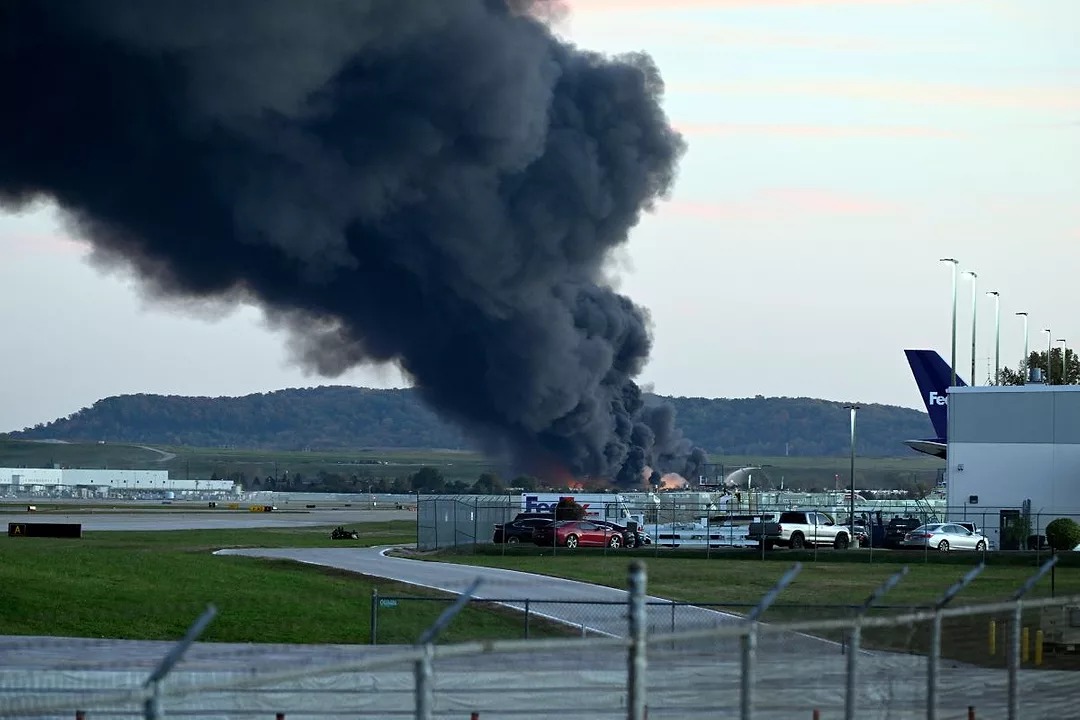
The National Transportation Safety Board (NTSB) has disclosed preliminary findings regarding the structural failure that caused UPS's McDonnell Douglas MD-11F cargo aircraft to crash during takeoff from Louisville–Muhammad Ali International Airport on November 4. According to the report, severe "fatigue cracks" were detected in the engine pylon and fastening elements that secured the aircraft's left engine.
\nCritical failure: left engine separated at takeoff
\nThe NTSB report states that the left engine separated from the fuselage along with its pylon seconds after takeoff, and the aircraft struck the ground without gaining more than 30 feet (9 meters) of altitude.
\n
\nThe crash killed a total of 14 people, including crew members and individuals on the ground.
Images shared in the preliminary report show the engine fracturing under extreme stress and becoming airborne in a massive fireball.
\n"Similarities to 1979 AA DC-10 accident"
\nJeff Guzzetti, former director of crash investigations for the U.S. Federal Aviation Administration, said the UPS crash bore striking similarities to the 1979 American Airlines DC-10 accident.
\n
\nIn both accidents, the left engine separated from the fuselage during takeoff.
However, the NTSB's UPS report found no evidence of external maintenance errors. The findings instead point more toward aging, metal fatigue, and structural deterioration.
\nFAA temporarily grounds MD-11 fleets
\nFollowing the UPS crash, the FAA issued a directive requiring urgent inspections of all MD-11F aircraft.
\nThe directive was subsequently expanded to include other aircraft with similar engine–pylon designs.
Currently:
\n- \n
9% of UPS's fleet,
\n 4% of FedEx's fleet
\nremain temporarily grounded. \n
UPS announced that it had grounded its MD-11 fleet on its own initiative as a precautionary measure even before the FAA announcement.
\nMaintenance intervals under scrutiny
\nA notable point in the investigation is that the failed component was still in the middle of its maintenance life.
\nAccording to the NTSB:
- \n
The engine attachment point underwent visual inspection in October 2021.
\n For more detailed inspection, the aircraft needed to complete 8,000 additional takeoff and landing cycles.
\n
Guzzetti stated:
\n"By design, this component should have exhibited fatigue much later. Yet in this case, it failed much sooner."\n
This raises serious questions about design strength, metal fatigue calculations, and the adequacy of maintenance intervals for aging fleets of MD-11F aircraft.
\nAircraft history
\nThe aircraft involved in the crash:
\n- \n
Was manufactured for Thai Airways in the early 1990s,
\n Was converted to cargo configuration approximately 20 years ago,
\n Was an MD-11F model powered by three GE CF6 engines.
\n
The passenger version of MD-11 aircraft was retired decades ago; the model is now used exclusively in cargo operations.
\nRoot cause unconfirmed: final report could take 1–2 years
\nThe NTSB stated that the preliminary findings represent only initial assessments and that final analysis and root cause investigation could take 1–2 years.
\nThe investigation will examine:
\n- \n
metal fatigue,
\n maintenance records,
\n pylon design,
\n vibration loads, and thermal stress
\namong other areas. \n
UPS and Boeing stated they are providing full support to the investigation.
\nKey Points:
\n- \n
The MD-11F crash was caused by fatigue cracks in the left engine attachment.
\n The engine separated seconds after takeoff, leaving the aircraft uncontrollable.
\n The FAA has mandated emergency inspections and temporary groundings for MD-11F aircraft in UPS and FedEx fleets.
\n The crash shares technical similarities with the 1979 AA DC-10 engine separation incident.
\n The failure of the defective component before its maintenance life expired suggests design or aging issues.
\n A final report is expected within 1–2 years.
\n
----------
\n\n--------------------
\nAuthor: SedatOnat.com
\n--------------------
\n\nWe would be delighted to receive your feedback.
\nWishing you happy reading.
\n
