

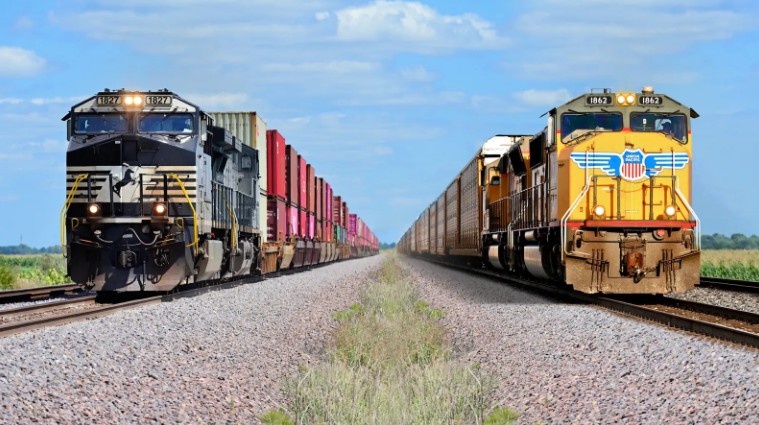
Union Pacific (UP) and Norfolk Southern (NS) claim that their merger could cut transit times by as much as two days, particularly in carload transportation.
However, shippers looking at the results of past mergers are taking a cautious view of these promises.
The new merger plan aims to eliminate transfer delays at east-west gateways like Chicago and New Orleans, making rail more competitive with trucking. According to UP and NS, this step would reduce inventory carrying costs and allow customers to reduce their carload fleets.
What the Merger Promises: Two Days Faster Shipments
The merger of UP and NS is expected to deliver the biggest benefits at transfer points, which currently cause the most delays.
For example, a shipment from a lumber mill connected to the NS network in the Southeast to Phoenix on UP's line currently involves four intermediate transfers.
Following the merger, this number of transfers is planned to be reduced to zero.
UP CEO Jim Vena stated in August that "with a unified transcontinental line, direct service design under single control would enable cars to reach their destination faster."
Speed Gains in Theory, Uncertainty in Practice
Railroad analyst C. Tyler Dick from the University of Texas says, "A unified line could reduce train-to-train connections, improving reliability and enabling more consistent car movement through the system."
However, Dick points out that numerous mergers since 1980 have not delivered lasting improvements in transit times:
"Previous mergers have not addressed bottlenecks at east-west gateways. The UP–NS merger is focused precisely on this point, but results are not guaranteed."
Chicago: A Chronic Bottleneck
Chicago remains the most critical yet most problematic junction in the U.S. rail network.
According to a retired railroad executive, "UP and NS connections in Chicago are weak. Even slow-moving trains could save 24 hours, but these savings are not automatic."
According to the executive's explanation, for example the North Platte–Bellevue line has two routing options through Chicago:
One is controlled by UP–NS but conflicts with commuter trains.
The other is less congested but outside the full control of either railroad.
This situation means that on-time delivery cannot be guaranteed even with the UP–NS merger.
Past Mergers: Promised Service Improvements Never Materialized
American Chemistry Council CEO Chris Jahn states, "Single-line service should theoretically reduce transit times, but we haven't seen that in the past."
A railroad logistics manager at a major energy company shares a similar view:
"Mergers have not shortened transit times enough to shrink our tank car fleet.
Some routes saw improvements but there was no noticeable difference at the overall level."
The manager points out that even in today's system, companies can operate run-through trains on each other's networks, adding, "There's no need for a merger to do that."
A Different Model from Canadian Lines
One positive example of mergers is the run-through trains launched by CN (Canadian National) and NS in Canada in 2017.
Two pairs of trains between Winnipeg (CN) and Elkhart, Indiana (NS) completely bypassed Chicago-area traffic, reducing transit time by 48 hours.
This example shows that efficiency gains can be achieved on high-volume lines without a merger.
Is the Merger Hope or a Repeating Story?
While the UP and NS merger is being received with high expectations in the railroad industry, many experts believe "every merger that promises service improvements repeats the same story."
Consolidation waves since 1980 have shaped modern railroad networks; however, no lasting breakthrough in transit times and equipment efficiency has been achieved.
According to experts, the problem is not the merger itself, but the lack of infrastructure and operational investments to solve bottlenecks.
Key Points:
Union Pacific (UP) and Norfolk Southern (NS) aim to cut carload transit time by up to 2 days through the merger.
The largest benefits are expected at east-west transfer points like Chicago and New Orleans.
Experts point out that mergers since 1980 have not fulfilled similar promises.
Chronic traffic congestion in Chicago could limit potential speed gains.
While single-line operations are theoretically beneficial, consistent improvements have not materialized in practice.
The CN–NS direct line example in Canada is one of the rare examples that delivers real time savings on busy routes.
Shippers are adopting a "wait-and-see" approach to witness the real benefits of the new merger.
Your feedback would make us happy.
Wishing you good reading from the start.

