

The United Kingdom is planning to achieve two ambitious targets simultaneously in rail freight: net zero emissions by 2050 and cargo growth of at least 75% over the same period. However, RailFreight.com author Simon Walton emphasizes that while these two targets appear compatible on paper, they create serious practical tensions in reality. According to Walton, the issue extends beyond simply acquiring new locomotives or clean technologies; it requires a multi-layered transformation process spanning infrastructure, capacity, fleet modernization, and multimodal logistics planning.
\nThe UK government formally announced this growth target approximately two years ago. However, the National Audit Office (NAO) has characterized this objective as a "massive challenge" in its assessments, particularly when considered alongside the country's broader decarbonization policies. According to the NAO, increasing freight volume by 75% risks directly contradicting the net zero objective unless pursued in parallel with existing infrastructure and energy systems modernization.
\nTechnological Promise: Class 93 and Tri-Mode Locomotives
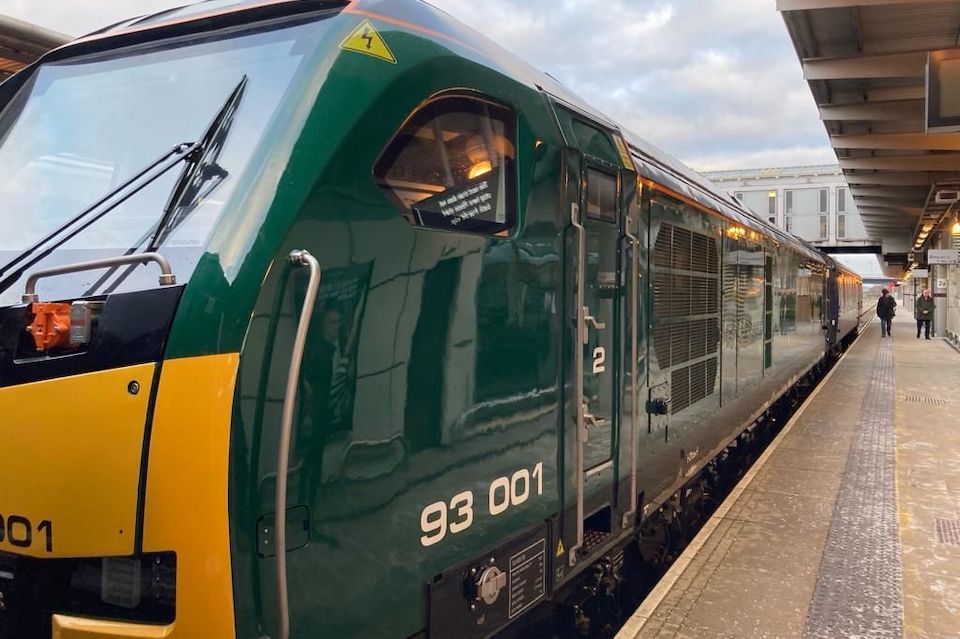
\nIn Walton's analysis, Class 93 locomotives emerge as one of the most concrete and symbolic examples of this transformation. Defined as tri-mode, these locomotives can operate on:
\n- \n
Electricity (overhead catenary),
\n Battery,
\n Diesel
\n
This architecture provides significant flexibility in the face of one of the UK rail network's most pressing problems: fragmented electrification.
\nLocomotives operating on diesel or battery on branch lines not yet fully electrified can switch to electricity when reaching mainlines. Consequently, Class 93s are frequently described in the sector as "future-proof". However, Walton clearly states that this technological advantage alone is insufficient.
\nCurrent Fleet Reality: Diesel Dominance
\nAs of 2025, the vast majority of the UK's freight locomotive fleet remains diesel-powered. While tri-mode and electric locomotives are increasing, they still represent a limited share of the total fleet. To reverse this picture, according to Walton, the UK requires:
\n- \n
over the next 20–25 years,
\n a sustained, predictable, and adequately financed fleet renewal program
\n
Without this, the net zero target risks remaining mere aspiration.
\nThe Real Barrier: Infrastructure and Electrification
\nIn Walton's analysis, infrastructure represents the greatest obstacle to achieving net zero. Rail electrification in the UK is:
\n- \n
fragmented across the country,
\n regionally imbalanced,
\n and not fully aligned with a long-term national plan.
\n
While this fragmented structure explains why tri-mode locomotives are necessary, it simultaneously constrains energy efficiency. Frequent switches to diesel or battery mode reduce emissions but do not eliminate them entirely.
\nAdditionally, Walton notes that rail infrastructure currently lacks sufficient spare capacity to accommodate a 75% increase in traffic. Line capacity, terminal areas, marshalling yards, and timetables are already strained at present levels.
\nRail Alone Is Insufficient: A Systemic Approach
\nOne of the analysis's principal conclusions becomes clear on this point: renewing rail vehicles alone is not sufficient. According to Walton, to simultaneously achieve net zero and growth targets, the following must be addressed holistically:
\n- \n
road freight (lorries),
\n inland waterways,
\n ports,
\n intermodal terminals,
\n and logistics planning models
\n
as a single integrated system.
\nIn this context, rail is not a standalone solution to absorb all freight; rather, it functions as the backbone of a broader multimodal logistics ecosystem.
\nA 25-Year Window
\nWalton argues that while the current diesel-heavy fleet may appear a near-term disadvantage, the approximately 25-year timeframe to 2050 can transform this into an opportunity if leveraged correctly. This period enables:
\n- \n
gradual infrastructure electrification,
\n phased fleet transformation,
\n reduced technological risk
\n
and represents a critical time window.
\nOverall Assessment
\nSimon Walton's analysis demonstrates that the future of UK rail freight depends not on a single technology, but on a prolonged and coordinated transformation strategy. While Class 93 tri-mode locomotives represent an important tool, real success depends on infrastructure investment, capacity planning, and holistic treatment of logistics systems. The net zero and 75% growth targets can advance without mutual contradiction only if this integrated approach is adopted.
\nKey Points:
\n- \n
The UK has set targets of 75% rail freight growth and net zero by 2050.
\n The National Audit Office describes this dual target as a "massive challenge."
\n Class 93 tri-mode locomotives represent a principal technological component of the transformation.
\n As of 2025, diesel dominance persists in the freight fleet.
\n The greatest barrier: fragmented electrification and capacity shortfalls.
\n Success requires a multimodal, systemic logistics approach.
\n
----------
\n\n--------------------
\nAuthor: SedatOnat.com
\n--------------------
\n\nWe would be grateful for your feedback.
\nWishing you happy reading.
\n
