

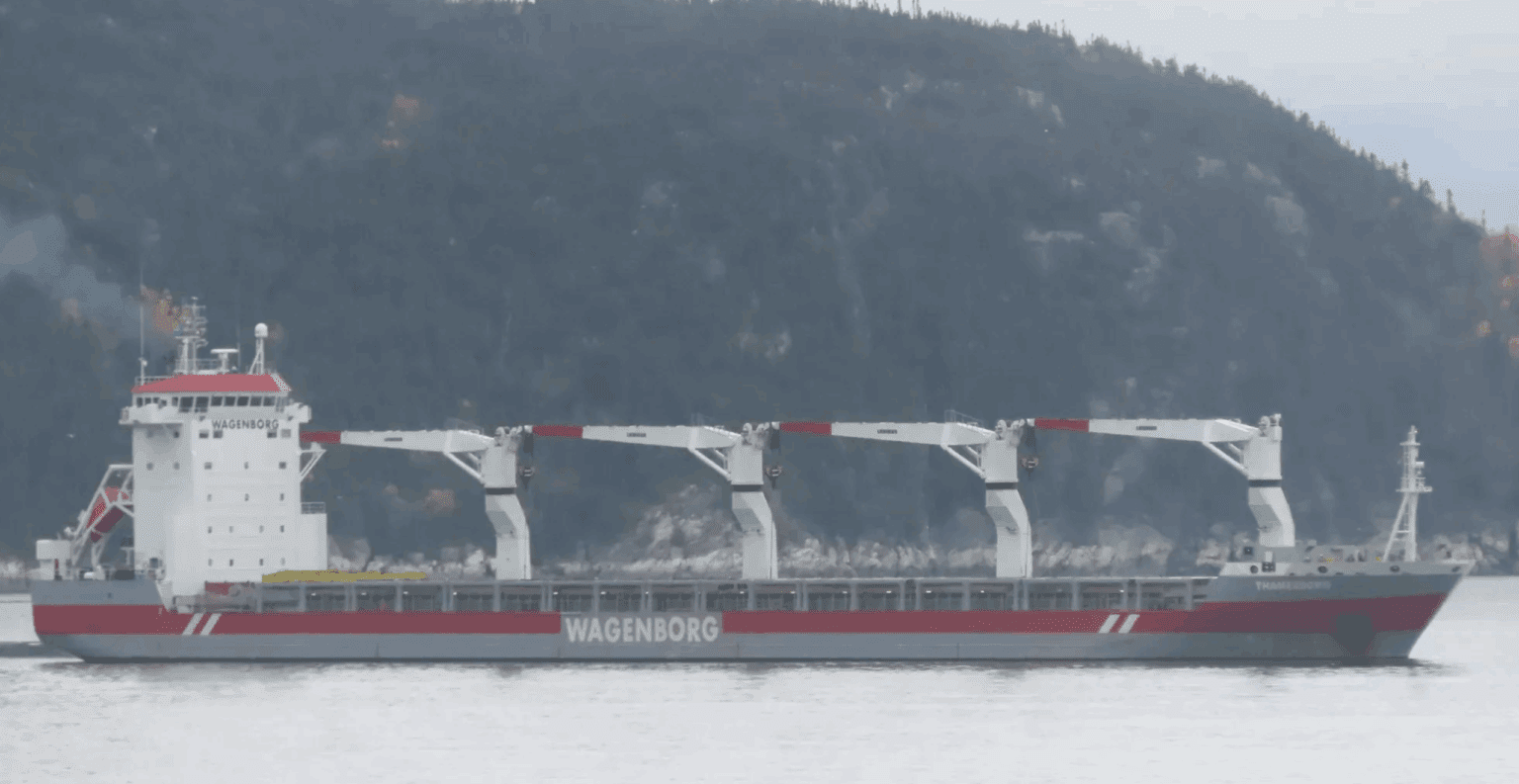
The Thamesborg, a general cargo vessel belonging to the Wagenborg fleet, departed from Lianyungang port in China destined for Canada. What was planned as a three-to-four-week voyage transformed into approximately a ten-week maritime odyssey. After running aground in the Franklin Strait region, the vessel was refloated following more than a month of challenging salvage operations. Successfully released on October 8, the ship proceeded under escort of the icebreaker Botnica and tugboat Beverly M I, transiting Baffin Bay, Davis Strait, and the St. Lawrence River to reach Baie Comeau port in Eastern Canada.
The company stated in its announcement that the vessel had safely reached port and that discharge operations of the remaining cargo had commenced. According to AIS data, the vessel remains anchored offshore. Wagenborg announced that following discharge operations, the vessel would enter repair. The Thamesborg's ability to reach port under its own power demonstrates the successful completion of the salvage operation.
The salvage operation involved transferring a portion of the vessel's cargo to two support vessels, Nunalik and Silver Copenhagen. In particular, Silver Copenhagen departed Baie Comeau after discharging its cargo. According to information confirmed by Canadian Coast Guard, the operation was completed without environmental pollution or injuries.
The cause of the incident remains under investigation. An official investigation is underway by the Transportation Safety Board of Canada (TSB), and the interim report expected to be released within 12 months will shed light on the cause of the grounding. Wagenborg stated that they are in full cooperation with authorities.
Arctic shipping experts contend that Thamesborg took an unusual route east of Franklin Strait, and this route resulted in grounding after contacting an unmapped underwater shoal. The incident has once again highlighted the risks of increased commercial traffic through the Northwest Passage due to global warming.
The Thamesborg case reveals that Arctic routes still lack adequate hydrographic data and maritime safety support, and therefore require more extensive mapping, monitoring, and coordination work to become fully safe. Despite the economic appeal of the route in the short term, this incident points to the need for a reassessment of Arctic shipping strategies from the perspective of long-term sustainability and safety.
Key Points:
Thamesborg ran aground in the Franklin Strait region during its voyage from China to Canada.
The vessel's salvage operation was successfully completed on October 8.
Nunalik and Silver Copenhagen vessels played an active role in cargo transfer.
Canadian Coast Guard confirmed that the incident caused no environmental damage.
Transportation Safety Board of Canada (TSB) is investigating the cause of the grounding.
Experts note that the vessel followed an unusual route and made contact with an unmapped shoal.
The incident has brought Arctic maritime trade route safety concerns back to the forefront.
Wagenborg will designate a new shipyard for the vessel's repair process.
The vessel reached Baie Comeau port under its own power, demonstrating the successful conclusion of the operation.
Author: SedatOnat.com

