

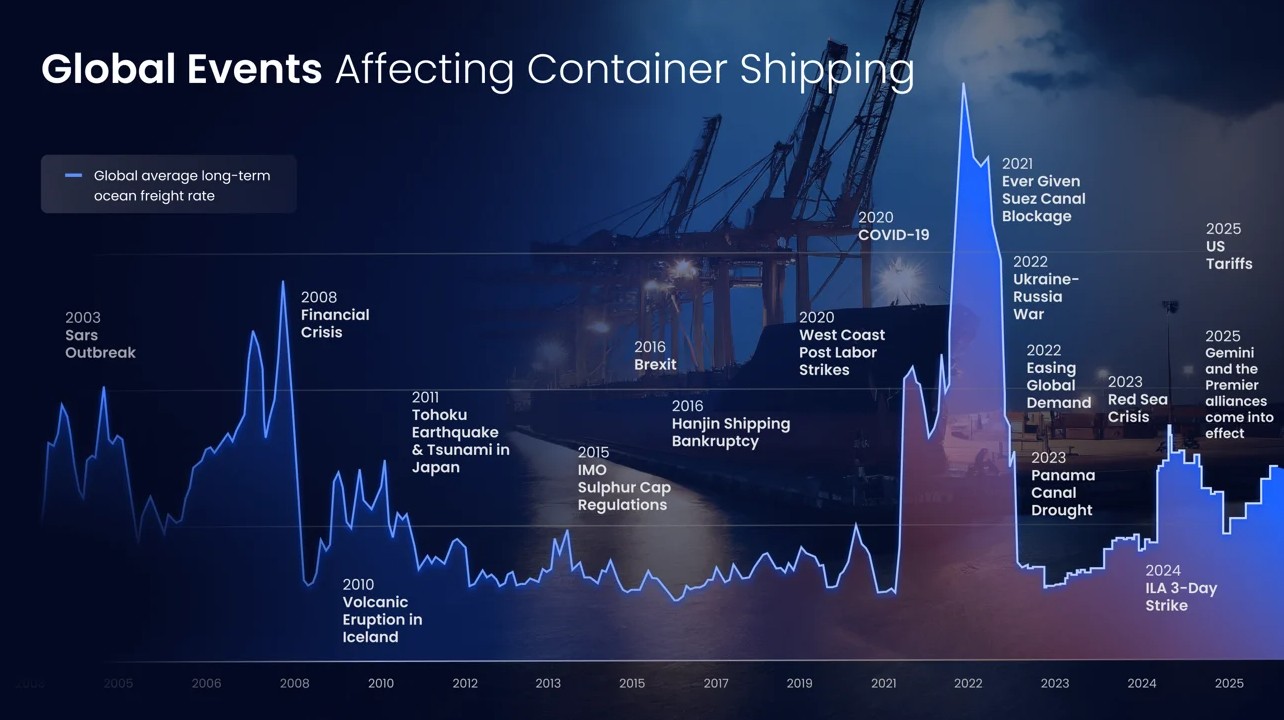
A.P. Moller-Maersk data shows that in 2024, more than 76% of European shippers experienced supply chain disruptions, with 1 in 3 companies struggling to source materials required for production. As 2025 approaches with similar conditions, businesses are shifting from avoiding risk toward embracing risk with anti-fragile structures. Pure risk avoidance strategies are giving way to proactive, agile, and adaptive risk management; because lack of visibility and insufficient risk intelligence create new hazards ranging from cost increases to damage to customer-supplier relationships. Below are the top 10 risks to monitor and key actions for each.
1) Geopolitical Risk:
The Russia-Ukraine conflict, Red Sea tensions, cyber attacks, new U.S. tariffs, and rising protectionism directly impact freight costs, capacity, on-time delivery, and international trade. Xeneta data shows that when tariffs rose in 2018, spot rates on the China-USWC lane surged 70%+. What to do? Adopt nearshoring/onshoring, diversified supplier portfolios, index-linked contracts, and rigorous compliance processes.
2) Economic Instability:
Most WEF chief economists expect weak growth in 2025. Following the de minimis shift, China-U.S. air cargo spot rates fell 50% from December peaks, then recovered 20%+ two weeks later. What to do? Deploy agile supply strategies (short-term contracts, mode/route diversification, dynamic pricing), strengthen relationships, and build safety stock for critical items.
3) AI and Emerging Technologies:
Gartner predicts generative AI will feed 25% of logistics KPIs by 2028. McKinsey forecasts the digital twin market will reach $125–150 billion by 2032. What to do? Develop use cases through small pilots, target measurable ROI; most critically, feed AI models with unbiased, mature freight data.
4) CFO Priorities:
BCG reports 67% of executives prioritize supply chain costs. What to do? Reduce budget surprises with real-time price intelligence, carbon, schedule reliability, surcharge, and benchmark data; balance price volatility with index-linked contracts and protect working capital.
5) Extreme Weather Events:
Top of the list of near-term crisis triggers in the WEF Global Risk Report 2025. Panama Canal drought and flooding/fire impacts disrupt supply. What to do? Scale routes and carriers by scenario, establish local-global supply balance; prioritize core product flows during demand shocks.
6) ESG and Emissions:
Container shipping CO₂ emissions rose 13.8% in the first 10 months of 2024; IMO net-zero 2050 targets create pressure. As EU-ETS kicks in, global carbon pricing discussions intensify. What to do? Select carriers with low-carbon track records using metrics like Xeneta CEI; adopt slow steaming, engine de-rating, fleet renewal, and transparent reporting.
7) Procurement Transformation:
60% of companies are changing their ocean tendering approach in 2025. Blank sailings and allocation cancellations weaken the 12-month fixed mindset. What to do? Establish proactive intelligence, operations aligned with business objectives, and a flexible procurement operation with non-savings metrics (continuity, sustainability, service levels).
8) Cyber-Attacks:
2024's CrowdStrike-related widespread outages inflicted $5+ billion in losses on the Fortune 500. Third-party access in supply chains creates domino effects. What to do? Select providers with certified security track records, apply the principle of least privilege, conduct penetration testing, and operate 24/7 monitoring.
9) Data Integrity and Quality:
Gartner reports poor data costs $12.9 million+ annually. AI/ML output is only as good as its input. What to do? Deploy real-time validation, aging controls, standardize data through collaboration; when necessary, use blockchain to limit retroactive error correction.
10) Persistent Talent Gaps:
Following the Great Resignation, procurement and supply demand for T-shaped competency sets is growing. What to do? Close the capacity gap through training-mentoring, internal academies, and automation in areas like e-sourcing and spend analytics; strengthen retention and engagement.
In conclusion
2025 success rests on proactive intelligence and full visibility, not remaining reactive. When index-linked contracts, diversified supply and routes, AI-driven decisions, and ESG-aligned carrier selection are deployed together, the supply chain does not merely remain resilient to shocks—it becomes anti-fragile, benefiting from disruption.
Key Takeaways:
76%+ of European shippers experienced disruptions in 2024; 2025 looks similar.
Geopolitics, economics, extreme weather, cyber risk, ESG, and data quality are the critical focus areas.
Index-linked contracts, near/reshoring, diversified supply, and real-time data reduce risks.
AI/digital twin pilots fail to deliver expected ROI unless fed with mature data.
ESG pressure is mounting; EU-ETS, IMO targets, and metrics like CEI are becoming decisive in carrier selection.
T-shaped teams, e-sourcing, and analytics manage talent gaps.
Author: SedatOnat.com
We would be delighted to receive your feedback.
We wish you happy reading in advance.

