

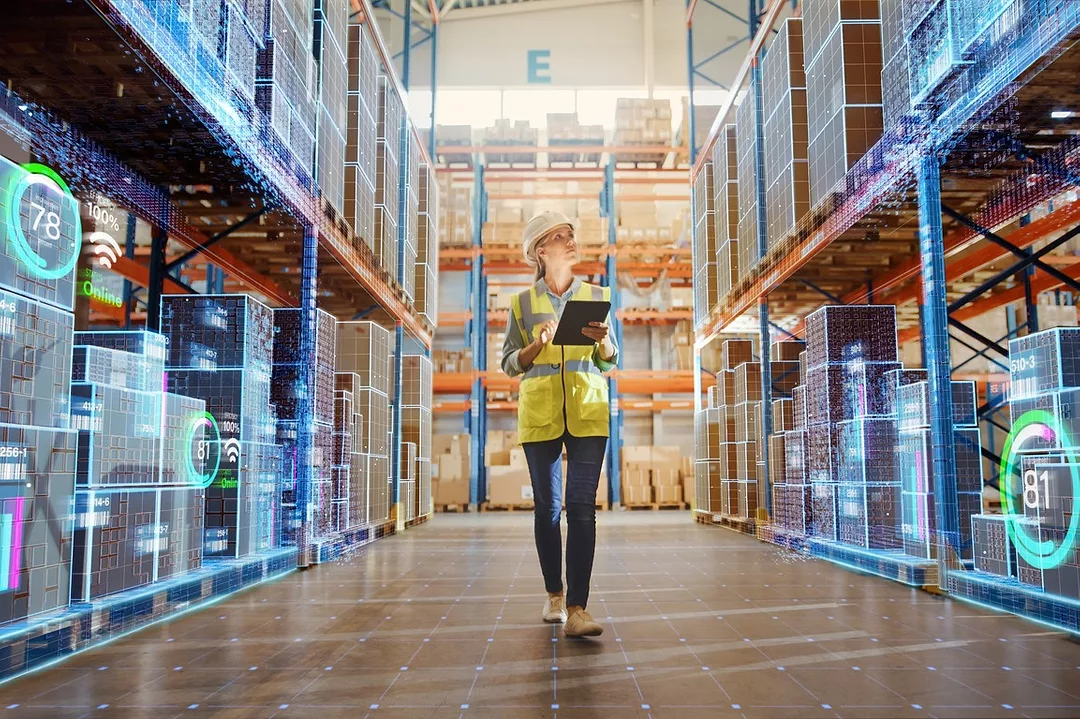
Demand forecasting has entered a new phase with data enrichment and AI-powered analytics. Today's successful forecasting systems rely not only on historical sales data, but on multidimensional inputs such as POS (point-of-sale) information, promotion plans, price elasticity, weather data, and social media signals. This integration significantly improves the accuracy of demand sensing models in short-term forecasts.
\nIn the medium and long term, hierarchical forecasting and probabilistic models come into play. Quantile regression and Bayesian approaches move beyond classical deterministic models, representing uncertainty more realistically. As a result, planning processes shift from mere "point estimates" to risk-based decisions grounded in probability distributions.
\nIn technical architecture, solutions such as feature stores, RAG (Retrieval-Augmented Generation), vector databases, and AutoML (Automated Machine Learning) are becoming increasingly prevalent. These tools provide speed and consistency in model training, while causal inference and explainability methods facilitate acceptance of models in the business world.
\nFrom an operational rhythm perspective, strong S&OP (Sales & Operations Planning) or IBP (Integrated Business Planning) integration ensures that forecasts work in synchronization with planning processes. Forecast outputs feed directly into production planning, inventory management, and capacity allocation.
\nIn distribution and inventory strategies, MEIO (Multi-Echelon Inventory Optimization) solutions create confidence interval-based inventory policies. These policies are linked with allocation and substitution rules to minimize inventory costs while maintaining customer service levels. Demand uncertainty is thus managed within an optimized flexibility framework.
\nAt the governance layer, Model Risk Management (MRM), drift monitoring, and data ethics principles are critical. These structures continuously monitor model performance, detect deviations early, and ensure the long-term reliability of forecasting systems.
\nIn conclusion, AI-powered demand forecasting is no longer merely an analytical tool; it has become an integral component of business strategy through the integration of data, algorithms, and processes. The supply chains of the future will be shaped by the speed, accuracy, and adaptive capability that these systems provide.
\nKey Points:
\n- \n
Demand sensing strengthens the short term.
\n Probabilistic approaches reflect uncertainty.
\n Feature stores and AutoML provide speed and quality.
\n MEIO optimizes inventory policy.
\n MRM and drift monitoring strengthen reliability.
\n
----------
\n\n----------
\n\nWe would appreciate your feedback.
\nWishing you happy reading from the start.
\n[911]

