

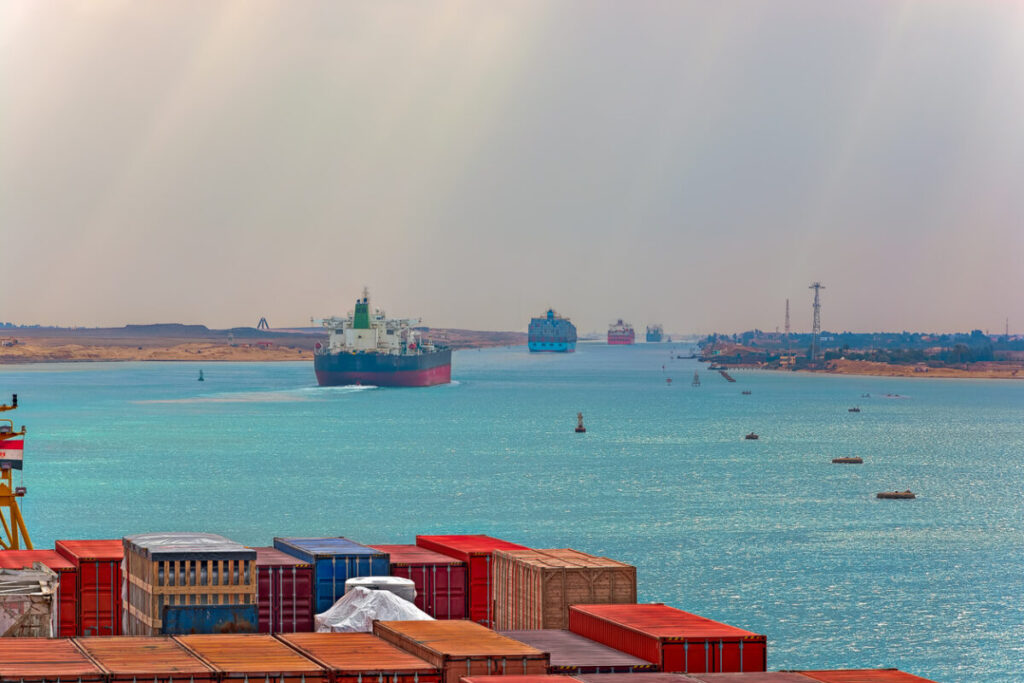
Sea-Intelligence released a new analysis showing that should transits through the Suez Canal resume following an Israel–Hamas ceasefire, the global container shipping sector could experience significant capacity relief.
\n
\nAccording to the analysis, reactivating the Suez route could free up approximately 2.1 million TEU of shipping capacity (equivalent to 6.5% of the global fleet).
This development has the potential to fundamentally reshape trade balances in Asia–Europe and Asia–US East Coast shipping by recovering vessel capacity currently locked into longer routes circumnavigating Africa.
\nPost-Ceasefire Scenario: Two Major Impacts on Global Shipping
\nAccording to Sea-Intelligence's modeling, reopening the Suez route will generate two primary effects:
\n- \n
Significant relief in global fleet capacity:
\nVessels returning from the longer African circumnavigation routes will redeploy to the Asia–Europe lane, reducing transit times and lowering shipping costs. \n Near-term congestion surge at European ports:
\nWith cargo from Asia arriving in Europe simultaneously, record increases in handling volumes could occur. \n
Suez Closure: Long Routes and Capacity Squeeze in 2025
\nSince late 2024, escalating Middle East tensions and Houthi attacks have severely curtailed transits through the Suez Canal.
\n
\nShippers have been forced to divert to longer routes via the Cape of Good Hope for Asia–Europe and Asia–US East Coast services, requiring approximately four additional vessels per trade route.
These longer routes, while driving up fuel costs, have effectively "locked in" a substantial portion of global vessel supply.
\nVarious Reopening Scenarios: Immediate or Phased Transition
\nWhile Sea-Intelligence has not forecasted when Suez transits will resume, it modeled several scenarios:
\n- \n
Immediate switch
\n Phased returns over 2, 4, and 6 weeks
\n
Under an immediate switch scenario:
\n- \n
Asia–Europe import flows would double for a two-week period,
\n European ports' handling volumes would spike to 39% above previous record levels.
\n
Even in an eight-week phased transition, port handling volumes would still run 10% above historical peaks.
\nChallenge for European Ports: A New Wave of Congestion
\nSea-Intelligence cites the capacity crunch experienced in March 2025, emphasizing that Suez Canal reopening could strain European port infrastructure once again.
\n
\nA sudden surge in cargo flow would increase the risk of berth congestion and container backlogs, particularly at major hubs like Rotterdam, Antwerp-Bruges, and Hamburg.
In the near term, port operations would need to scale up, while longer-term adjustments would restore more balanced vessel routes and delivery cycles.
\nGlobal Impact: A Rebalancing of Logistics
\nReopening the Suez route would bring relief not only to Asia–Europe services but also to Asia–US East Coast trade.
\n
\nShorter transit times, fuel savings, and fleet optimization could contribute to lower freight rates.
Additionally, delivery times from Asian production centers to Europe and the US could shorten by 10 to 14 days, potentially accelerating inventory turns and rebalancing global supply chains.
\nConclusion: 2.1 Million TEU of Capacity Returns
\nAccording to Sea-Intelligence's estimate, as Suez transits normalize:
\n- \n
Approximately 2.1 million TEU of capacity, or 6.5% of the active global fleet,
\n will become available for redeployment after being released from extended African circumnavigation routes.
\n
This represents the largest capacity recovery seen since the post-pandemic period.
\nHowever, experts caution that resuming transits could trigger a complex transition: near-term port congestion followed by mid-term freight rate declines.
Key Takeaways:
\n- \n
Sea-Intelligence disclosed that Suez Canal reopening could release 2.1 million TEU of capacity.
\n This equates to 6.5% of the global active container fleet.
\n The need for four additional vessels per route on Asia–Europe and Asia–US East Coast services would be eliminated.
\n Under an immediate return scenario, European ports could see 39% surge in volumes.
\n Even with phased transitions, a 10% increase is anticipated.
\n Analysts forecast near-term port congestion, followed by longer-term freight stabilization.
\n Suez reopening could initiate a strategic period of normalization in global logistics.
\n
----------
\n\n--------------------
\n
