

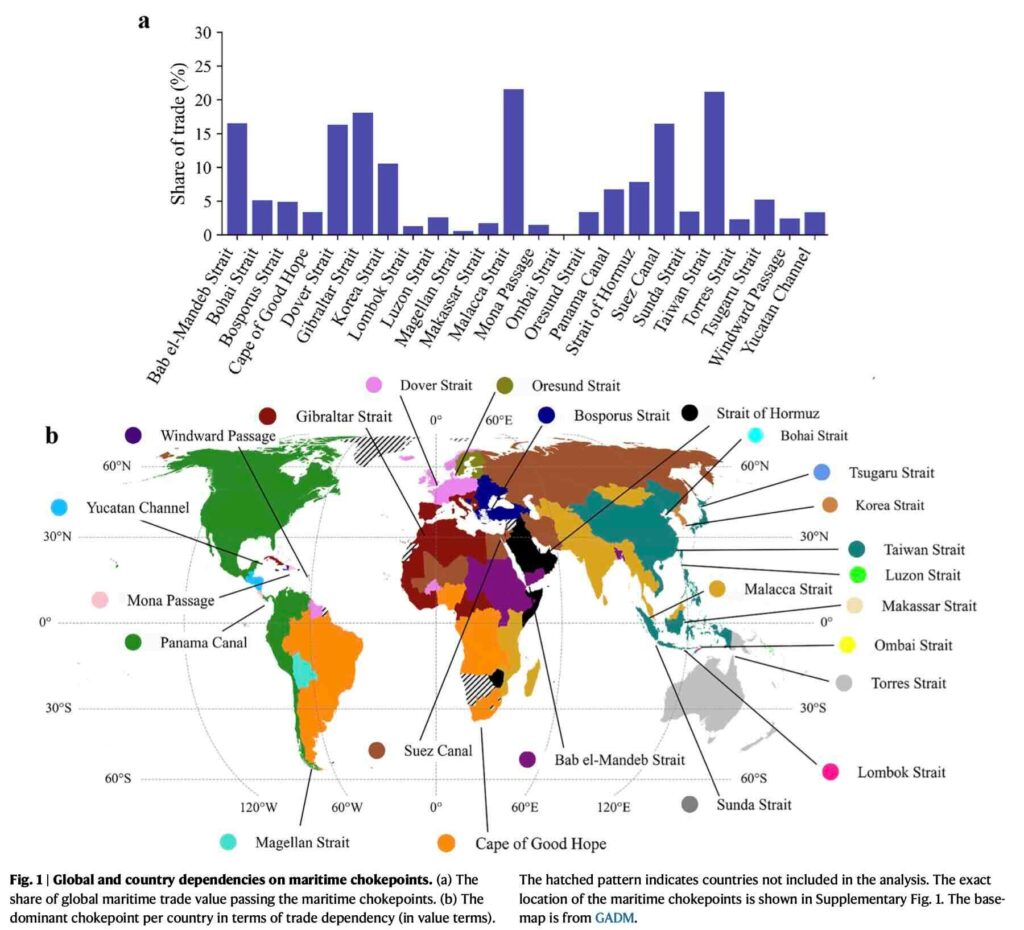
University of Oxford has published a new study demonstrating that disruptions at maritime chokepoints—the world's most critical vulnerabilities in global sea trade—inflict substantial annual damage on the global economy. According to the research, bottlenecks at these narrow passages affect approximately 192 billion USD in trade each year, with delays, rerouting, insurance premiums, and rising freight costs resulting in economic losses of around 14 billion USD.
\nOxford researchers examined the world's most strategically important 24 maritime chokepoints and calculated 10.7 billion USD in direct annual economic losses. This amount represents approximately 0.04% of global trade. The research indicates that the greatest impacts are concentrated in countries such as Egypt, Yemen, Iraq, and Panama, which are highly dependent on critical maritime passages. The economic structure of these countries is in a particularly vulnerable position against disruptions at these chokepoints.
\nThe study also reveals that rising global freight costs generate an additional 3.4 billion USD in annual losses. When a chokepoint closes or routes are extended due to risk, freight prices rise rapidly; this increase affects not only countries directly impacted by the disruption but also the entire trade network and consumer prices. This demonstrates how interconnected global supply chain costs have become.
\nDr. Jasper Verschuur, lead author of the study, highlighted the global scale of the risk, noting that "When one of these narrow passages is disrupted, the consequences can quickly ripple across continents." Verschuur emphasizes that the world economy's dependence on a limited number of transit points weakens the resilience of supply chains, making proper risk management strategies critical.
\nThe research points out that chokepoint risks are often interconnected. Human-caused threats—armed conflict, terrorism, piracy—and natural hazards—such as tropical cyclones—can trigger one another. For example, at locations such as Bab el-Mandeb, Bosporus, and Lombok Strait, armed conflict and terrorist attacks occur concurrently. Similarly, approximately 40% of tropical storms simultaneously affect multiple chokepoints. In some cases, piracy activities in one region have been observed to increase the likelihood of attacks in other regions. These overlapping risks increase the probability of multiple chokepoints being disabled simultaneously; in such a scenario, global trade's rerouting capacity rapidly diminishes.
\nOxford researchers emphasize the necessity of a layered resilience strategy approach to mitigate these risks. This strategy comprises a multi-layered structure that includes emergency stockpiles, supply chain diversification, security investments, advanced insurance models, and specialized risk products. It is noted that each country and company must develop risk management strategies tailored to the chokepoints on which they depend.
\nProfessor Jim Hall, co-author of the study, drew attention to the importance of the issue, stating that "Maritime chokepoints may be geographically small, but they have an enormous impact on how the global economy functions." Hall emphasized that chokepoint security is a global priority given the global economy's dependence on these narrow passages.
\nThe research reveals that governments and companies must conduct systematic analyses of vulnerability points to strengthen resilience capacity against future shocks. The findings of the Oxford team remind us how sensitive all global flows—from energy logistics to consumer goods supply—are to disruptions at these narrow bottlenecks.
\nKey Points:
\n- \n
24 global chokepoints analyzed; annual economic loss of $14 billion.
\n Direct losses of $10.7 billion; additional freight costs of $3.4 billion.
\n Most affected countries: Egypt, Yemen, Iraq, Panama.
\n Risks are largely interconnected; armed conflict, terrorism, piracy, and tropical storms can affect the same regions simultaneously.
\n High probability of multiple chokepoints experiencing simultaneous disruption.
\n Oxford recommends a layered resilience strategy approach.
\n
----------
\n\n--------------------
\nAuthor: SedatOnat.com
\n--------------------
\n\n
