

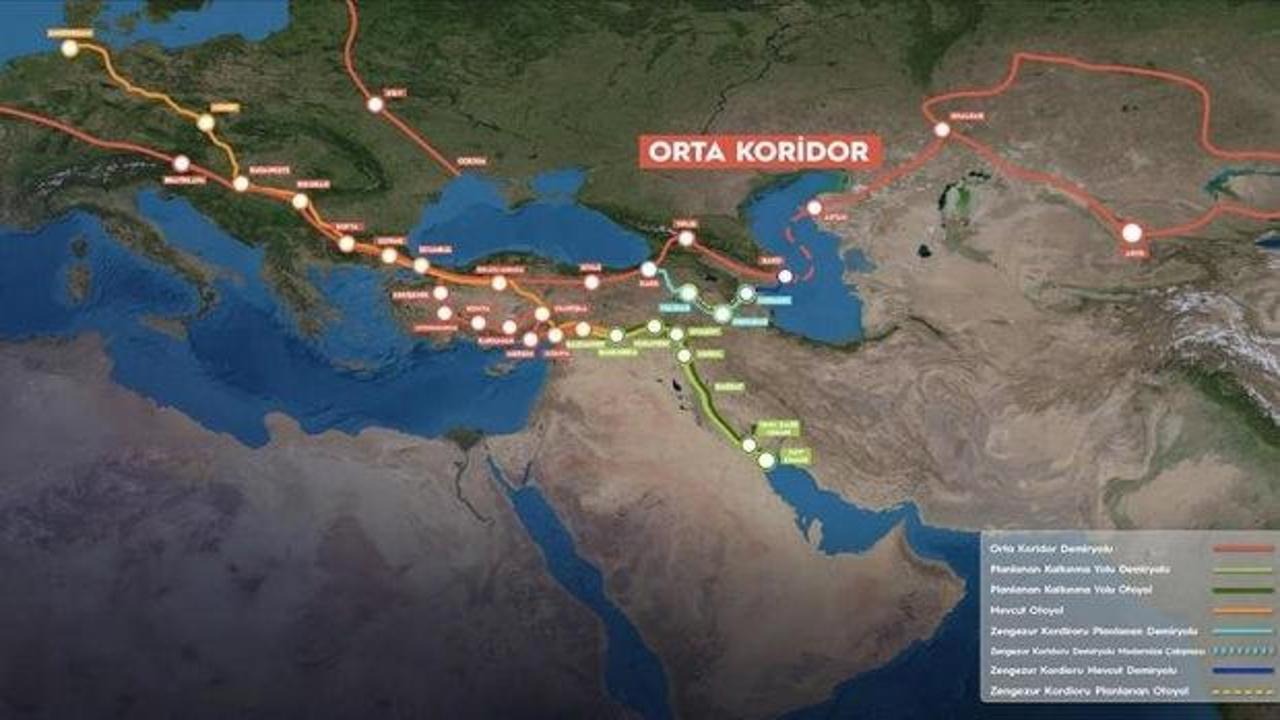
The Middle Corridor, known as the Trans-Caspian International Transport Corridor, is becoming increasingly visible in global trade at a time of heightened geopolitical fragility and supply chain restructuring. The route stretching from the Lianyungang region in eastern China through Kazakhstan, the Caspian crossing, Azerbaijan, and Georgia to Türkiye offers an alternative geo-economic connection to the Northern Corridor passing through Russia and traditional maritime routes via Suez.
The corridor's institutional foundation was laid through an agreement signed in 2013 between Kazakhstan, Azerbaijan, and Georgia. As China became involved in the process, the corridor's coordination capacity increased and formal coordination mechanisms strengthened. In the following period, the Trans-Kazakhstan railway line was completed, establishing an uninterrupted railway chain from China to the western shores of the Caspian. The Baku–Tbilisi–Kars (BTK) railway line, operational since 2017, made railway transit across the Caucasus to Türkiye and Europe practically possible.
Alongside this architecture, the Zangezur Corridor, first brought to the agenda through a ceasefire statement signed between Azerbaijan and Armenia in 2020, aims to connect mainland Azerbaijan with Nakhchivan through Armenia via road and rail. Should Zangezur materialize, the Türkiye–Azerbaijan land connection becomes uninterrupted, and the Trans-Caspian route gains a shorter connection to Europe. For this reason, Zangezur is viewed as a strategic complement to the scaling of the Middle Corridor.
Expectations for the corridor's acceleration are reinforced by time advantages. While geopolitical risks and sanctions cause China–Europe transit times on the Northern Corridor to run at 20–25 days, and maritime-focused classical routes can stretch to 35–45 days, average transit time on the Middle Corridor is calculated at approximately 18 days. It is projected that this time could be reduced to 14 days if Ro-Ro capacity is increased, customs processes are simplified, and railway infrastructure operates at full capacity.
Freight volume on the corridor is also rising. Shared data shows that cargo transported over the corridor increased by 62% to 4.5 million tonnes in 2024, with potential to reach 5.2 million tonnes by year-end. Increased transit risks over Suez and ongoing pressures on routes passing through Russia play a decisive role in this growth. In this context, Türkiye is positioned as one of the corridor's most critical countries and is strengthening its role through new investments.
One of the most concrete steps on Türkiye's side stands out as the Railport intermodal terminal being developed in Kocaeli. The first train departure on November 21 strengthens Türkiye's role as not merely a transit country but a logistics hub in the corridor. When Railport reaches full capacity, it is targeted to achieve an annual handling capacity of 360,000 TEU, 1.5 million tonnes of general cargo, and 125,000 trailers. This capacity contributes to reducing transfer times on the Europe–Asia route.
Multi-stakeholder initiatives addressing bottlenecks at the Caspian crossing are also in play. An agreement signed in late November among the International Carriers Association, the Albayrak Group, and Kazakhstan Railways (KTZ) carries objectives of increasing Ro-Ro sailings across the Caspian, reducing capacity congestion, and enhancing corridor efficiency. Capacity expansions at Aktau and Kuryk (Kazakhstan) as well as Baku Port (Azerbaijan) support this effort.
The corridor is also on the agenda of European institutions. In "EU–Kazakhstan connectivity" meetings held at the European Parliament, the Middle Corridor is emphasized as a strategic alternative. Should differences in gauge, border bureaucracy, and regulatory inconsistencies be resolved, the corridor is estimated to reach 11 million tonnes annually by 2030.
Sector representatives point out that Türkiye's unique geographical position is no longer merely a map advantage but now represents direct strategic power. OMSAN Logistics Board Chairman Ergun Arıburnu notes that Türkiye's location at the intersection of Europe, Asia, the Middle East, the Caucasus, and North Africa transforms the country into a natural logistics junction. Arıburnu emphasizes that digital integration is critical along the corridor; consolidating reservations and customs procedures on a single platform can reduce time losses.
In the analysis, assessments by Caspian Policy Center (CPC) expert Eric Rudenschild show that the Middle Corridor opens an economic sovereignty space for Central Asian countries by offering a trade route that doesn't pass through Russia or China. Rudenschild notes that through this corridor, countries' dependence on intermediaries decreases and they can access markets on more transparent terms. Additionally, the TRIPP (Trump Route for International Peace and Prosperity) initiative planned by the United States is reported to aim at increasing cargo capacity more than twofold through the Zangezur Corridor.
In the broader picture, the Middle Corridor stands out as a route that bypasses Russia, is relatively insulated from sanctions risk, and is attempting to scale through multimodal logistics investments. Türkiye, with its Railport, Marmara connections, port-railway integration, and digitalization capacity, assumes an indispensable role at the western end of this architecture.
Key Takeaways:
The Middle Corridor stands out as a strategic route along the China–Kazakhstan–Caspian–Azerbaijan–Georgia–Türkiye line that bypasses Russia.
Freight volume rose 62% to 4.5 million tonnes in 2024, with 5.2 million tonnes expected by year-end.
Time advantage is strong; improvements are projected to reduce transit time to 14 days.
The BTK line and Railport investment strengthen Türkiye's role.
Ro-Ro capacity is being increased across the Caspian; KTZ and private sector partnerships are active.
Initiatives such as the Zangezur Corridor and TRIPP carry capacity expansion potential.
Author: SedatOnat.com
Your feedback would make us very happy.
We wish you happy reading in advance.

