

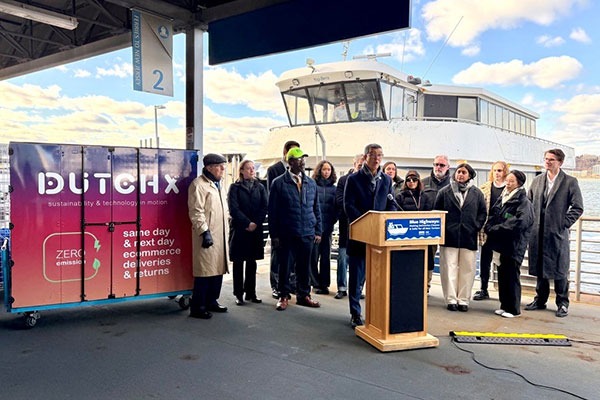
New York City has initiated a fundamental pilot project in its logistics infrastructure to address rising delivery volumes, congested truck traffic, and urban air pollution. The city administration has launched a new pilot program that uses waterways as an active freight network to reduce road-based transport dependency for cargo movement. This initiative is being implemented under the Blue Highways program and aims to reunite New York's historical port identity with modern urban logistics.
The pilot project creates a marine freight route between Pier 79 in Manhattan and Brooklyn Marine Terminal in Red Hook, Brooklyn. Cargo is transported across New York Harbor via ferry and then transferred to electric cargo bikes for last-mile delivery upon reaching Manhattan. This distribution model covers the dense commercial and residential zones between 23rd Street and 70th Street in Manhattan.
New York City Department of Transportation (NYC DOT) Commissioner Ydanis Rodriguez expressed the program's vision in these words:
"Waterways are the new highways in New York City."
According to Rodriguez, Blue Highways represents New York's transition from a 20th-century truck-focused freight system to a cleaner, smarter, and more resilient logistics structure for the 21st century.
Operational Structure and Initial Volumes
The pilot operation is being conducted in partnership with logistics firm DutchX and passenger and cargo transportation company NY Waterway. In its initial phase, the system is expected to transport 300–400 packages per day. Cargo categories include:
cosmetics,
fashion items,
lifestyle goods,
small-volume household products
City officials indicate that volume will be increased gradually as the pilot progresses, and performance will be regularly measured using metrics such as capacity utilization, truck miles traveled reduction, and emissions impact.
Why Waterways?
In New York City, approximately 90% of cargo entering and circulating within the city is transported by trucks. This situation, particularly in dense areas like Manhattan, creates:
chronic traffic congestion,
delivery delays,
air and noise pollution,
pedestrian and bicycle safety risks
City officials aim to reduce this pressure by using waterways for freight and provide logistics flows with an alternative backbone.
NY Waterway CEO Armand Pohan emphasized the importance of this approach, stating:
"Our city's waterways are key to getting trucks off Manhattan streets while getting freight delivered more quickly and efficiently."
Cargo Bike Integration and Last-Mile Delivery
One of the pilot's distinguishing features is the completion of waterway transport with electric cargo bikes. Compared to traditional truck–van distribution, this approach offers:
near-zero exhaust emissions,
greater maneuverability on narrow streets,
reduced parking and stopping issues
Cargo bikes stand out as a hyper-local distribution model, particularly for small to medium-sized e-commerce orders.
DutchX Co-Founder Marcus Hoed described the pilot as a "beginning," stating:
"It proves that better options exist, and it is only the beginning of what this system will unlock."
Future Plans: A Broader Waterway Network
New York City does not plan to limit the Blue Highways model to a single route. Authorities are evaluating similar freight operations at three additional locations:
Pier 11,
34th Street Pier,
Battery Maritime Building
The long-term goal is to establish a multi-node water-based freight network across New York Harbor.
As this network expands, the city will be able to accommodate rising online order volumes without adding more trucks and will strengthen its logistics infrastructure in terms of climate resilience.
Strategic Assessment
The Blue Highways pilot simultaneously addresses three fundamental urban logistics challenges:
Congestion reduction
Emissions & air quality improvement
Supply chain resilience
New York's approach establishes an important reference point for how multimodal last-mile logistics models can be shaped in dense metropolitan areas.
Key Takeaways:
NYC has launched a water-based freight pilot under the Blue Highways program.
Route: Pier 79 (Manhattan) – Brooklyn Marine Terminal (Red Hook).
Cargo is transported by ferry and distributed via electric cargo bikes.
Initial volume: 300–400 packages per day.
Objective: reduce truck traffic and emissions, improve delivery reliability.
The city is evaluating expansion of the model to at least three new locations.
Author: SedatOnat.com
Your feedback would make us happy.
Wishing you good reading in advance.

