

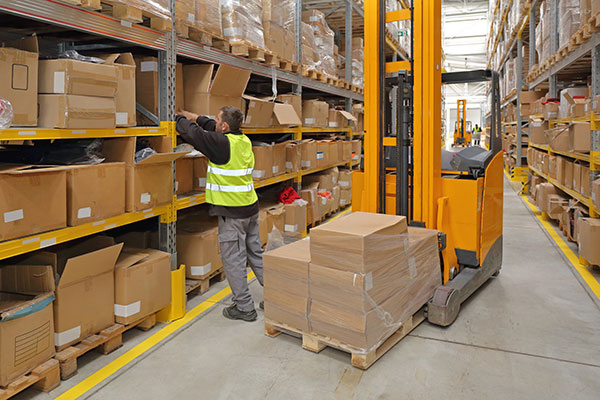
Order picking is among the most labor-intensive, time-consuming, and costly activities in warehouse operations. Although it may appear straightforward on the surface, order picking emerges as an exceptionally complex process where intense human movement, diverse product characteristics, equipment utilization, and time pressure converge. Nevertheless, many warehouse management systems still plan this process based on simple averages. Neural networks, however, are fundamentally transforming this approach.
Traditional systems estimate how long an order will take to pick by examining historical averages. However, in the real world, no two orders are identical. An order consisting of small and lightweight items requires a different amount of time than picking a single heavy and bulky parcel retrieved from upper shelves. Furthermore, factors such as the time of day, shift congestion, fatigue, equipment type, and warehouse traffic significantly affect these timeframes.
Neural networks prefer to learn rather than simplify this complexity. Instead of rigid rules, the system, fed by real warehouse data, creates dynamic patterns.
How Do Neural Networks Work in the Warehouse?
Neural networks evaluate numerous inputs simultaneously. Among these are:
item size and weight,
storage location (shelf height, aisle position),
order size and composition,
worker experience,
utilized equipment,
time of day,
peak shift congestion
Variables such as these are incorporated. The system analyzes how these factors affect actual picking times and produces increasingly accurate estimates over time.
Thanks to this approach, managers can plan not for an "average" day, but for today's actual conditions. As a result, workforce distribution becomes more balanced and delays are identified earlier.
Realistic Time Estimates
For instance, during a busy afternoon shift, 500 orders must be completed before the truck loading deadline. Traditional systems offer rough time estimates by reviewing historical data. Neural networks, however:
determine whether orders contain heavy items,
identify whether items are located in hard-to-reach areas,
account for whether congestion typically occurs during those hours,
factor in performance degradation due to prolonged work
into their calculations. As a result, the estimate becomes realistic and operationally actionable. This enables more reliable delivery promises to customers.
A New Approach to Route Optimization
The majority of time in order picking is spent on travel time. In theory, this resembles solving the shortest path problem. However, in practice, warehouses are irregular, corridors are congested, and human behavior is variable.
Traditional algorithms attempt to calculate the mathematically "optimal" route. Neural networks, however, learn which routes have actually worked in the past. Fed by data from scanners, voice picking, and wearable devices, the system identifies which corridors workers avoid and which passages save time.
In this way, the system recommends routes that are realistic and quickly computable, not idealized ones. For example, instead of the classic Z picking method, it can recommend ladder picking or single-entry-exit strategies depending on conditions. Over time, it can even learn why a particular corridor consistently slows down.
Continuous Learning and Adaptation
The greatest advantage of neural networks is that they never stop learning. Every shift, every season, and every order adds new data to the system. As a result, the model:
adapts to seasonal peaks,
adjusts to campaign periods,
rapidly accommodates new equipment or layout changes
This means tighter workforce planning for managers, fairer performance expectations for workers, and more consistent fulfillment for customers.
Strategic Impact
Warehouses will always remain complex. Neural networks do not eliminate this complexity, but rather make it manageable. Converting daily operational data into meaningful insights is of critical importance, especially given labor shortages and rising e-commerce volumes.
Key Takeaways:
Traditional systems plan order picking based on average timeframes.
Neural networks learn from real warehouse conditions to produce more accurate forecasts.
Time estimation and route optimization are improved together.
Systems leverage actual movement patterns that have proven effective in the past.
Continuous learning enables seasonal and shift-based adaptation.
Result: more balanced workloads, fewer delays, and more reliable deliveries.
Author: SedatOnat.com
We would be delighted to receive your feedback.
Wishing you happy reading.

