

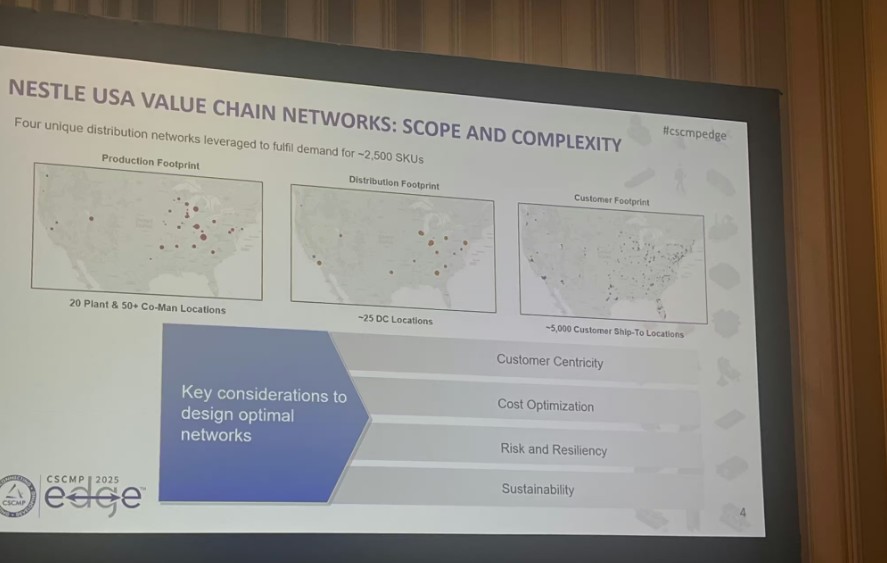
Nestlé USA uses a distribution network optimization modeling approach that it refines annually as part of its supply chain strategy, enabling the company to reduce total delivery costs while simultaneously addressing risk, sustainability, and customer satisfaction.
Karan Gill, Head of Artificial Intelligence for Supply Chain Optimization at Nestlé, presented at the CSCMP EDGE Conference on how the company shapes its distribution network decisions using a data-driven approach.
A Comprehensive and Dynamic Distribution Network
Nestlé USA operates approximately 25 distribution centers across the country.
Some of these centers are owned by Nestlé, while others are operated by third-party logistics (3PL) providers.
A majority of the centers are located in the Midwest region.
Through this network, Nestlé delivers to approximately 5,000 customer distribution centers (DCs).
Gill noted that the system maintains a careful balance between customer focus, cost optimization, resilience, and sustainability:
"When determining our distribution points, we evaluate not just cost, but also risks, capacity, carbon footprint, and service levels within the same model."
Three Networks – Three Strategies: Ambient, Chilled, Frozen
Nestlé USA manages three distinct distribution networks to account for its diverse product portfolio:
Ambient (room-temperature products)
Chilled (refrigerated products)
Frozen (frozen products)
Gill and his team publish separate roadmaps annually for each of these three networks.
These roadmaps determine which customers will be served from which distribution centers and how to optimize the flow design.
The objective is to minimize total delivered cost while accounting for physical and operational constraints.
Model Components: A Multi-Layered Optimization Approach
Nestlé's network model evaluates multiple cost and constraint parameters simultaneously:
Transportation costs (distance & mode costs)
Handling and storage costs
Warehouse capacity limits
Flow balance and inventory strategy
Delivery time windows and customer contract terms
The model also determines which products should be shipped directly from factory to customer and which should be distributed through warehouses.
Gill emphasized that this system not only reduces costs but also improves inventory efficiency and service levels.
Continuous Re-optimization: Adapting to Changing Conditions
Gill stressed that optimization is not a one-time project but a continuous process:
"Both internal and external conditions constantly change: our production sources shift, transportation costs fluctuate, and customer demand moves.
That's why we review our network design every year."
Nestlé's annual re-modeling process is closely tied to the company's mergers and acquisitions (M&A) activities.
Gill noted that past acquisitions and divestitures have frequently required the network structure to be rebalanced, and optimization has provided "critical decision support" throughout these processes.
Works in Both Growth and Crisis
According to Gill, network optimization serves as the company's "compass" in both growth and crisis periods:
"Network optimization shows us where to build new facilities when times are good.
But when times are tough, it tells us just as clearly which points to consolidate or close."
This strategic flexibility strengthens Nestlé's supply chain resilience while maintaining an optimal balance between cost control and service continuity.
Data-Driven Sustainability and Customer Focus
Nestlé incorporates carbon emissions and energy efficiency criteria into its distribution network model.
This allows the company to maintain cost advantages while achieving sustainable logistics goals.
Gill noted that this approach is not merely a "green" strategy but also delivers long-term operational efficiency.
"Sustainability is no longer a line item; it's part of strategic resilience."
Conclusion: A Dynamic, Intelligent, and Responsive Distribution Ecosystem
Nestlé's optimization model is built on principles of data-driven decision-making, continuous learning, and flexible network planning.
This approach enables the company to both enhance customer experience and reduce logistics costs.
The presentation at CSCMP EDGE demonstrated that Nestlé has developed a best-practice example of AI-driven network design not only in the food and beverage sector but also in supply chain management more broadly.
Key Takeaways:
Nestlé USA operates 25 distribution centers and ships to 5,000 customer DCs annually.
The company designs separate optimization networks for ambient, chilled, and frozen products.
The model simultaneously optimizes transportation, storage, capacity, delivery times, and inventory strategies.
Annual re-modeling enables rapid adaptation to changing demand, costs, and production structures.
Optimization provides strategic decision support in both growth (new facility investment) and crisis (center consolidation) scenarios.
Sustainability criteria are now an integral part of cost optimization.
Karan Gill: "Network optimization sits at the heart of Nestlé's supply chain flexibility."
We would be delighted to receive your feedback.
Wishing you happy reading from the start.

