

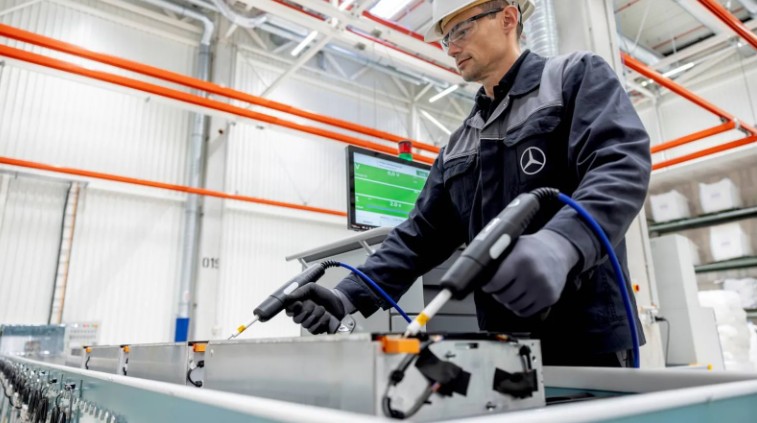
Mercedes-Benz has opened a new battery recycling facility in Kuppenheim, Germany, in line with its sustainability objectives. The automotive giant announced in a press release on October 21, 2024, that the facility has an annual battery processing capacity of 2,500 tonnes and will enable the production of more than 50,000 new battery modules. Mercedes-Benz is the first original equipment manufacturer (OEM) to close the battery recycling loop within its own operations.
The new facility was constructed as part of a scientific research project conducted between three German universities and financed by Germany's Federal Ministry for Economic Affairs and Climate Action. The facility will examine the entire supply chain of battery recycling in detail, from logistics to reintegration into the supply chain. As Europe's first mechanical-hydrometallurgical battery recycling facility, it will be capable of recovering up to 96 percent of critical raw materials such as nickel, lithium, and cobalt used in battery production.
Mercedes-Benz Group Board Chairman Ola Källenius stated in the press bulletin: "Mercedes-Benz has set the goal of building the most desirable cars in a sustainable manner. As a pioneer in automotive engineering, Europe's first integrated mechanical-hydrometallurgical battery recycling factory represents an important milestone in enhancing raw material sustainability."
Mercedes-Benz invested "tens of millions of euros" in the facility's construction and noted that the knowledge gained from operating the facility could increase production volumes in the medium and long term. The facility will also play a critical role in complying with the European Union's new battery recycling regulations. According to the EU regulation adopted in July 2023, certain recycled content thresholds must be met in batteries for newly sold electric vehicles by 2026: 16 percent for cobalt, 85 percent for lead, and 6 percent for lithium and nickel. Additionally, batteries must include labels showing the amount of recycled material they contain by 2026 and QR codes by 2027.
German Chancellor Olaf Scholz stated in the press bulletin: "The future of the automobile is electric, and batteries are one of its fundamental components. Recycling is also critical to ensuring that batteries can be produced in a resource-conserving and sustainable manner."
Mercedes-Benz selected Primobius as the technology partner for the recycling facility. Primobius is a joint venture between SMS Group, a German-based mechanical engineering company, and Neometals, an Australia-based company, which develops recycling technology for critical materials. The battery recycling process includes the disassembly of battery modules, drying of active battery materials, and their processing. The facility's multi-stage mechanical process enables the separation and sorting of plastics, copper, aluminum, and iron, while the hydrometallurgical process allows individual active materials to be recovered from battery cell electrodes. These recovered materials will be used in the production of new batteries.
Jörg Burzer, a member of the Mercedes-Benz Group Board responsible for production, quality, and supply chain, stated: "Innovative technology enables us to recover valuable raw materials from batteries at the highest degree of purity. This transforms today's batteries into tomorrow's sustainable raw material mine."
With this step, Mercedes-Benz has once again demonstrated its commitment to sustainable automotive production. The new facility aims to support environmental sustainability while increasing the company's independence in its raw material supply chain.
Key Points:
Mercedes-Benz has established a new battery recycling facility in Kuppenheim, Germany.
The facility has an annual battery processing capacity of 2,500 tonnes and aims to produce more than 50,000 new battery modules.
The project is financed by Germany's Federal Ministry for Economic Affairs and Climate Action.
The facility was constructed as part of a scientific research project conducted between three German universities.
As Europe's first mechanical-hydrometallurgical battery recycling facility, it recovers up to 96 percent of critical raw materials such as nickel, lithium, and cobalt.
Mercedes-Benz selected Primobius as the technology partner for the recycling facility.
Compliance with the European Union's new battery recycling regulations will be ensured.
Ola Källenius and Jörg Burzer emphasized the importance of the project for sustainability and raw material supply chain.
German Chancellor Olaf Scholz stated that battery recycling is critical for sustainable production.
We would be delighted to receive your feedback.
Wishing you happy reading.

