

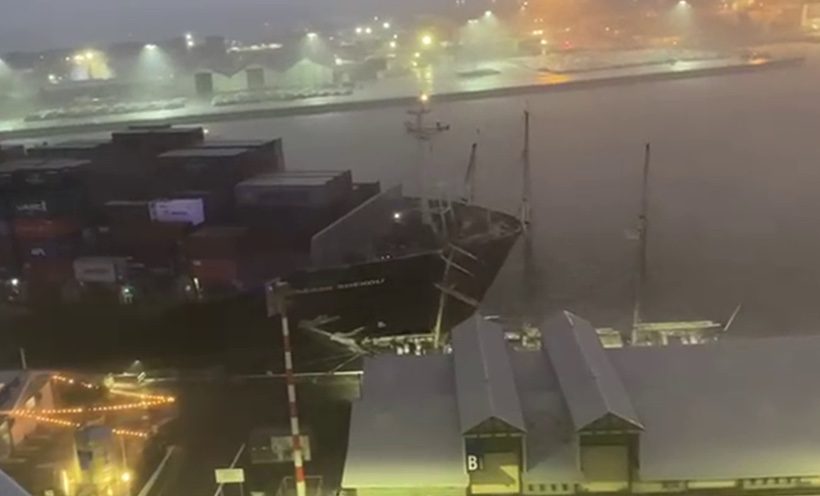
The final report published by Australia's Transport Safety Bureau (ATSB) provides a detailed account of the chain of failures that led to the 333-meter container ship Maersk Shekou striking the historic sailing vessel Leeuwin II at Fremantle Port in Western Australia on the morning of August 30, 2024. The findings reveal that a lack of coordination on the bridge, critical distraction at a key moment, and violations of port procedures were the primary causes of the accident.
Vessel Data Recorder: An unissued command was the accident's starting point
Analysis of the ship's VDR (Vessel Data Recorder) revealed that the first harbor pilot never issued a planned 10-degree port helm order to turn the vessel into the inner harbor channel. This critical unissued command went unnoticed by both the second pilot and the bridge team.
Despite the command not being given, the pilot attempted to maneuver the ship using the main engine and four escort tugs. Meanwhile, the helmsman at the wheel maintained the previous heading of 083 degrees, effectively preventing the ship from turning. Due to this breakdown in coordination, Maersk Shekou drifted off course toward Victoria Quay and struck the Leeuwin II, which was moored at the dock.
Second pilot's phone call made matters worse
The ATSB highlighted one of the most striking aspects of the incident: the second pilot was occupied with an unnecessary phone call while the vessel was transiting through the critical channel section. This distraction prevented the recognition that the first pilot had not issued the command and that the helmsman was maintaining the wrong heading.
ATSB Chairman Angus Mitchell summarized this situation in the report as follows:
"The presence of distracting activities on the bridge, even during the most critical transit area, can lead to serious consequences. This incident is a concrete example of that."
Loss of shared mental model
The report shows that the bridge team—comprising pilots and ship personnel—failed to maintain the shared mental model essential for coordinated awareness and synchronized action. Without a common understanding of the steps required for the maneuver, incorrect helm orders, poor timing, and a chain of miscommunications led to the collision.
Delay in mooring tugs compounded the problem
According to ATSB's findings, as Maersk Shekou approached the inner harbor turning point, one of the supporting tugs had not yet been connected. Consequently, the bridge team was still focused on the mooring process as they entered the most complex phase of the maneuver. This increased workload made it easier for critical errors to go unnoticed.
Violations of Fremantle Port procedures: operational limits exceeded
The report also reveals that risk control measures established by port authorities were largely not implemented.
During Maersk Shekou's entry into the inner harbor:
not all tugs were connected,
the operation was conducted before sunrise,
wind conditions were above the port's permitted operational limits.
All of these violated the port's official operating procedures.
The container ship sustained minor damage, while the Leeuwin II suffered complete loss of her masts and two crew members were injured. No injuries occurred among the pilots or Maersk Shekou's crew.
The ATSB notes that safety corrective actions have been initiated by both Fremantle Ports and Fremantle Pilots to address these failures.
Key Points:
The first pilot failed to issue the critical port 10° command; no one noticed.
The second pilot became distracted by a phone call during the critical phase.
The helmsman maintained the previous heading, effectively negating the pilot's maneuver.
Delay in tug mooring increased bridge team workload.
The vessel was admitted to port under conditions contrary to procedures (high winds, darkness, missing tug).
Leeuwin II sustained severe damage; 2 people were injured.
Author: SedatOnat.com
We would be delighted to hear your feedback.
We wish you happy reading in advance.

