

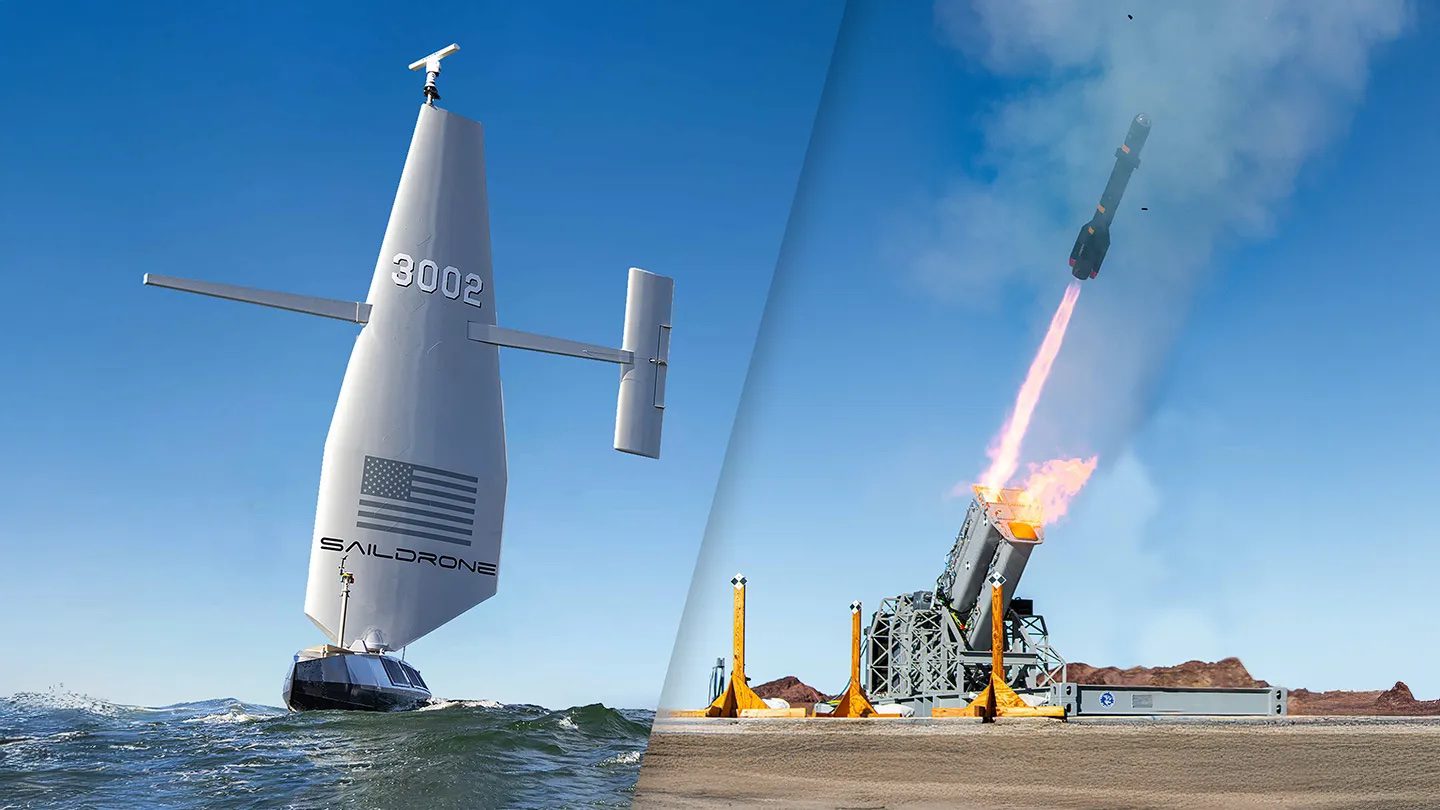
Lockheed Martin has announced a $50 million investment in Saildrone, marking a significant step forward in autonomous maritime technology. The investment aims to develop armed autonomous platforms for the U.S. Navy by integrating Lockheed Martin's battle-proven weapon systems into Saildrone's unmanned surface vessels (USVs).
Project scope and objectives
In the initial phase, Lockheed Martin's JAGM Quad Launcher missile system will be integrated onto the Saildrone Surveyor platform. This system features multi-purpose precision-guided munition capability and can be deployed against anti-ship and land targets. Larger Saildrone models are currently in development; these versions are being designed to carry heavier weapon loads. Integration of systems such as the Mk70 Vertical Launch System (VLS) and thin line towed sonar arrays (for submarine detection) is being planned.
Strategic partnership in defense industry
Stephanie C. Hill, head of Lockheed Martin's Rotary and Mission Systems business unit, stated that this collaboration represents a response to President Donald Trump's call for the defense industry to think differently and leverage all the power of industry. Hill noted: "We are combining commercially proven autonomous platforms with our battle-tested weapon systems. This will create powerful synergy to produce rapid and scalable lethal maritime solutions."
Saildrone's history and technological contributions
Saildrone, which commenced commercial operations in 2013, became the first company to produce autonomous surface platforms formally commissioned by the U.S. Navy in 2021. Today, Saildrone vessels are actively deployed in operational missions across numerous regions worldwide.
Saildrone CEO Richard Jenkins summarized the technological dimension of the partnership as follows:
"For the past decade, we have focused on improving the reliability, durability, and autonomous capabilities of the Saildrone platform. Now, through this partnership, we will integrate electronic warfare, submarine defense, reconnaissance-surveillance, and kinetic capabilities into a single system."
While Saildrone will continue to be responsible for shipbuilding, Lockheed Martin will serve as the lead mission integrator. This structure will enable both military and commercial technologies to converge on a modular open-architecture system.
Production and employment impact
As the program scales, Austal USA's Gulf Coast shipyards will produce the new larger Saildrone platforms. However, the companies noted that this production process is shipyard-agnostic, meaning it can be extended to other American shipyards if needed. This situation will create positive effects in terms of local employment and regional industrial capacity.
Next-generation autonomous warfare systems
The partnership between Lockheed Martin and Saildrone represents a fundamental shift in naval defense strategies. Autonomous surface vehicles (USVs) aim to provide cost-effective and low-risk solutions for tasks such as submarine detection, reconnaissance, electronic warfare, and missile strikes in future warfare environments.
According to experts, this investment will accelerate the U.S. Navy's "Unmanned Navy Vision". Autonomous maritime platforms will serve as a critical force multiplier both in submarine defense and coastal security.
The project is also seen as the first step in Lockheed Martin's strategy to integrate its existing weapon systems —such as the JAGM, Mk70 VLS, and sensor-integrated command and control networks— with next-generation artificial intelligence-enabled autonomous maritime vehicles.
As a result, naval fleets will gain more flexible, faster, and lower-cost mission execution capabilities compared to manned vessels.
Key Points:
Lockheed Martin invested $50 million in Saildrone.
Objective: Develop armed autonomous marine surface vessels (USVs).
Initial phase: JAGM Quad Launcher integration; subsequent phase includes Mk70 VLS and sonar arrays.
Saildrone will continue shipbuilding; Lockheed Martin will assume the lead integrator role.
Live-fire testing planned for 2026.
Production will take place at Austal USA and other U.S. shipyards.
Partnership aligns with the Trump administration's call for defense innovation.
Intended mission areas: Electronic warfare, submarine defense, reconnaissance, and missile systems.
The project will accelerate the U.S. Navy's unmanned naval fleet concept.
Author: SedatOnat.com
We would be delighted to receive your feedback.
Wishing you happy reading.

