

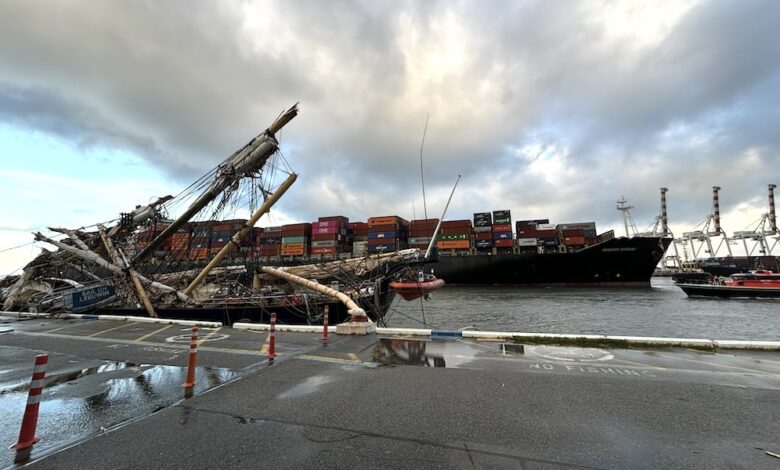
Australia's Transport Safety Bureau (ATSB) has completed its investigation into the Maersk Shekou – Leeuwin II collision that occurred at Fremantle Port in 2024. According to the report, the accident was caused by inadequate coordination between the bridge team and harbor pilots, misunderstanding of orders, and lack of disciplined Bridge Resource Management.
Sequence of events
The 333-meter Singapore-flagged Maersk Shekou was entering Fremantle Port on the morning of August 30, 2024 under severe wind and heavy rain. The vessel had two harbor pilots on board.
According to Vessel Data Recorder (VDR) recordings, the first pilot failed to relay to the helmsman the port 10° helm order that was required to turn into the inner harbor. Other bridge team members failed to notice this omission.
As a result, the helmsman continued to maintain a heading of 083° in accordance with the previous instruction, which prevented the vessel from making the planned turn. Although the pilot attempted to execute the turn using the main engine and the thrust of four tugs, the helmsman's actions caused the vessel to maintain its course.
As the vessel's heading remained unchanged, Maersk Shekou struck the three-masted training sailing vessel Leeuwin II, which was anchored at Victoria Quay. Subsequently, the vessel's stern made contact with the wharf, and some of the containers aboard struck the roof of the Western Australia Maritime Museum.
Leeuwin II completely lost its masts in the collision and two crew members sustained minor injuries. Maersk Shekou's hull suffered a small hole, but there were no injuries to persons on the vessel or among the pilots.
ATSB: "There was no shared understanding among the team"
ATSB Chairman Angus Mitchell, in explaining the report's findings, emphasized that a "shared mental model" had not been established among the bridge team:
"For a bridge team to operate effectively, all members must maintain a shared understanding throughout the passage. Essential information must be communicated clearly to all team members, and any incorrect actions must be quickly identified and corrected."
The report found that the two pilots on the bridge and ship personnel failed to adequately monitor the vessel's turning maneuver and did not challenge the incorrect actions, thereby failing to prevent the accident.
Pilot's attention diverted by mobile phone
The investigation also revealed that the second pilot was engaged in an unnecessary mobile phone call while the vessel was transiting through a critical section of the harbor entrance channel.
Mitchell noted that this situation caused the pilot to neglect his supervisory duties, stating:
"This inattention prevented the senior pilot from noticing that he had failed to issue the turn order. It also caused him to overlook that the helmsman was directing the vessel in the wrong direction. This incident clearly demonstrates the importance of minimizing distracting factors on the bridge."
Delay in tug attachment
Another factor contributing to the accident was a delay in the process of attaching the tugs. As the vessel approached the inner harbor entrance, the bridge team was still occupied with the attachment of the final tug. This prevented the team from properly managing the critical turn point in a timely manner.
Leeuwin II returns to sea
One year after the collision, Western Australia's iconic vessel Leeuwin II was ready to return to the sea.
Used in youth ocean education programs since the 1980s, this three-masted sailing vessel had sustained severe hull damage and loss of masts in the collision.
Following comprehensive repair work carried out with strong community support, the vessel was relaunched at Victoria Quay on October 24, 2025, in a ceremony marking the occasion.
The ceremony celebrating Leeuwin II's "rebirth" featured live music, sea shanties, and festivities.
Key Points:
The ATSB report determined the cause of the accident to be bridge team coordination failure and poor communication.
The first pilot failed to relay the turn order; the helmsman directed the vessel in the wrong direction.
The second pilot was occupied with a mobile phone call at a critical moment.
Delay in tug attachment increased distraction.
Leeuwin II lost its masts in the collision, but was fully repaired by October 2025.
ATSB: "Safe navigation is impossible without a shared understanding among the bridge team."
Author: SedatOnat.com

