

Maritime data and analytics firm Sea-Intelligence reported that the dynamics of vessel cascading in global container shipping are entering a new and structural phase in the second half of 2025 (2025-2H). The analysis, published as part of Sunday Spotlight – Issue 744, is based on data from more than 16,000 vessel transfers occurring during 2024–2025 and points to a permanent shift in global capacity distribution.
According to the analysis, forced route changes in container lines during 2024 due to the Red Sea crisis led to intensive capacity redeployment, particularly on the Asia–Europe mainline. During this period, significant tonnage flowing out of main East–West routes was redirected to Asia–North Europe and subsequently to Asia–Mediterranean lines. However, Sea-Intelligence notes that as of the second half of 2025, these routes have now reached capacity saturation levels.
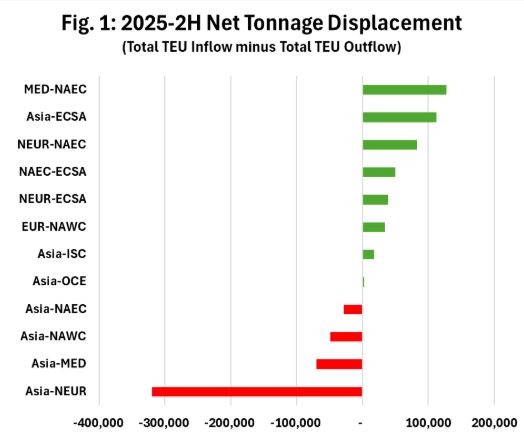
This saturation makes it difficult to retain excess tonnage on the primary and semi-primary lines as previously occurred, and is pushing vessels toward secondary trade lanes. In particular, the Asia–Mediterranean route, which absorbed capacity flowing from the Asia–North Europe line in 2024, is becoming a net capacity-losing route by 2025-2H and is undergoing an outward cascading process for vessels.
According to Sea-Intelligence data, the Mediterranean–North America East Coast route emerges as the highest net capacity gainer globally in 2025-2H. This route recorded a total net increase of +127,686 TEU. Of this increase, +178,189 TEU comes directly from capacity flowing from the Asia–Mediterranean route. Another noteworthy aspect is that these transfers include large-tonnage vessels in terms of ship size. Among the relevant shifts are 11 vessels in the 14,000–15,000 TEU segment.
The route in second place was the Asia–East Coast South America line. This route recorded a net capacity intake of +112,998 TEU. Sea-Intelligence notes that this capacity is predominantly composed of vessels in the 8,000–14,000 TEU range and that these vessels largely departed from traditional East–West mainlane routes. This situation indicates that routes connected to Latin America are now becoming permanent operational areas not just for secondary purposes, but for mid-sized vessels.
One of the most striking findings of the analysis concerns the return rates of these vessel movements. Sea-Intelligence reported that 97 percent of vessels cascading to secondary routes in 2025-2H did not return to their previous trade routes. This figure demonstrates that the cascading process has ceased to be a temporary crisis response and has transformed into a capacity reallocation that can be described as a permanent structural shift.
This structural transformation has significant implications for container line fleet strategies. Large-scale vessels are now being deployed more permanently not only in main East–West corridors, but also in markets such as North America East Coast and South America. This situation makes factors such as port infrastructure, draft capacity, and terminal efficiency increasingly critical on the relevant routes.
According to Sea-Intelligence, this new cascading phase demonstrates that capacity planning in global container shipping is now shaped by decisions that are increasingly less reversible and longer-term in nature. Rather than reacting to short-term shocks, shipowners are repositioning their fleets according to regional demand centers. This creates lasting effects on freight rates, service frequencies, and competitive structures.
In conclusion, the findings presented by Sea-Intelligence show that the global container fleet is entering a new era of structural cascading as of 2025. Capacity that has reached saturation on primary routes is spreading permanently toward secondary routes, and the geographical balance of global maritime shipping is being reshaped.
Key Takeaways
Sea-Intelligence detected a structural transformation in vessel cascading during 2025-2H
Asia–Europe and Asia–Mediterranean routes have reached capacity saturation
Mediterranean–North America East Coast route emerged as the biggest winner with +127,686 TEU
Asia–East Coast South America route recorded a net capacity increase of +112,998 TEU
97 percent of displaced vessels did not return to their previous routes
The process is being evaluated as permanent rather than temporary capacity redistribution
Author: SedatOnat.com
We would be delighted to hear your feedback.
We wish you happy reading in advance.

